Support for Washington clashes with fears of escalation, energy disruption, and migration pressure across the continent
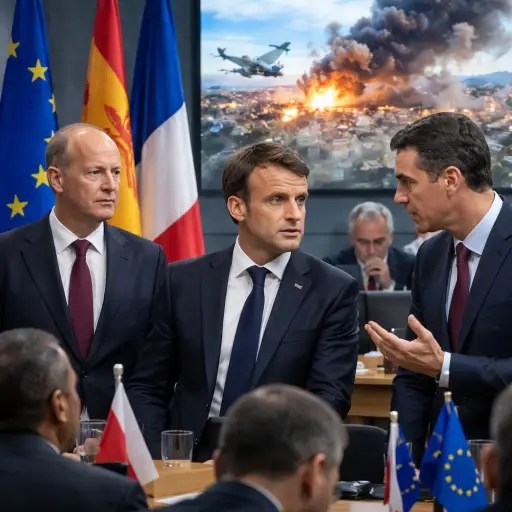
European governments are showing deep divisions as the United States and Israel intensify military operations against Iran, exposing strategic and political fault lines across the continent and reviving a long‑running debate about how closely Europe should align itself with Washington when conflicts in the Middle East risk widening into broader regional confrontations.
Across European capitals, officials are struggling to reconcile commitments to transatlantic solidarity with growing domestic concern that the conflict could spiral beyond its initial military objectives and destabilize an already volatile region whose political shocks have repeatedly reached Europe’s borders.
Germany has signaled cautious support for the American and Israeli position, emphasizing Israel’s security concerns while urging restraint and continued diplomatic engagement, a careful balancing act that reflects Berlin’s effort to maintain its traditional alliance with Washington while acknowledging the risks of further escalation.
German officials have framed their response as one rooted in both historical responsibility and geopolitical realism, arguing that the conflict must not be allowed to expand into a broader war involving additional regional powers that could undermine fragile security dynamics throughout the Middle East.
In sharp contrast, Spain has emerged as one of the most outspoken critics of the strikes, with senior figures in Madrid warning that the attacks could ignite a dangerous chain reaction that destabilizes neighboring countries and weakens international efforts aimed at containing nuclear tensions.
Spanish leaders have argued that the use of force risks undermining diplomatic channels that European governments have long supported as the primary means of addressing disputes with Iran, and they have called for renewed international mediation to prevent the conflict from escalating further.
The disagreement between Berlin and Madrid reflects a broader divide inside the European Union, where governments remain split between those who prioritize strong alignment with the United States and those who increasingly advocate a more independent European foreign policy.
Several governments in Southern and Western Europe have expressed unease about being drawn into the political consequences of a war they did not initiate, particularly as public opinion across the continent remains wary of prolonged military confrontations in the Middle East.
Northern and Eastern European states, meanwhile, have generally emphasized the importance of maintaining unity with Washington, arguing that the transatlantic alliance remains the foundation of European security at a time when global geopolitical tensions are rising.
Officials in Brussels acknowledge privately that these competing perspectives are complicating efforts to craft a unified European response, with diplomatic discussions increasingly focused on how to preserve internal cohesion while responding to a rapidly evolving crisis.
Beyond the immediate political debate, economic concerns are weighing heavily on European leaders who fear that a widening conflict involving Iran could disrupt vital shipping routes and energy supplies that pass through the Persian Gulf.
Energy analysts warn that even limited disruptions to oil and gas flows could send prices sharply higher, placing additional pressure on European economies that are still navigating the aftershocks of previous energy shocks and inflationary waves.
European industries remain particularly vulnerable to fluctuations in energy markets, and policymakers are wary that renewed instability could once again force governments to intervene with emergency subsidies or price controls to shield consumers and businesses.
Another growing concern among European officials is the possibility that escalating violence in the Middle East could trigger new migration flows toward Europe, a scenario that has already prompted quiet contingency planning among interior ministries.
Countries along the Mediterranean route are especially sensitive to this possibility, recalling how earlier conflicts in Syria and Iraq produced large movements of displaced people that reshaped political debates and strained asylum systems across the European Union.
Humanitarian organizations are also warning that a prolonged confrontation could generate regional instability affecting neighboring countries, potentially leading to population displacement that eventually reaches Europe’s borders.
Diplomats say the current divisions highlight a deeper strategic dilemma facing Europe as global power rivalries intensify and conflicts increasingly involve multiple international actors with competing interests.
For some European policymakers, the crisis underscores the need for a stronger and more coordinated European foreign policy capable of responding independently to international crises rather than relying primarily on American leadership.
Others argue that maintaining close alignment with the United States remains essential in a world where geopolitical tensions are growing and democratic allies must coordinate their responses to security threats.
The debate is unfolding at a moment when European governments are already grappling with complex challenges ranging from economic uncertainty to domestic political pressures and ongoing security concerns in neighboring regions.
As the conflict between the United States, Israel, and Iran continues to develop, European leaders are likely to face increasing pressure to clarify their positions and determine whether the continent can present a unified diplomatic voice.
For now, the war has exposed a Europe that remains deeply interconnected with global events yet divided over how best to respond when distant conflicts threaten to shape the continent’s own political and economic future.


 The Tower Post