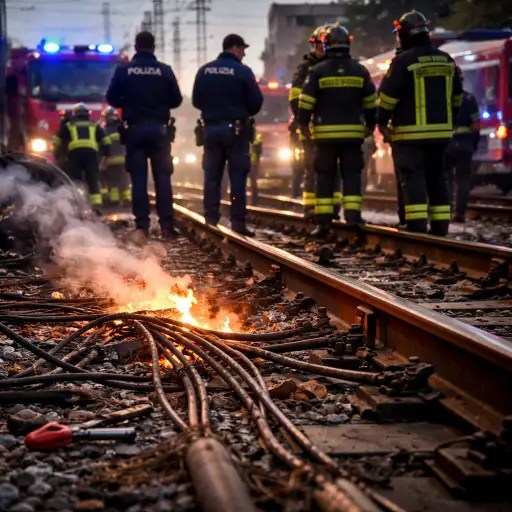
Suspected anarchist groups claim responsibility for damage near Bologna as European authorities confront new fears over infrastructure security during major international events
Authorities in Italy are investigating a series of suspected sabotage attacks on railway infrastructure near Bologna that disrupted travel for roughly 40,000 passengers and raised alarm during the height of the winter sports season drawing global attention to the country. Rail operators and security officials said coordinated damage to signaling equipment and cables caused widespread delays and cancellations along one of the busiest corridors linking northern and central Italy, forcing emergency inspections and triggering a broad security response across the national rail network.
The disruptions began before dawn when technicians monitoring the rail control systems noticed abnormal failures across several sections of track leading into Bologna, a key transport hub that connects high speed lines between Milan, Florence, and Rome. Initial checks suggested deliberate tampering rather than mechanical failure, prompting rail operator teams to suspend traffic on multiple lines while engineers and police units inspected the infrastructure for further damage or possible hazards along the route.
Passengers across the region reported sudden stops, long platform waits, and crowded stations as rail authorities struggled to reroute trains and organize replacement services. Commuters traveling for work, tourists moving between cities, and visitors heading toward winter sporting venues all faced hours of disruption. By midmorning, travel delays had spread across much of the northern network, illustrating how quickly localized infrastructure damage can cascade through interconnected European rail systems.
Investigators later confirmed that signaling cables had been cut in several locations and protective equipment cabinets forced open, acts that officials described as consistent with deliberate sabotage. The attacks appeared carefully timed to create maximum disruption while avoiding immediate detection, according to transport security specialists reviewing the damage. Engineers were able to restore partial service after emergency repairs, but the incident left lingering delays and heightened concern among transport authorities.
Shortly after the disruptions became public, messages circulated on extremist online channels in which groups identifying with anarchist movements appeared to claim responsibility for the sabotage. The statements framed the attacks as protest actions tied to the international winter sports events being held in Italy, criticizing public spending on large scale competitions and infrastructure projects. Authorities are working to verify the authenticity of the claims while examining possible links to past acts of railway vandalism attributed to radical networks.
Law enforcement agencies emphasized that the investigation remains ongoing and that the individuals responsible have not yet been formally identified. Security officials are reviewing surveillance footage from stations, maintenance depots, and trackside cameras while forensic teams analyze the damaged equipment for fingerprints and tool marks. The coordinated nature of the sabotage suggests planning and knowledge of railway systems, investigators said, though they cautioned against drawing early conclusions about the scope of the network involved.
The incident has intensified concerns across Europe about the vulnerability of transport infrastructure during major international events, when high passenger volumes and global attention can make networks attractive targets for protest or disruption. Railway systems, with long stretches of exposed track and complex signaling equipment, are particularly difficult to secure fully, despite extensive monitoring and patrols. Officials in several neighboring countries have quietly reviewed their own rail security procedures in response to the developments in Italy.
Italy has been hosting an influx of athletes, spectators, and journalists connected to the winter sports season, placing additional strain on transportation systems that are already among the busiest in Europe. High speed rail lines have become essential arteries for moving visitors between major cities and event locations, meaning even brief interruptions can ripple across the entire travel schedule. Transport authorities said contingency plans helped prevent larger disruptions but acknowledged that the sabotage exposed real vulnerabilities.
Government officials condemned the attacks and stressed that infrastructure security would be reinforced throughout the remainder of the sporting season. Additional patrols by railway police and national security forces have been deployed along critical segments of track, while technicians are conducting precautionary inspections of signaling equipment across the network. Authorities also urged the public to report suspicious activity near railway infrastructure, emphasizing that prevention relies heavily on rapid detection of unusual behavior.
Despite the disruption, rail service gradually resumed as engineers completed repairs and system tests restored safe operations on the affected lines. By the following day, most major routes passing through Bologna were operating again, though delays persisted while schedules were rebuilt. Transport officials praised the work of emergency crews who managed to restore the network under intense pressure while ensuring that safety protocols remained fully intact.
Security analysts say the sabotage underscores a broader challenge facing modern infrastructure across Europe, where political protest, extremist activism, and geopolitical tensions increasingly intersect with the physical systems that keep societies moving. While the damage near Bologna was limited in scope, the symbolic timing during a period of international attention amplified its impact and demonstrated how relatively small acts can disrupt complex transport networks.
As the investigation continues, Italian authorities are cooperating with European security agencies to track possible cross border links and assess whether similar groups could attempt further disruptions during high profile events. For now, the damaged cables near Bologna have been replaced and trains are once again moving along the restored lines, but the episode has left a clear warning that even in highly developed transport systems the rails remain vulnerable to those seeking to turn infrastructure into a stage for political confrontation.



 The Tower Post