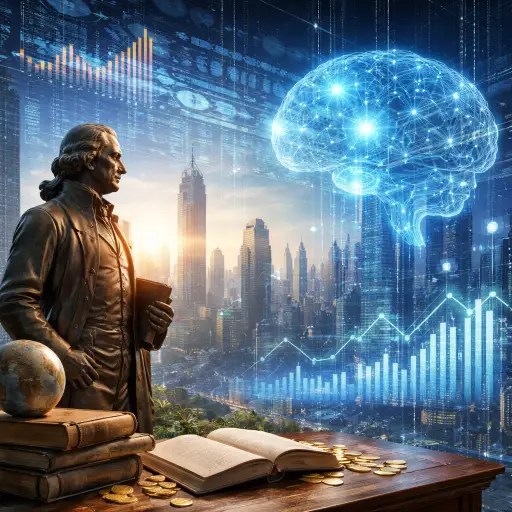
The rise of powerful digital platforms and artificial intelligence is prompting economists to revisit centuries‑old warnings about monopolies and the balance of markets
Across universities, policy institutes, and government advisory circles, economists are revisiting ideas first articulated more than two centuries ago by Adam Smith, the Scottish philosopher often described as the father of modern economics. The renewed interest is not merely historical curiosity but a response to a rapidly transforming global economy shaped by artificial intelligence and digital platforms. As powerful technology companies expand their influence across data, infrastructure, and commerce, scholars are asking whether Smith’s insights about competition, monopolies, and the functioning of markets can help guide the rules of the AI age.
Smith wrote in a world dominated by merchants, colonial trade networks, and early industrial production, yet many of his observations about concentrated power appear strikingly relevant in the digital economy. In his writings, he warned that merchants and producers often sought to restrict competition in order to protect their profits, arguing that markets function best when rivalry is preserved and when no single actor can control the flow of goods or information. Today, those warnings are echoing in debates about the dominance of large technology platforms whose services have become essential infrastructure for communication, retail, and computing.
The conversation has intensified as artificial intelligence systems increasingly depend on enormous datasets, specialized computing resources, and global cloud networks. Critics argue that these requirements favor a small group of corporations capable of investing billions into infrastructure and research. Supporters of the current system counter that such scale is necessary to develop advanced AI safely and efficiently. The resulting debate has drawn economists back to Smith’s broader question of how societies should balance innovation, competition, and public welfare.
In policy discussions across North America, Europe, and Asia, regulators are examining whether existing competition frameworks can adequately address the dynamics of digital platforms. Traditional antitrust law was designed around tangible goods and clearly defined markets, yet AI-driven ecosystems often combine services, data flows, and network effects that blur those boundaries. Economists studying Smith’s work note that he anticipated many of these tensions when he warned that market participants frequently attempt to shape rules in ways that preserve their dominance.
The revival of Smith’s thinking has also been fueled by the extraordinary scale of modern technology firms. Companies operating global search engines, cloud services, digital advertising networks, and social platforms now influence how information circulates and how businesses reach customers. Some economists argue that this concentration mirrors the monopolistic tendencies Smith cautioned against, while others contend that digital competition is more fluid than it appears, with new technologies capable of rapidly shifting market leadership.
Artificial intelligence has added urgency to the debate because the technology is rapidly becoming embedded in finance, manufacturing, healthcare, and education. Economists worry that if a small number of companies control the core AI models and infrastructure, they could shape not only markets but also the direction of technological progress itself. This concern has prompted renewed discussion of Smith’s belief that markets function best when power is dispersed and when economic actors must constantly compete for consumers’ trust.
At the same time, many scholars emphasize that Smith was not simply a champion of laissez‑faire economics, as he is sometimes portrayed in popular discourse. His writings acknowledged that governments have a role in establishing rules that protect competition, enforce contracts, and prevent abuses of power. In the context of AI, that interpretation has encouraged policymakers to explore new regulatory approaches aimed at transparency, interoperability, and fair access to digital infrastructure.
Some economists believe that AI could ultimately reinforce Smith’s optimism about markets by lowering barriers to entry for smaller companies. Advanced tools may enable startups to analyze data, automate processes, and reach global audiences without building massive internal systems. From this perspective, artificial intelligence could stimulate a new wave of entrepreneurial competition, provided that access to computing resources and data remains sufficiently open.
Others remain skeptical, pointing out that the most advanced AI models require immense computational power and specialized chips that remain concentrated among a handful of corporations and governments. They argue that without deliberate policy interventions, the technological landscape could evolve toward a structure in which only a few players control the most powerful systems. Such a scenario, critics say, would echo the monopolistic structures that Smith believed undermined the healthy functioning of markets.
Academic conferences and research papers increasingly frame the discussion as a dialogue between centuries of economic thought and the realities of digital capitalism. Scholars are examining how concepts such as the invisible hand, market incentives, and public goods might apply to algorithms that learn from vast pools of data. The goal is not to replicate Smith’s world but to reinterpret his principles in light of technologies he could never have imagined.
The debate is also shaping political conversations about national competitiveness and technological sovereignty. Governments are investing heavily in AI research, partly to ensure that their economies remain competitive in a future defined by automation and intelligent systems. Yet policymakers are also grappling with the risk that national champions in the technology sector could become so dominant that they stifle domestic innovation, a dilemma that resonates strongly with Smith’s warnings about concentrated economic power.
Meanwhile, technology companies themselves have begun engaging with the historical discussion, often arguing that their scale enables them to deliver services that smaller competitors cannot match. Executives frequently emphasize the benefits of integrated ecosystems that combine software, hardware, and cloud infrastructure. Critics respond that such integration can make it difficult for new entrants to compete, reinforcing the cycle of concentration that Smith feared.
Public awareness of these issues has grown as AI systems become part of everyday life, influencing everything from online shopping recommendations to automated financial decisions. Consumers rarely see the complex economic structures behind these technologies, yet their daily interactions with digital platforms are shaped by them. Economists say this growing visibility could influence how societies choose to regulate AI and digital markets in the years ahead.
For many scholars, the revival of Adam Smith’s ideas is less about nostalgia than about intellectual continuity. Economic history offers a long record of societies confronting the same underlying questions about power, incentives, and fairness in new technological contexts. The current AI revolution is simply the latest chapter in that story, forcing policymakers and economists to reconsider foundational principles that have guided market economies for generations.
As artificial intelligence continues to transform industries and reshape global competition, the relevance of Smith’s insights appears likely to grow rather than fade. The challenge for modern economists is to determine how those ideas should evolve in a world where algorithms trade, recommend, predict, and govern flows of information at unprecedented scale. Whether the digital economy ultimately strengthens competition or concentrates power further remains uncertain, but the renewed conversation about Smith suggests that the past still holds valuable clues for navigating the future of markets.




 The Tower Post