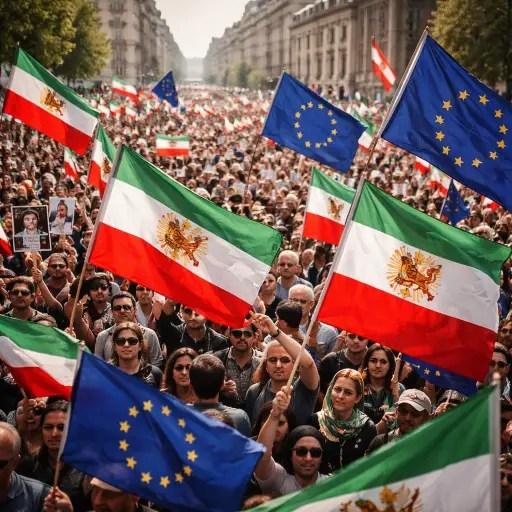
Pro-democracy and monarchist activists unite in visible displays of dissent and solidarity amid debate over the Middle East crisis
Large demonstrations unfolded across several European capitals as Iranian diaspora groups and their supporters gathered in public squares to demand political change in Iran, transforming prominent avenues into seas of flags, banners, and chants that echoed through city centers while drawing attention to the widening international debate about the country’s political future and the broader regional tensions shaping discussion across the continent.
Participants included a strikingly diverse coalition of activists ranging from pro-democracy campaigners and human rights organizations to monarchist supporters who advocate a return to constitutional monarchy in Iran, a convergence that illustrated both the fragmentation and the shared determination of opposition voices abroad as they sought to amplify their calls for systemic transformation inside the Islamic Republic.
In cities known for hosting large Iranian communities, demonstrators assembled in front of parliamentary buildings, historic plazas, and diplomatic quarters where speeches, music, and coordinated chants expressed solidarity with protesters inside Iran while emphasizing that political dissent within the country continues despite heavy restrictions and an atmosphere of heightened surveillance.
The gatherings carried a distinctly transnational tone as participants waved Iranian tricolor flags alongside European and human rights banners, underscoring the diasporic dimension of the movement and reflecting the ways in which communities scattered across Europe have become key voices in shaping international awareness of Iran’s domestic political struggles.
Monarchist groups, some displaying portraits of figures associated with Iran’s former royal family, marched beside activists who instead advocated for a democratic republic, and although their long‑term political visions differ, organizers from both camps framed the demonstrations as a rare moment of unity centered on the shared demand for an end to authoritarian rule and the establishment of political freedoms.
Speakers addressing the crowds frequently highlighted the experiences of women, students, and civil society activists in Iran whose acts of defiance have drawn global attention, arguing that sustained visibility abroad can help keep international pressure focused on human rights conditions and prevent the crisis from fading from the global agenda.
European policymakers have been watching these demonstrations closely as they reflect the growing political engagement of diaspora communities and feed into wider debates within European institutions about sanctions, diplomatic pressure, and the appropriate response to Iran’s domestic turmoil and regional policies.
Observers noted that the protests also illustrate Europe’s complex role in Middle Eastern affairs, where governments must balance diplomatic engagement, security concerns, and public pressure from voters who increasingly expect stronger advocacy for democratic principles and human rights beyond the continent’s borders.
For many participants the demonstrations were deeply personal events shaped by family connections and memories of life in Iran, and numerous protesters spoke about relatives who remain inside the country, describing the rallies not only as political gatherings but also as emotional expressions of solidarity with those they believe cannot speak freely at home.
The protests unfolded largely peacefully but were marked by intense energy as crowds filled central boulevards with rhythmic chanting, coordinated marches, and impromptu speeches, creating a visible spectacle that drew curious passersby and significant media attention while reinforcing the sense that the Iranian question continues to resonate strongly within Europe’s public sphere.
Political analysts say the presence of both pro‑democracy activists and monarchist supporters at the same rallies highlights an ongoing debate about what a post‑Islamic Republic political system might look like, a discussion that remains unresolved yet increasingly visible as diaspora movements expand their organizational networks across multiple countries.
As evening approached in several cities, demonstrators gradually dispersed but many organizers pledged that the rallies would mark only the beginning of a renewed campaign aimed at keeping Iran at the forefront of international attention, suggesting that Europe’s streets may continue to serve as a stage where competing visions for Iran’s future are debated before a global audience.
 The Tower Post