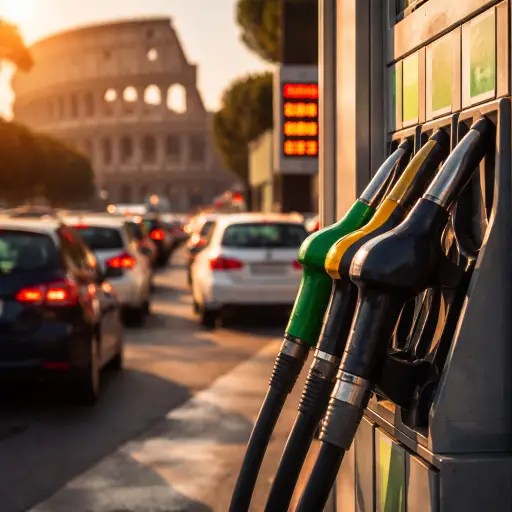
Government weighs emergency relief for motorists and businesses as geopolitical tensions expose Europe’s persistent energy vulnerability
Italian officials are weighing a temporary reduction in fuel taxes as soaring energy costs ripple through households and businesses, a move that reflects growing concern in Rome that geopolitical conflict in the Middle East is once again pushing global oil and gas markets into volatile territory. Policymakers say the measure is being explored as part of a broader effort to shield consumers from rapidly rising transport and heating expenses while preventing a new wave of inflation from spreading through the country’s fragile economic recovery.
Discussions within the government have intensified as energy traders warn that escalating tensions in the Middle East are tightening supply expectations and injecting uncertainty into already strained global markets. Analysts say the conflict has revived fears of shipping disruptions and supply bottlenecks that could ripple across the Mediterranean and beyond, pushing benchmark crude prices higher and immediately feeding into the cost of petrol and diesel across Europe.
For Italy, where fuel taxes make up a significant portion of the price drivers pay at the pump, the political pressure to intervene has grown steadily. Consumer groups argue that households are once again facing the familiar dilemma of balancing transportation costs with everyday necessities, while industry associations warn that logistics companies, farmers, and manufacturers are absorbing mounting expenses that could soon be passed along to consumers.
Government officials say the tax cut proposal remains under evaluation and would likely be structured as a temporary measure designed to stabilize prices during the most acute phase of the energy shock. Such steps have precedent: past administrations have occasionally adjusted excise duties when international oil markets spiked sharply, although fiscal constraints have always complicated the decision.
The debate inside Italy mirrors a broader European conversation about how governments should respond to sudden surges in energy costs driven by global events far beyond the continent’s borders. Several European economies remain heavily dependent on imported fuels despite years of efforts to diversify energy sources, leaving them exposed whenever geopolitical tensions disrupt supply expectations.
Business groups across Italy have been particularly vocal in recent weeks, warning that higher fuel costs are spreading through supply chains at a moment when many companies are still recovering from earlier inflation shocks. Transport operators say diesel prices have become the single most unpredictable element in their operating budgets, while agricultural producers warn that rising fuel and fertilizer costs could threaten margins during an already uncertain growing season.
Energy economists say the current price surge highlights how sensitive European economies remain to events in distant energy-producing regions. Even without direct supply disruptions, the mere perception of risk in major shipping corridors or oil infrastructure can move markets quickly, translating within days into higher retail fuel prices for drivers across the continent.
Italy’s policymakers must balance those realities with the country’s fiscal constraints, which remain under close scrutiny by European institutions and financial markets. Reducing fuel taxes would provide immediate relief to consumers but could also widen budget pressures unless offset by other revenue measures or spending adjustments.
Supporters of the tax cut argue that failing to act could impose wider economic costs if transport prices begin feeding into the cost of food, construction materials, and everyday goods. They note that energy shocks have historically triggered broader inflation waves that ultimately prove more expensive for governments to contain.
Critics, however, caution that lowering fuel taxes can blunt incentives to reduce fossil fuel consumption and may conflict with long-term climate commitments. Environmental groups say that while temporary relief may be justified in moments of crisis, governments should simultaneously accelerate investment in renewable energy and public transport to reduce dependence on imported oil.
The unfolding debate underscores a deeper strategic challenge facing Europe as a whole. Despite rapid growth in renewable power and policy commitments to decarbonization, the continent still relies heavily on global oil markets for transportation and industry, meaning geopolitical shocks can still reverberate quickly through domestic economies.
As officials in Rome continue evaluating their options, the prospect of a fuel-tax adjustment has become a symbol of a larger dilemma confronting European policymakers: how to protect citizens from sudden global energy shocks while steadily transitioning toward a more resilient and independent energy system.

 The Tower Post