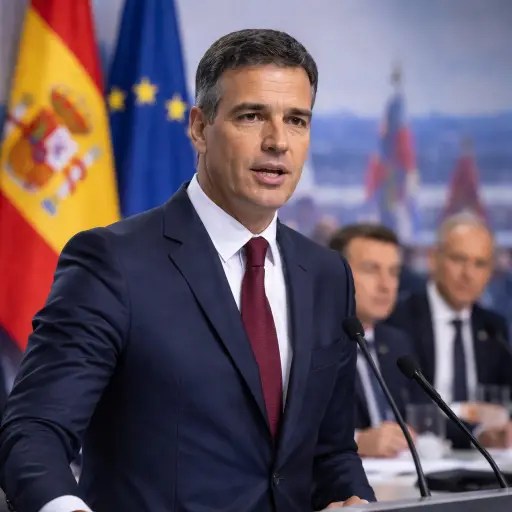
Spain’s prime minister breaks with cautious European diplomacy as divisions deepen across the continent over Washington’s military posture toward Tehran
Spain’s Prime Minister Pedro Sánchez has stepped into an unusual role on the European stage, becoming one of the most outspoken critics of U.S. military actions targeting Iran and the broader strategy pursued by the administration of President Donald Trump. At a moment when most European leaders are choosing careful language and calibrated responses, Sánchez has repeatedly warned that escalating military pressure risks widening an already volatile regional conflict and undermining fragile diplomatic channels that Europe has tried for years to preserve.
Speaking in parliamentary debates, international forums and press briefings, Sánchez has framed Spain’s position as a defense of multilateralism and international law rather than a rejection of the United States as an ally. Yet the tone of his criticism has stood out in a continent where governments often balance disagreement with Washington against the political and security realities of the transatlantic alliance. Spanish officials say the prime minister believes silence from European capitals would amount to tacit acceptance of a strategy that could drag the region into a broader confrontation.
The dispute revolves around a new phase of U.S. military pressure on Iran that has revived fears of open conflict in the Middle East. Washington has argued that forceful action is necessary to deter Iranian aggression and protect regional stability. Sánchez, by contrast, has insisted that military escalation risks producing the opposite outcome by strengthening hardline factions inside Iran and weakening diplomatic efforts that once held the prospect of nuclear restraint and regional dialogue.
Within the European Union, the Spanish leader’s blunt language has exposed a deeper dilemma: the bloc’s struggle to respond collectively to global crises when member states hold different strategic priorities and domestic political pressures. Some governments share Spain’s concerns but prefer to express them privately in diplomatic channels. Others worry that public confrontation with Washington could damage cooperation on security, trade and the war in Ukraine.
Spain’s government has presented its criticism as part of a broader effort to revive Europe’s diplomatic voice on international security. Officials in Madrid argue that the European Union cannot aspire to geopolitical influence if it remains hesitant to articulate independent positions on major conflicts. In this view, Sánchez’s intervention is intended not only to address the immediate tensions surrounding Iran but also to push European partners toward a more coherent foreign policy.
Behind the scenes, however, European diplomats acknowledge that unity has proven elusive. Governments in Eastern Europe tend to place greater emphasis on maintaining close strategic alignment with Washington, especially given ongoing security concerns linked to Russia. Others in Western Europe share Spain’s skepticism about military escalation but remain cautious about openly challenging U.S. leadership.
The result is a fragmented response that underscores the structural limits of Europe’s foreign policy machinery. While the European Union possesses diplomatic institutions and a shared external policy framework, major decisions still depend heavily on the political will of national governments. When those governments interpret risks differently, the continent’s collective voice can become hesitant or muted.
Sánchez’s critics at home argue that Spain risks isolating itself by adopting a confrontational tone toward the United States. Conservative opposition figures have accused the government of turning foreign policy into a platform for ideological messaging rather than pragmatic diplomacy. They warn that Spain’s influence within NATO could weaken if Madrid is perceived as challenging the strategic direction set by Washington.
Supporters of the prime minister counter that Spain’s stance reflects a long tradition in parts of Europe that prioritize diplomacy over military solutions in the Middle East. They also note that public opinion across the continent often favors negotiated settlements and expresses deep concern about the humanitarian consequences of armed conflict in the region.
The debate unfolding around Sánchez ultimately reflects a larger question about Europe’s role in an increasingly unstable world. As geopolitical tensions intensify from Eastern Europe to the Middle East, European governments face pressure to define whether the continent will act primarily as a partner following U.S. strategic leadership or as a distinct diplomatic actor capable of challenging it.
For now, Sánchez appears willing to accept the political risks of speaking more forcefully than many of his counterparts. Whether his stance will shift the broader European debate remains uncertain, but his comments have already amplified a conversation that had largely remained behind closed doors in Brussels and other capitals.
As tensions continue to shape the global agenda, the Spanish leader’s criticism has become a reminder that Europe’s search for a unified foreign policy is still far from complete. The question facing the continent is not only how to respond to the latest crisis surrounding Iran but also how to reconcile national interests with the ambition of acting collectively on the world stage.
 The Tower Post