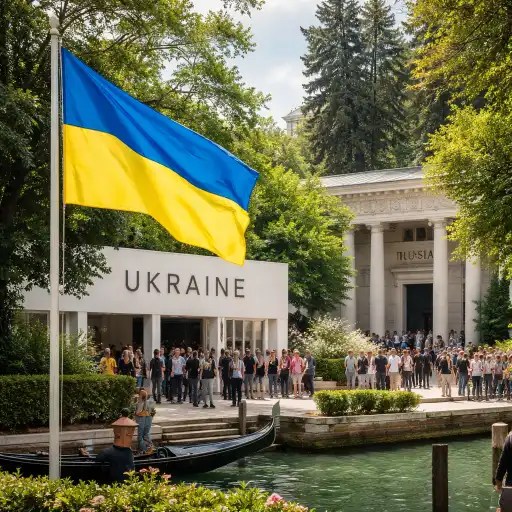
Ukraine urges Venice Biennale to exclude Russia, igniting a continent‑wide debate over art, war, and moral responsibility

Ukraine has urged organizers of the Venice Biennale to bar Russia from participating in the celebrated international art exhibition, arguing that allowing the country a presence at one of the world’s most influential cultural stages risks obscuring the realities of the ongoing war and undermining efforts to hold Moscow accountable for its actions.
Officials in Kyiv say the request reflects a broader concern that cultural institutions cannot remain detached from the political and humanitarian consequences of the conflict, warning that a Russian pavilion at the exhibition could be interpreted as a sign that international cultural life continues unaffected despite the devastation caused by the war.
According to Ukrainian cultural authorities, the visibility offered by the Venice Biennale carries global symbolic power, and granting Russia a platform in such a setting could contribute to what they describe as the whitewashing of alleged war crimes committed during the invasion, a message Ukrainian representatives say would be deeply painful for artists and civilians who have experienced the consequences of the fighting.
The Venice Biennale, often described as the Olympics of the art world, gathers artists, curators, and visitors from across the globe and has long served as a stage where national pavilions present artistic projects tied to their cultural identities, making the question of participation particularly sensitive during periods of international conflict.
For Ukraine, the issue is inseparable from the wider diplomatic campaign it has pursued since the escalation of the war, during which Kyiv has called on international organizations, sports federations, and cultural institutions to suspend or limit Russian participation in order to maintain pressure on Moscow through every available global platform.
Supporters of Ukraine’s position argue that culture cannot be separated from politics when a large‑scale war is unfolding in Europe, insisting that prestigious institutions have a responsibility to acknowledge the moral context surrounding their events rather than presenting a façade of neutrality that ignores the suffering produced by the conflict.
Many artists and curators across Europe have echoed that argument, stating that the art world has historically taken stands during periods of crisis and that allowing Russia to participate without restriction could undermine the credibility of institutions that claim to defend freedom, human rights, and artistic expression.
At the same time the proposal has sparked intense debate among cultural leaders who fear that banning artists or national pavilions may threaten the principle of cultural exchange that international exhibitions like the Venice Biennale were originally designed to promote.
Critics of exclusion say that art has often served as a bridge between societies during moments of deep political tension and warn that removing artists solely on the basis of nationality could set a precedent that weakens the independence of cultural institutions and exposes them to increasing political pressure.
Some commentators also note that artists frequently challenge or criticize the governments associated with their national pavilions and that excluding an entire country might silence voices that oppose the war or attempt to confront it through artistic expression.
In Ukraine, however, cultural figures argue that the context of the conflict makes such distinctions difficult to sustain, pointing out that museums, theaters, and historical landmarks have suffered damage during the fighting while many Ukrainian artists have been displaced or forced to work under conditions of profound uncertainty.
They contend that offering Russia a prestigious cultural platform while Ukrainian cultural life continues to struggle under the shadow of war would create a troubling contradiction that undermines international solidarity with those affected by the conflict.
European governments and cultural institutions have approached the issue cautiously, aware that decisions taken within the art world can carry diplomatic implications and may influence how future cultural events respond to conflicts involving participating nations.
Some officials have expressed sympathy with Ukraine’s concerns while emphasizing that the final decision rests with the organizers of the Biennale, who must balance their commitment to international representation with the growing pressure from artists, activists, and political leaders.
For the Biennale itself the controversy highlights the increasingly complex role played by cultural institutions in a world where global conflicts are immediately reflected in artistic and intellectual spaces.
What was once seen primarily as a forum for creative experimentation has now become an arena where questions of ethics, responsibility, and political accountability intersect with the presentation of contemporary art.
The debate surrounding Russia’s participation has therefore evolved into something larger than a dispute about a single pavilion, revealing deeper tensions about how the global cultural community should respond when artistic collaboration collides with geopolitical conflict.
As discussions continue across galleries, ministries, and cultural organizations throughout Europe, the Venice Biennale has become a symbol of the broader struggle to define the role of culture in times of war and to determine whether artistic platforms can remain neutral when the world beyond their walls is shaped by violence and division.

 The Tower Post