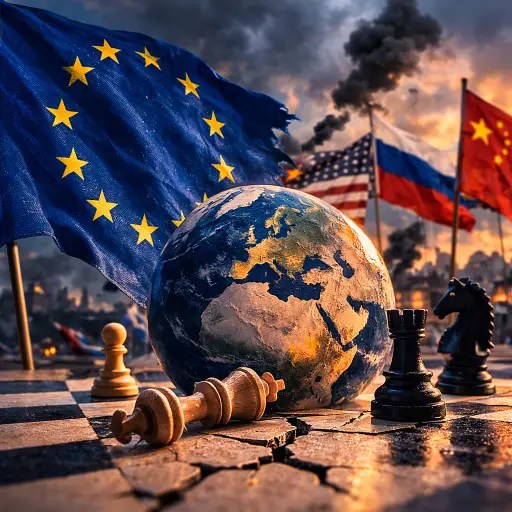
EU leaders warn the traditional rules-based order is weakening as geopolitical rivalries intensify

European leaders are increasingly warning that the international system which shaped global politics for decades is undergoing a profound transformation. Speaking in Brussels, European Commission President Ursula von der Leyen said the European Union must recognize that the familiar rules-based global order can no longer be taken for granted. Her remarks reflect growing concern across European institutions that rising geopolitical tensions, intensifying power competition, and the return of open conflict are reshaping the strategic environment surrounding the continent.
According to von der Leyen, Europe is entering an era in which assumptions that once guided diplomacy and economic cooperation are being challenged simultaneously. Conflicts in multiple regions, deepening rivalries among major powers, and the weaponization of economic tools have contributed to a sense that the international landscape is fragmenting. The European Commission chief emphasized that these developments require the European Union to adapt its foreign policy posture and strengthen its ability to act collectively in moments of crisis.
The warning comes as policymakers across Europe reassess how the bloc should position itself in a world defined less by predictable alliances and more by shifting balances of power. For decades, European prosperity and security were closely tied to a system built on multilateral institutions, open trade routes, and widely accepted diplomatic norms. While those structures still exist, European officials now believe their stability can no longer be assumed.
Von der Leyen argued that Europe must move from a largely reactive diplomatic role toward a more assertive geopolitical strategy. In her view, the European Union needs the capacity not only to respond to events but also to shape them. This means strengthening strategic partnerships, investing in defense cooperation among member states, and protecting critical economic sectors that are increasingly exposed to geopolitical pressure.
Security analysts say the Commission president’s remarks illustrate a broader shift within European policymaking circles. The idea that economic interdependence alone could guarantee stability has been widely questioned in recent years. Instead, governments are placing greater emphasis on resilience, technological sovereignty, and the ability to defend political interests in a competitive global environment.
European officials are particularly focused on the growing overlap between economic policy and geopolitical strategy. Trade routes, energy supplies, digital infrastructure, and access to raw materials have all become central elements of international competition. As a result, the European Union is expanding initiatives designed to secure supply chains, invest in strategic technologies, and reduce vulnerabilities that could be exploited during geopolitical disputes.
The evolving strategy also reflects lessons drawn from recent crises that exposed Europe’s dependence on external actors in key sectors. From energy markets to semiconductor production, policymakers concluded that strategic autonomy must play a greater role in the EU’s long-term planning. While European leaders stress that cooperation with partners remains essential, they increasingly argue that resilience requires the ability to operate independently when necessary.
Von der Leyen’s message resonates with debates taking place inside several European capitals about the future of the continent’s global role. Some governments support a more assertive European foreign policy capable of projecting influence beyond the region, while others emphasize the importance of maintaining strong transatlantic ties and multilateral frameworks. Balancing these priorities has become one of the central challenges for EU diplomacy.
Despite these internal discussions, there is growing consensus that the geopolitical environment surrounding Europe is becoming more volatile. Conflicts in neighboring regions, expanding defense budgets worldwide, and rising tensions among major powers all contribute to a perception that the post-Cold War period of relative stability is fading. European institutions now see strategic preparedness as an essential requirement rather than a distant objective.
As the European Union reflects on its next steps, von der Leyen’s warning underscores a broader realization that the international system is entering an uncertain phase. For European policymakers, the question is no longer whether the global order is changing, but how quickly Europe can adapt to it. The coming years may determine whether the European Union emerges as a more unified geopolitical actor or struggles to keep pace with the shifting balance of power shaping the world.


 The Tower Post