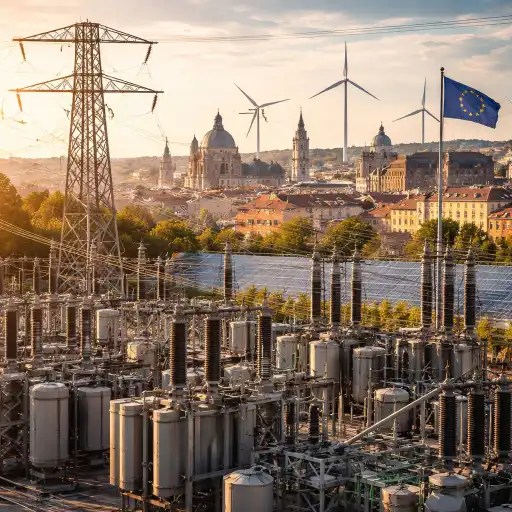
Governments across Europe call for urgent reforms to stabilize power costs and review the carbon market as energy volatility strains households and industry.
European leaders are intensifying efforts to bring down electricity prices as persistent volatility in the energy market continues to strain households and industrial producers across the continent. Government officials and policy makers are pressing the European Commission to present urgent proposals aimed at stabilizing power costs while maintaining the bloc’s long-term climate goals. The push reflects growing political and economic pressure from member states where rising utility bills have become a defining concern for families, manufacturers and small businesses alike.
At the center of the discussion is a review of the European Union’s carbon market, formally known as the Emissions Trading System, which places a price on carbon emissions from power plants and heavy industry. Several governments argue that while the mechanism remains essential to the transition toward cleaner energy, its impact on electricity prices must be reassessed in light of the economic pressures facing consumers and energy-intensive industries. Officials say the goal is not to dismantle the climate framework but to ensure that it functions in a way that protects economic stability.
Energy ministers from multiple EU countries have emphasized that the recent swings in electricity prices expose structural weaknesses in Europe’s power market. Although renewable energy capacity has expanded significantly in recent years, the pricing of electricity in many wholesale markets remains linked to the cost of gas-fired power generation. When gas prices spike due to global supply disruptions or geopolitical tensions, electricity prices often rise sharply as well, even in countries with growing renewable output.
Industry groups across Europe have warned that prolonged high electricity costs threaten the competitiveness of key sectors including steel, chemicals, manufacturing and technology production. Companies that rely heavily on electricity say unpredictable prices complicate long-term planning and investment decisions. Business leaders argue that unless energy costs become more stable, European industries could face increasing pressure from global competitors operating in regions with lower power prices.
Households have also felt the consequences of energy market instability. In several member states, governments have introduced temporary subsidies, price caps or tax reductions to cushion the impact of rising utility bills. While these measures have provided short-term relief, many policymakers acknowledge that they are not sustainable solutions. Instead, EU leaders are increasingly focusing on structural reforms designed to make electricity pricing more resilient over time.
Among the ideas under discussion is a redesign of electricity market rules to reduce the influence of fossil fuel costs on overall pricing. Some policymakers have proposed expanding long-term contracts for renewable energy, which could provide more predictable prices for both producers and consumers. Others suggest adjusting market mechanisms so that the growing share of wind, solar and other renewable sources more directly shapes electricity prices.
The review of the carbon market has become one of the most politically sensitive aspects of the debate. The system is widely regarded as a cornerstone of the EU’s climate strategy, encouraging companies to reduce emissions by making pollution more expensive. However, critics argue that fluctuations in carbon prices can contribute to higher electricity costs during periods of market stress. Supporters of reform say a careful evaluation could help maintain the environmental integrity of the system while limiting unintended economic consequences.
Energy analysts note that Europe’s transition toward cleaner power generation is occurring during a period of rapid technological change and geopolitical uncertainty. Investments in renewable infrastructure, electricity grids and energy storage are expanding, but the benefits of these developments are not always immediately reflected in consumer prices. Experts say improving the integration of renewable energy into the market could play a key role in stabilizing electricity costs over the long term.
Another element of the emerging plan involves strengthening cross-border energy cooperation among EU member states. By improving interconnections between national power grids, electricity can move more freely across the continent, helping regions with surplus generation supply areas experiencing shortages. Policymakers believe that a more interconnected European grid could reduce price spikes and increase overall resilience in the energy system.
The debate also highlights the complex balance between economic priorities and climate commitments. The European Union has positioned itself as a global leader in the transition to low-carbon energy, setting ambitious targets for reducing greenhouse gas emissions and expanding renewable power. Maintaining public support for these goals, however, increasingly depends on ensuring that the energy transition does not lead to persistently high electricity costs.
Officials involved in the policy discussions say the coming proposals are expected to outline several options rather than a single sweeping reform. Member states hold differing views on how far the EU should go in reshaping the electricity market, and negotiations are likely to involve significant compromise. Some governments favor modest adjustments to existing systems, while others argue that more fundamental changes are necessary to protect economic competitiveness.
Despite these differences, there is broad agreement that energy affordability has become a strategic issue for Europe’s economic future. Lower and more stable electricity prices are seen as essential not only for consumers but also for attracting investment in new industries such as green manufacturing, hydrogen production and advanced technology development. Policymakers argue that a well-functioning electricity market will be crucial for supporting innovation while meeting climate objectives.
As discussions continue, analysts expect the European Commission to face pressure from multiple directions. Environmental groups warn against weakening the carbon market, while industrial organizations emphasize the urgency of lowering power costs. Governments must also consider the political implications at home, where voters increasingly link energy policy with economic security.
For now, the push for reform reflects a broader recognition that Europe’s energy system is entering a new phase. As renewable energy expands and electricity becomes central to transportation, heating and industrial processes, the design of the power market will shape economic conditions across the continent. The debate unfolding among EU leaders signals that ensuring affordable electricity may become one of the defining policy challenges of Europe’s energy transition.


 The Tower Post