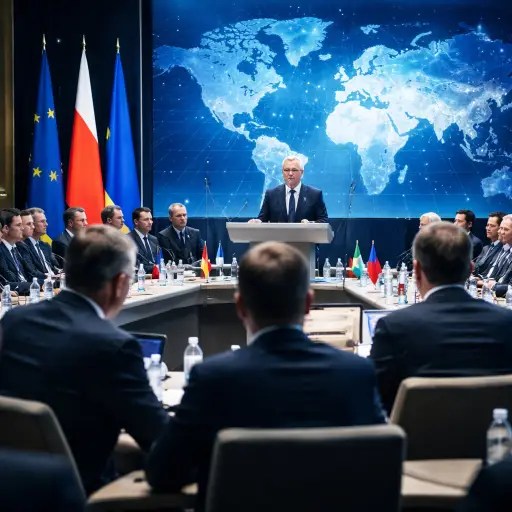
European leaders are confronting a period of mounting uncertainty as geopolitical tensions and conflicts across several regions challenge the stability of the international system that has shaped global relations for decades.
In remarks to diplomats and policy officials, European Council President António Costa warned that the rules-based order guiding cooperation between nations is under increasing pressure, urging European governments to strengthen their commitment to democratic values and multilateral partnerships.
Speaking at a diplomatic forum, Costa emphasized that the predictability of the international environment can no longer be taken for granted. Conflicts in multiple regions, intensifying competition among major powers, and growing skepticism toward international institutions have combined to create what many analysts describe as one of the most complex geopolitical climates in a generation. European policymakers now face the challenge of protecting cooperation while adapting to a shifting global balance of power.
Across the continent, officials increasingly argue that the European Union must reinforce political unity and strategic resilience if it hopes to safeguard the democratic model that underpins the bloc. Many governments see the defense of international law, collective decision-making, and open economic systems as central to Europe’s role in global affairs.
Costa’s warning resonated with diplomats who believe Europe is entering a period where cohesion will be tested repeatedly. The EU Council president noted that the erosion of multilateral frameworks could leave smaller and mid-sized nations vulnerable to pressure from larger geopolitical actors. Maintaining a functioning system of rules and agreements, he argued, remains both a moral responsibility and a practical requirement for economic stability and international security.
Within European capitals, debates continue about how the EU should respond to the changing international environment. Some policymakers advocate deeper foreign policy coordination and stronger defense cooperation among member states. Others emphasize the need for sustained diplomatic engagement and expanded economic partnerships with regions that share commitments to democratic governance and open trade.
The urgency of these discussions has grown as conflicts and political tensions disrupt supply chains, trigger humanitarian crises, and intensify competition for resources. These developments have forced European governments to reassess long-standing assumptions about security and the durability of the institutions that once appeared to guarantee peace and stability.
Diplomats frequently note that the European Union’s influence on the global stage depends heavily on its ability to act collectively. When member states coordinate their positions, the bloc can exert significant diplomatic and economic influence through negotiations, sanctions, and mediation efforts. However, differing national priorities on issues such as energy policy, trade relations, and security strategies can sometimes complicate efforts to present a unified stance.
Despite these challenges, Costa suggested that Europe’s diversity may also be a source of strength. The EU’s experience balancing varied political traditions, economic structures, and social priorities demonstrates that cooperation among diverse nations is possible even in times of uncertainty. He encouraged diplomats to deepen engagement with international partners who remain committed to international law and peaceful conflict resolution.
The broader concern about the fragility of the rules-based international order reflects a growing consensus among analysts and policymakers. Over the past decade, many international institutions have struggled to mediate disputes or enforce agreements in an increasingly polarized world. As competing power centers pursue divergent strategic goals, the mechanisms designed to preserve global stability have frequently been strained.
European governments now face the task of navigating this complex landscape while preserving the principles that have defined the European project since its creation. Leaders across the continent continue to stress that democracy, human rights, and cooperation between nations remain central to Europe’s identity.
As discussions among diplomats and national leaders continue, Costa’s message has reinforced the idea that the coming years will require sustained coordination and vigilance. For Europe, defending the international system may depend not only on diplomatic rhetoric but also on long-term investment in alliances, institutions, and the democratic values that underpin them.
 The Tower Post