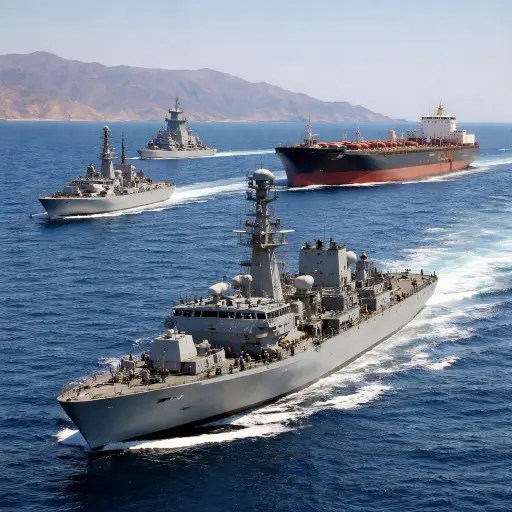
European governments weigh coordinated naval measures as tensions threaten one of the world’s most vital energy corridors
European governments are intensifying diplomatic and military coordination to safeguard commercial shipping moving through the Strait of Hormuz, a narrow but indispensable maritime corridor linking the Persian Gulf to global markets. Concern over potential disruptions has grown sharply as regional tensions persist, prompting the United Kingdom, Germany, and Italy to accelerate discussions about joint maritime security measures designed to ensure that tankers and cargo vessels can continue to transit the waterway safely. The emerging effort reflects a wider recognition across Europe that the stability of global trade routes can no longer be taken for granted.
The Strait of Hormuz occupies a central position in the architecture of the global energy system. Roughly one third of the world’s seaborne oil shipments pass through the channel each day, along with significant volumes of liquefied natural gas and other commodities essential to modern economies. Any sustained interruption could send shockwaves through financial markets, disrupt industrial supply chains, and trigger price volatility for fuel and electricity across continents. For European economies already navigating an era of energy uncertainty, the uninterrupted flow of shipments through the strait has become a strategic priority.
Officials in London, Berlin, and Rome are now exploring a framework for closer naval coordination in the region, building upon existing maritime security initiatives while adapting to evolving risks. Discussions among defense planners focus on how European vessels might contribute to surveillance, escort operations, and intelligence sharing in order to deter attacks or interference with commercial shipping. The goal is not to escalate tensions but to reinforce the principle that international waterways must remain open and secure for lawful trade.
Maritime security experts say the challenge lies in balancing deterrence with restraint. The strait’s narrow geography means ships must follow tightly defined traffic lanes, leaving them potentially vulnerable to harassment, drones, or fast attack craft. A visible but measured naval presence could reassure shipping companies and insurers that the route remains safe without creating the impression of militarization. European planners are therefore emphasizing coordination, transparency, and cooperation with regional partners.
The United Kingdom has played a leading role in earlier maritime protection missions in the Gulf, and British officials are expected to remain central to the new discussions. Germany and Italy, meanwhile, have signaled willingness to expand their contributions to maritime monitoring and patrol activities if a broader European framework is agreed. Diplomats stress that any mission would operate within international law and seek alignment with existing multinational security arrangements in the region.
Shipping companies are closely watching these developments, aware that the security environment around the Strait of Hormuz directly affects insurance premiums, shipping schedules, and logistical planning. Even temporary uncertainty can lead operators to reroute vessels, delay departures, or impose surcharges on cargo. Such measures ripple through global supply chains, affecting everything from fuel prices to the cost of manufactured goods.
Energy analysts warn that the stakes extend well beyond the oil market. The strait also handles a substantial share of the world’s liquefied natural gas exports, a resource that has become increasingly important to European energy systems. Any disruption could tighten supply and complicate the delicate balance between energy demand, storage levels, and price stability in international markets.
Within European policy circles, the conversation about protecting maritime trade routes is also linked to a broader reassessment of economic security. The vulnerability of global supply chains has become a recurring theme in recent years, leading governments to pay closer attention to chokepoints such as the Strait of Hormuz, the Suez Canal, and other critical passages. Safeguarding these routes is now viewed not only as a naval responsibility but also as a pillar of economic resilience.
Regional diplomacy remains a key element of the strategy. European officials emphasize that sustained engagement with Gulf states is essential for reducing tensions and preventing incidents that could escalate into wider disruptions. Maritime patrols and surveillance efforts are therefore being discussed alongside diplomatic outreach aimed at reinforcing stability and communication among all actors operating in the region.
Analysts note that Europe’s interest in the Strait of Hormuz reflects the enduring interconnectedness of the global economy. Energy flows from the Gulf fuel industries in Asia, Europe, and beyond, while shipping networks bind together markets separated by thousands of miles of ocean. When risks emerge in a single maritime corridor, the effects can reverberate across the entire trading system.
At the same time, policymakers are aware that a coordinated maritime mission would require careful planning, clear rules of engagement, and sustained political commitment. Naval deployments are resource intensive and must be balanced with other security obligations facing European governments. Discussions therefore focus not only on immediate measures but also on how to design a mission that could remain effective over time.
For now, the message from European capitals is one of vigilance and preparation. By strengthening naval coordination and signaling readiness to protect commercial shipping, the United Kingdom, Germany, and Italy aim to reassure global markets that one of the world’s most vital trade arteries will remain open. Whether these efforts evolve into a formal multinational mission or remain a framework for cooperation, the initiative underscores a shared understanding that safeguarding maritime routes is fundamental to economic stability.
 The Tower Post