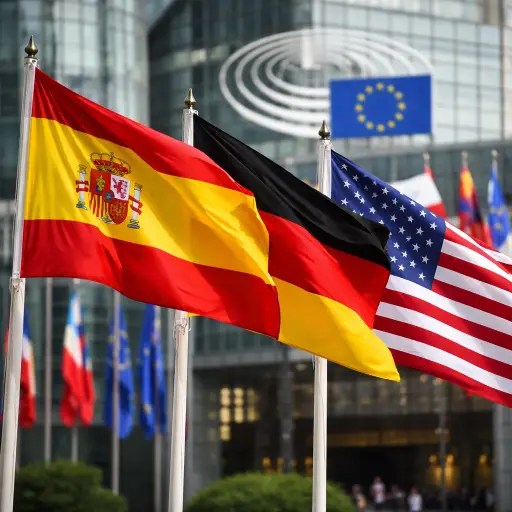
Spain’s accusation that Germany is acting as a ‘vassal’ of the United States exposes widening divisions within Europe over NATO spending and the continent’s long-term strategic autonomy
A diplomatic clash inside Europe has erupted after Spain publicly accused Germany of behaving like a “vassal” of the United States during tense discussions over NATO defense spending, highlighting a widening rift within the European alliance about military priorities, political independence, and the future balance of power between Europe and Washington.
The dispute emerged after Berlin reportedly supported renewed pressure from Washington urging Madrid to increase its military expenditure in line with NATO commitments, a position that Spanish officials argue reflects American geopolitical priorities rather than Europe’s own strategic interests.
Spanish government sources say the criticism was triggered during closed-door consultations among European defense representatives, where Germany was seen aligning closely with U.S. arguments that NATO members must accelerate defense investment amid ongoing security challenges and rising global instability.
Madrid reacted sharply to what it interpreted as Berlin reinforcing American demands rather than advocating a distinctly European approach to defense planning, with Spanish officials warning that such alignment risks turning European policy debates into extensions of Washington’s strategic agenda.
The unusually blunt language from Spain signals deeper frustrations within parts of southern Europe about how defense obligations are being framed, particularly as governments face competing domestic pressures ranging from inflation and energy costs to social spending commitments and economic recovery priorities.
German officials have rejected the accusation, arguing that their position reflects long-standing NATO agreements rather than subservience to U.S. policy, and emphasizing that strengthening European military readiness is essential to maintaining stability across the Atlantic alliance.
Behind the public rhetoric lies a broader strategic debate that has intensified across Europe in recent years over the question of strategic autonomy, a concept championed by several EU leaders who argue that the continent must develop greater independent defense capacity even while remaining committed to NATO.
Supporters of that vision contend that Europe must avoid becoming overly dependent on Washington’s security umbrella, while critics warn that weakening transatlantic unity could undermine deterrence and create uncertainty at a time when geopolitical tensions are already reshaping global alliances.
Spain’s remarks have therefore resonated beyond the immediate dispute with Germany, drawing attention to the delicate balance European governments are trying to maintain between strengthening NATO cooperation and asserting greater political independence in shaping the continent’s long‑term security strategy.
As the debate unfolds, diplomats across Europe acknowledge that disagreements over defense spending are likely to intensify in the coming months, with the current dispute serving as a reminder that the question of how closely Europe should align with U.S. global strategy remains one of the most sensitive and unresolved issues within the transatlantic partnership.


 The Tower Post