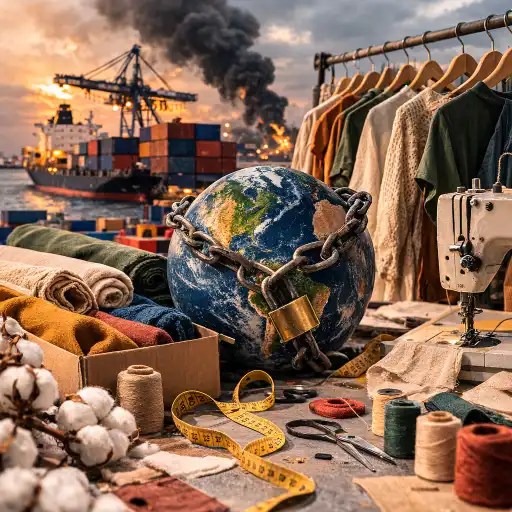
Geopolitical tensions and instability around key trade corridors are forcing fashion brands to reconsider how ethical materials are sourced, transported, and manufactured.
The global fashion industry, long engaged in a delicate transition toward sustainability, is confronting a new and destabilizing challenge as geopolitical tensions ripple across critical supply chains. The escalating conflict involving Iran and broader instability across surrounding regions are disrupting shipping routes, raising energy costs, and interrupting the complex international networks that deliver textiles and raw materials to factories around the world. For fashion companies that have spent years building ethical sourcing systems and lowering their environmental footprint, the current turbulence is creating an unexpected test of resilience.
Many of the world’s sustainable fashion initiatives depend on highly coordinated global supply networks that stretch from cotton farms and fiber producers to dyeing facilities, garment factories, and distribution centers. A single garment marketed as sustainable may involve organic cotton from one region, recycled fibers from another, and final assembly thousands of kilometers away. When political tensions disrupt transportation corridors or raise insurance costs for shipping, these carefully calibrated networks can quickly become fragile.
Industry analysts say the current geopolitical climate is already causing delays in textile shipments and uncertainty among suppliers operating near sensitive trade routes. Maritime security concerns and shifting regional alliances are affecting some of the busiest freight corridors linking Asia, Europe, and the Middle East. As a result, fashion brands that depend on predictable logistics are encountering longer lead times and rising transportation costs that ripple through every stage of production.
For sustainable fashion labels, the disruption is especially painful because environmentally responsible sourcing often depends on specialized suppliers rather than mass commodity markets. Organic cotton cooperatives, regenerative agriculture projects, and low-impact dye houses are frequently smaller operations that cannot easily absorb sudden fluctuations in demand or transportation costs. When shipments stall or factories slow production, the entire sustainability chain can be thrown off balance.
Executives from several apparel companies warn that the ongoing tensions could trigger a wave of supply shocks across the textile sector. With shipping costs fluctuating and energy markets reacting to geopolitical uncertainty, manufacturing expenses are beginning to climb. Those increases ultimately threaten to translate into higher retail prices for consumers already facing broader economic pressure.
The paradox facing the fashion industry is that disruptions meant to be temporary can undermine years of climate progress. When brands cannot access preferred sustainable materials quickly enough, some are forced to rely on alternative suppliers that may not meet the same environmental standards. In some cases this means turning to conventional cotton, synthetic fibers, or production facilities that operate with higher carbon emissions.
Transportation changes can also carry environmental consequences. When sea routes become unpredictable, companies sometimes resort to faster but more carbon-intensive air freight to meet delivery schedules. While these emergency measures may keep store shelves stocked, they increase the industry’s overall emissions footprint at a time when brands are publicly committing to aggressive climate targets.
Supply chain transparency, once promoted as a cornerstone of ethical fashion, is also becoming harder to maintain during periods of geopolitical tension. Monitoring systems that track the origin of fibers and working conditions in factories rely on stable access to partners and auditors across multiple countries. When regions become politically sensitive or economically unstable, oversight can weaken, raising concerns among sustainability advocates.
Some brands are now accelerating efforts to regionalize their production networks. Instead of relying on long global supply chains, companies are exploring manufacturing closer to their main consumer markets. Nearshoring strategies in parts of Europe and North America, as well as expanded textile production in Southeast Asia and Africa, are increasingly being discussed as ways to reduce exposure to geopolitical risk.
Yet shifting production geography is far from simple. Building new sustainable supply networks requires years of investment, training, and certification. Textile processing facilities must meet environmental standards, workers must be trained in responsible manufacturing techniques, and supply contracts must be renegotiated. Even companies determined to change direction cannot transform their sourcing strategies overnight.
Meanwhile, raw material producers are feeling the pressure from both ends of the market. Farmers cultivating organic cotton and regenerative fibers depend on stable purchasing commitments from fashion brands. When companies hesitate to place large orders due to uncertainty in global trade routes, those agricultural communities face financial risks that could discourage future sustainable farming practices.
The broader geopolitical environment is also influencing investor sentiment in the fashion sector. Sustainability initiatives often require long-term financial commitments, and investors may grow cautious when global instability threatens profitability. Analysts warn that if uncertainty continues, some companies may slow the pace of environmental innovation in order to prioritize short-term operational stability.
At the same time, the crisis is forcing a deeper conversation inside the industry about resilience and responsibility. Many sustainability experts argue that the disruption highlights the need for stronger local supply chains, diversified sourcing, and closer collaboration between brands and suppliers. Rather than abandoning environmental commitments, they suggest the current moment could push the sector toward more robust and adaptable models.
Technology is also emerging as part of the response. Digital supply chain mapping, satellite tracking of agricultural regions, and blockchain-based traceability tools are being expanded to provide greater visibility into sourcing networks. These systems allow brands to identify vulnerabilities more quickly and shift orders before disruptions cascade through the entire production process.
Environmental groups emphasize that maintaining progress toward sustainable fashion will require coordinated action beyond individual brands. Governments, trade organizations, and logistics companies all play roles in stabilizing transport corridors and supporting responsible production standards. Without broader cooperation, even the most committed companies may struggle to protect their sustainability goals.
For consumers, the effects of geopolitical tension in fashion supply chains may appear gradually rather than suddenly. Clothing prices could rise modestly, product releases may become less predictable, and certain eco-friendly materials may appear less frequently in new collections. Behind these subtle changes lies a complex web of global trade pressures reshaping how garments are produced.
In the long term, the disruptions triggered by conflict and geopolitical rivalry may reshape the geography of the fashion industry itself. Companies that once depended on highly dispersed global networks are beginning to consider more compact, diversified systems designed to withstand political shocks. The transition will not be easy, but many executives now see resilience as inseparable from sustainability.
As fashion brands continue navigating the uncertain landscape created by geopolitical tensions, the industry faces a defining question about the future of responsible production. Whether companies respond by retreating from sustainability commitments or by building stronger and more adaptable supply chains could determine the environmental trajectory of fashion for decades to come.



 The Tower Post