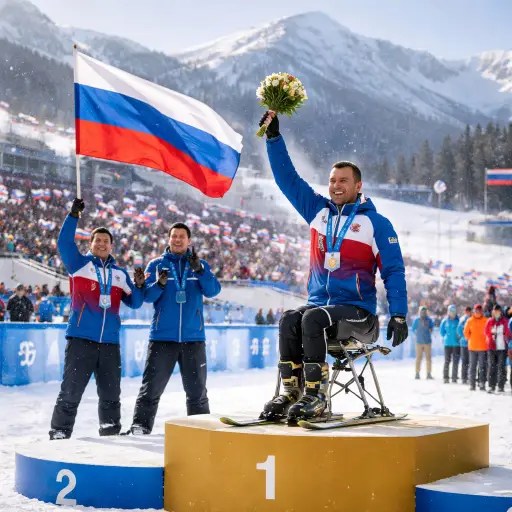
Russian athletes step back onto the international Winter Paralympics stage as debate grows over the place of sport during wartime
After years of absence from the international Winter Paralympics arena, Russian athletes have returned to the global stage in a moment that has stirred celebration, controversy, and renewed questions about the relationship between sport and geopolitics. When the final result of a dramatic race confirmed a Paralympic victory for a Russian competitor, the arena fell briefly silent before the sound system began playing the Russian national anthem. For many spectators, it was a moment that felt both historic and complicated, reflecting the tension between the universal ideals of sport and the realities of a world still shaped by conflict.
Inside the stadium, the ceremony unfolded with the familiar rituals of international competition. The athlete stood on the podium wearing winter gear dusted with snow, raising a gloved hand as the flag rose above the venue. Teammates watched from the stands, some cheering, others visibly emotional. It marked the first time in more than a decade that the Russian anthem had been played after a Paralympic winter victory, an occurrence that immediately drew attention far beyond the sporting world.
The return of Russian competitors to Paralympic competition followed a long and complex process of negotiation between sporting bodies, national committees, and international federations. Officials involved in the decision described the move as part of a broader effort to gradually restore participation while maintaining oversight and compliance with international sporting regulations. For the athletes themselves, many of whom had continued to train despite years of uncertainty, the opportunity to compete again represented the culmination of perseverance through one of the most turbulent periods in modern sports governance.
In the mixed zones where journalists gather after competitions, athletes spoke carefully about what the moment meant. Some emphasized the years of preparation required simply to return to form, describing training sessions held far from international circuits and the difficulty of maintaining motivation without the usual calendar of events. Others framed the victory as a symbol of personal resilience rather than political significance, saying the focus of their careers had always been performance, discipline, and the pursuit of excellence on snow and ice.
Supporters of the decision to allow Russian athletes back into competition argue that sport has long served as a bridge between societies during periods of political tension. They say the Paralympic movement in particular carries a mission that transcends national disputes, emphasizing inclusion, human potential, and the celebration of athletes who have overcome profound challenges. From this perspective, the anthem ceremony was less about geopolitics and more about recognizing a sporting achievement that deserved acknowledgment under the same rules applied to every competitor.
Critics, however, see the moment very differently. For them, the playing of the anthem during wartime carries symbolic weight that cannot easily be separated from the broader political context. Some athletes from other countries expressed unease privately, suggesting that international competitions inevitably reflect the world in which they occur. Advocacy groups and commentators also questioned whether the return to full ceremonial recognition risks appearing detached from ongoing global tensions.
The debate surrounding the anthem ceremony spread quickly across social media platforms and international news coverage. Clips of the podium moment circulated widely, accompanied by sharply divided commentary. Some viewers described the scene as an overdue restoration of normal sporting procedures, while others argued that the timing sent a message that the boundaries between diplomacy and sport are becoming increasingly blurred. The controversy highlighted how global sporting events often function as symbolic stages where national identity and international politics intersect.
Officials within the Paralympic movement have attempted to balance these competing perspectives by emphasizing the principles that guide their decisions. Representatives stressed that the organization’s mission centers on athletes and competition, not on endorsing any government or political agenda. At the same time, they acknowledged that international sport cannot exist in isolation from global developments and that every policy choice is likely to attract scrutiny in the current climate.
For many Paralympians competing in the same events, the focus remained firmly on the competition itself. The winter disciplines featured demanding courses shaped by icy winds, steep terrain, and unpredictable weather conditions that tested athletes’ skill and endurance. Competitors spoke about strategy, equipment adjustments, and the intense concentration required to navigate each run or lap. In that environment, the immediate reality of the race often overshadowed the wider debates unfolding beyond the slopes.
Spectators inside the venue experienced the ceremony in real time, with reactions ranging from applause to quiet observation. Some fans waved flags and celebrated the athletic performance they had just witnessed, while others simply watched as the anthem echoed across the stadium. For many attending the event, the moment underscored how international sport can evoke pride, discomfort, admiration, and reflection simultaneously.
Sports historians note that the intersection of politics and international competition is hardly new. From boycotts to diplomatic protests, global sporting events have long mirrored the political currents of their eras. The Paralympic movement itself emerged from a postwar effort to promote rehabilitation and international understanding, making the present debate particularly resonant for those who study the history of sport as a reflection of broader social change.
In the training centers and national programs that prepare athletes for winter competition, coaches and support staff continue to focus on performance and preparation for the next events. They emphasize technical refinement, mental resilience, and the collaborative work required behind the scenes to bring an athlete to peak condition. Within those spaces, the long path back to international participation has been measured not only in policy decisions but also in thousands of hours of practice on frozen tracks and snowy hills.
The athlete at the center of the ceremony later described the victory as the realization of a dream shared by teammates and coaches who had waited years for the chance to compete again on the world stage. Speaking through an interpreter, the competitor said the sound of the anthem during the medal ceremony would remain a defining memory of the career. At the same time, the athlete acknowledged the complexity of the moment, recognizing that different audiences would interpret it in different ways.
As the Winter Paralympics continue, attention will shift to upcoming races and the performances of athletes from across the globe. Yet the image of the podium ceremony and the sound of the anthem have already become one of the defining moments of the current competition. Whether viewed as a symbol of normalization or as a reminder of unresolved tensions, the return of Russian athletes to the Paralympic stage ensures that the conversation about sport, identity, and international relations will remain part of the story long after the snow settles.
 The Tower Post