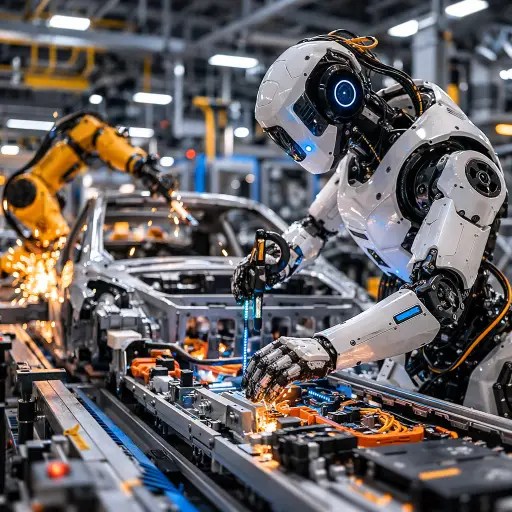
New venture founded by Rivian CEO aims to deploy intelligent robots capable of performing complex factory tasks, signaling a potential turning point for global industrial automation.
A new robotics startup is drawing significant attention across the technology and manufacturing sectors after securing a massive investment round aimed at redefining how factories operate. Mind Robotics, a company focused on building artificial intelligence–powered industrial machines, has raised $500 million in fresh funding to accelerate the development of advanced factory robots capable of performing complex physical tasks traditionally handled by human workers.
The company was founded by the chief executive of electric-vehicle manufacturer Rivian, bringing together engineers from the automotive, robotics, and artificial intelligence industries. Their mission is ambitious: to create intelligent robotic systems capable of working across factory floors with the adaptability, precision, and learning capability required for modern manufacturing.
Investors backing the venture believe that the next major transformation in global industry will come from AI-driven robotics that can handle intricate assembly processes, move materials, and collaborate with human workers in dynamic environments.
A New Generation of Industrial Machines
Mind Robotics is developing machines designed to perform tasks that have historically proven difficult for traditional industrial robots. While robots have been used in manufacturing for decades—especially in automotive production lines—most systems rely on repetitive programmed motions and operate in highly controlled conditions.
The new systems being designed by Mind Robotics aim to go far beyond that model.
Using advanced artificial intelligence and computer vision technologies, the robots are intended to perceive their surroundings, recognize components, and adapt their movements in real time. The goal is to allow them to perform complex physical work such as wiring car systems, assembling intricate mechanical parts, transporting materials, and performing precision tasks that previously required skilled human labor.
According to people familiar with the project, the robots are designed to continuously learn from data collected during operations. By analyzing thousands of interactions on the factory floor, the systems could improve their accuracy and efficiency over time.
If successful, the technology could allow factories to automate processes that have remained difficult to scale through conventional robotics.
Investors Bet on the Future of AI Manufacturing
The half-billion-dollar funding round reflects growing confidence among venture capital firms that artificial intelligence will dramatically reshape the industrial economy.
Investors participating in the round include several major technology-focused funds and manufacturing-sector backers who see robotics as the next frontier in AI deployment. Their bet is that intelligent machines capable of performing real-world tasks will unlock enormous productivity gains across industries ranging from automotive and electronics to logistics and heavy machinery.
Manufacturing companies around the world are already facing significant challenges, including labor shortages, rising costs, and increasing pressure to modernize production lines. AI-powered robots could help address those pressures by enabling factories to operate more efficiently while reducing reliance on repetitive manual labor.
Industry analysts say that while software has been the dominant focus of artificial intelligence investment in recent years, the next wave of innovation may occur in the physical world—where AI systems interact directly with machines, tools, and materials.
“AI is moving out of the cloud and into the real world,” said one manufacturing technology analyst. “Robotics is where that transformation becomes tangible.”
From Electric Vehicles to Robotics
The involvement of Rivian’s chief executive in founding Mind Robotics has also captured the attention of the automotive industry. Electric vehicle manufacturing requires highly sophisticated production systems, and the experience gained in building advanced vehicle assembly lines is expected to influence the startup’s approach to robotics.
Engineers involved in the project are reportedly focused on building robots capable of operating in the same flexible environments as human workers. Unlike traditional robotic arms that follow rigid programming, these systems are designed to respond dynamically to changes on the factory floor.
For example, if a component is placed slightly out of position, the robot should be able to detect the difference and adjust its movement accordingly—something that conventional automation often struggles to accomplish.
The startup’s leadership believes that integrating AI learning models with advanced mechanical systems will allow robots to become far more capable than previous generations of industrial machines.
Potential Impact on the Workforce
The rapid development of intelligent factory robots is also raising important questions about the future of work.
Many industrial jobs involve repetitive tasks such as assembling parts, tightening fasteners, or transporting materials across production lines. These roles could become increasingly automated as AI-powered robots gain the ability to perform them more efficiently.
Some investors supporting the technology believe that automation will ultimately create new opportunities by shifting human labor toward higher-skill roles such as system supervision, engineering, and robot maintenance.
However, labor experts caution that the transition may not be simple. Manufacturing remains a critical source of employment in many regions, and widespread adoption of advanced robotics could reshape local economies.
The debate surrounding automation is likely to intensify as new AI-driven machines move from research labs into real factories.
A Race to Build the Smart Factory
Mind Robotics is entering an increasingly competitive field. Technology companies, robotics startups, and large manufacturers are all racing to develop systems that can bring artificial intelligence into industrial environments.
Major technology firms are investing heavily in AI hardware, sensors, and robotic software platforms designed to power the factories of the future. Meanwhile, automotive and electronics manufacturers are exploring ways to incorporate intelligent machines into their production systems.
The concept of the “smart factory”—where interconnected machines coordinate production autonomously—has long been discussed as the next stage of industrial evolution. AI robotics could finally make that vision achievable at scale.
The Road Ahead
Despite the enthusiasm surrounding the new funding round, significant challenges remain.
Developing robots capable of handling complex physical tasks reliably in real-world factory conditions is extremely difficult. Variations in materials, lighting, component placement, and equipment can create unpredictable situations that machines must learn to handle safely.
Mind Robotics plans to use the new investment to expand its engineering teams, build prototype systems, and begin pilot deployments with manufacturing partners.
If those early trials prove successful, the company could help usher in a new era of intelligent automation—one where AI systems work side by side with human workers on factory floors around the world.
For now, investors are betting that the combination of artificial intelligence and robotics may become one of the most transformative technologies in modern manufacturing.
And with hundreds of millions of dollars now fueling its development, Mind Robotics is positioning itself at the center of that industrial revolution.



 The Tower Post