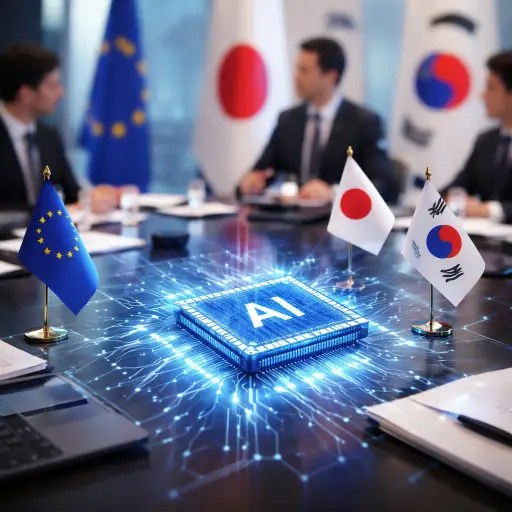
A new transcontinental partnership aims to build trusted AI systems, secure semiconductor supply chains and establish ethical technology standards beyond the influence of the U.S.–China rivalry.
In a significant move that could reshape the global governance of artificial intelligence, the European Union has announced the creation of a strategic technological alliance with Japan and South Korea. The initiative signals an ambitious effort to coordinate research, align ethical standards and strengthen semiconductor supply chains among three of the world’s most technologically advanced democratic economies.
The partnership represents one of the most comprehensive attempts yet to establish a cooperative framework for artificial intelligence outside the dominant technological rivalry between the United States and China. European officials describe the alliance as a platform for developing “trusted AI,” emphasizing transparency, safety and human-centered technological design.
At its core, the initiative seeks to align regulatory principles and industrial strategy in areas that are rapidly becoming central to global economic competition. Artificial intelligence is now deeply embedded in sectors ranging from healthcare and manufacturing to national security and digital infrastructure. As governments race to harness its economic potential, concerns about safety, ethics and technological dependence have intensified.
European policymakers view cooperation with Asian partners as a way to strengthen what they call a “values-based technology ecosystem.” Japan and South Korea share similar concerns about responsible AI deployment, data governance and the reliability of global supply chains. By combining research capabilities and regulatory experience, the three partners aim to create a coordinated approach that could influence international standards.
One of the alliance’s primary priorities is the development of trustworthy artificial intelligence systems. This includes collaborative research programs, academic exchanges and joint funding for advanced AI laboratories. Officials involved in the initiative say the goal is not simply technological competitiveness but also the establishment of guardrails that ensure AI systems remain accountable, explainable and aligned with democratic norms.
European regulators have already taken a leading role in shaping global AI governance through legislation focused on risk management and transparency. Japan and South Korea, both home to major technology firms and sophisticated research institutions, are expected to contribute expertise in robotics, industrial automation and semiconductor engineering.
The alliance also highlights the strategic importance of semiconductor supply chains, an issue that has gained urgency in recent years. Chips are the essential components powering AI systems, data centers and advanced electronics. Disruptions in semiconductor production have exposed vulnerabilities in global manufacturing networks, prompting governments to rethink how these critical technologies are sourced and produced.
Europe has been investing heavily in expanding its semiconductor manufacturing capacity, while Japan and South Korea remain among the world’s leading producers of advanced chips and chipmaking equipment. Through the new partnership, the three sides aim to coordinate investments, share technological expertise and improve resilience in semiconductor supply chains.
Industry analysts believe such coordination could help reduce dependence on a limited number of production hubs while strengthening technological autonomy among participating economies. In practical terms, this may involve joint research into next-generation chip architectures, shared industrial standards and collaborative manufacturing initiatives.
Beyond industrial policy, the alliance is also designed to deepen scientific cooperation. Universities and research institutions across the three regions are expected to participate in joint AI research projects, focusing on areas such as robotics, machine learning, quantum computing and advanced data processing. Collaborative academic networks could accelerate innovation while ensuring that research outcomes are aligned with shared ethical frameworks.
Another key aspect of the partnership involves the establishment of interoperable AI governance systems. Governments increasingly recognize that fragmented regulatory approaches can hinder innovation and create uncertainty for companies operating across borders. By coordinating policy frameworks, Europe, Japan and South Korea hope to build a predictable environment for technological development while maintaining strong protections for privacy and safety.
Officials involved in the negotiations emphasize that the alliance is not designed to exclude other partners. Rather, it is envisioned as a foundational coalition that could expand over time to include additional countries committed to responsible technology development. Some observers suggest that the initiative could eventually serve as the basis for a broader international network of democratic technology governance.
The announcement also reflects growing geopolitical awareness surrounding artificial intelligence. As AI becomes a strategic asset in economic growth, defense capabilities and digital infrastructure, governments are increasingly treating technological cooperation as a matter of long-term security.
By strengthening ties across Europe and East Asia, the new alliance could create an alternative center of technological influence. Analysts note that while the United States remains a dominant force in AI innovation, and China continues to invest heavily in state-backed technology development, a coordinated Europe–Japan–South Korea partnership could introduce a third major axis shaping global standards.
Business leaders in the technology sector have broadly welcomed the initiative, seeing opportunities for expanded research collaboration and more predictable regulatory frameworks. Companies developing AI tools often face uncertainty when operating across jurisdictions with differing rules. A coordinated approach could help streamline compliance while encouraging responsible innovation.
However, experts caution that turning political ambition into practical cooperation will require sustained commitment. Joint research programs, semiconductor investments and regulatory alignment all demand significant funding and long-term coordination among governments, industries and academic institutions.
Despite these challenges, the alliance signals a growing recognition that the future of artificial intelligence will not be determined by technological capability alone. Governance, ethics and international collaboration are becoming equally important components of the emerging AI ecosystem.
For Europe, Japan and South Korea, the partnership represents an opportunity to demonstrate that innovation and democratic values can advance together. If successful, the initiative could influence how artificial intelligence is developed, regulated and deployed across the world.
In an era increasingly defined by technological competition, the alliance suggests that cooperation among like-minded economies may play a decisive role in shaping the next generation of global digital standards.




 The Tower Post