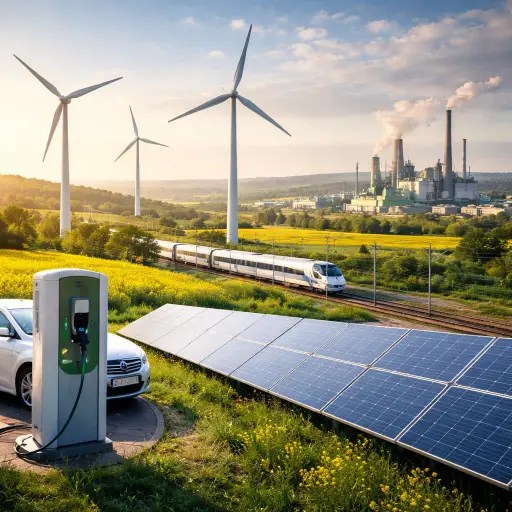
Economists warn the European Union must dramatically increase spending now to avoid passing a massive “climate debt” to future generations.
Across Europe, economists and climate policy experts are delivering a stark warning: the longer the European Union delays large-scale investments in the clean energy transition, the more expensive the future will become.
A new economic analysis circulating among policy circles argues that Europe must begin spending far larger sums on climate infrastructure immediately if it wants to avoid what researchers call a looming “climate debt” — a financial burden that would fall on future taxpayers if governments postpone the transformation of energy systems, transportation networks and industrial production.
The concept is simple but powerful. If governments fail to invest early in renewable energy, resilient infrastructure and climate adaptation, the eventual costs of dealing with climate damage, energy volatility and economic disruption will far exceed the price of acting today.
According to the economists behind the report, Europe now stands at a critical turning point. The continent has committed to ambitious emissions reduction goals and a long-term transition toward climate neutrality. Yet current levels of investment remain far below what experts say is required to meet those targets while maintaining economic stability.
The report argues that the cost of delay is not abstract. Each year of insufficient investment increases the likelihood that governments will face a far steeper bill later — not only to build new infrastructure but also to repair the damage caused by extreme weather, disrupted food systems and volatile energy markets.
In recent years Europe has already experienced a preview of what climate-driven economic strain could look like. Severe heatwaves have affected agriculture and water supplies. Floods have damaged transportation networks and housing. Meanwhile, energy price shocks have exposed the vulnerabilities of the continent’s energy system.
Economists say these challenges will intensify if the pace of the energy transition remains too slow.
“The economic logic is clear,” said one of the economists involved in the research. “Every euro invested early in clean energy and climate resilience reduces the far larger costs of adaptation, reconstruction and economic disruption later.”
The report calls for a major expansion of public and private investment across several sectors simultaneously.
One of the largest priorities is the modernization of Europe’s electricity grid. As renewable energy expands, the continent will need far more transmission capacity to move power from wind farms and solar installations to cities and industrial centers. Without major upgrades, experts warn that energy bottlenecks could slow the entire transition.
Another urgent need is the rapid electrification of transportation and industry. This requires large investments in charging infrastructure, rail networks, and the electrification of heavy manufacturing processes that still rely heavily on fossil fuels.
Buildings also represent a major challenge. Across Europe, millions of homes remain poorly insulated and dependent on gas heating. Renovating these buildings is expensive, but economists say postponing the work only locks in higher energy consumption and emissions for decades.
Climate adaptation — preparing societies for the physical impacts of warming — is another area where investment must rise sharply. Flood defenses, water management systems and climate-resilient agriculture are increasingly seen as essential economic safeguards rather than optional environmental measures.
Supporters of large-scale climate investment often compare the situation to infrastructure decisions made in previous generations. Europe’s highway networks, rail systems and energy grids were built through decades of sustained public spending. Those investments created the foundations for modern economic growth.
The climate transition, economists say, represents a similar generational project.
But unlike previous infrastructure programs, this transformation must happen under severe time pressure. The window for limiting the most damaging effects of climate change is rapidly narrowing, which means the pace of economic transformation must accelerate.
Some policymakers worry about the fiscal implications of dramatically expanding climate spending. Many European governments are already managing high levels of public debt, and debates over fiscal rules have intensified across the European Union.
Yet the economists behind the report argue that the real financial risk lies in doing too little, not too much.
Their analysis frames climate spending not as an ordinary budget expense but as a form of long-term economic insurance. Investments made today, they argue, prevent much larger liabilities tomorrow — from disaster recovery costs to economic losses caused by unstable energy supplies.
In this sense, the term “climate debt” captures a growing concern among economists: that delaying action effectively shifts enormous costs onto younger generations.
Future taxpayers, the report warns, could find themselves paying for emergency infrastructure projects, disaster reconstruction and accelerated energy transitions that will be far more expensive than a steady, planned transformation starting now.
The political challenge is that the benefits of early investment are often invisible. Wind farms, grid upgrades and building renovations require large upfront spending, while the financial savings appear gradually over time.
But economists say the evidence is increasingly clear that early action produces far lower overall costs.
In addition, large-scale climate investment could bring economic benefits beyond emissions reduction. Expanding renewable energy industries, upgrading infrastructure and electrifying transport could create new jobs and strengthen Europe’s industrial competitiveness in emerging clean-technology markets.
Several European industries — including battery manufacturing, green hydrogen production and offshore wind technology — are already expanding rapidly. Experts say sustained public investment could position Europe as a global leader in the technologies needed for a low-carbon economy.
Still, the report warns that global competition is intensifying. Other major economies are also investing heavily in clean energy industries, and delays in Europe could allow rivals to dominate future markets.
For policymakers, the message from economists is increasingly urgent: climate investment is not only an environmental necessity but an economic strategy.
If Europe acts decisively now, the transition could be managed gradually and predictably. If it waits too long, governments may face abrupt and expensive adjustments driven by climate damage and market instability.
“The choice is between planned investment and forced spending later,” one researcher explained. “Either Europe pays now to build the future, or it pays much more later to repair the consequences of delay.”
As governments debate budgets and economic priorities, that warning is likely to shape policy discussions across the continent in the months ahead.
The central argument from economists is clear: climate spending today is not a cost to be avoided, but a debt to the future that Europe can still choose not to incur.


 The Tower Post