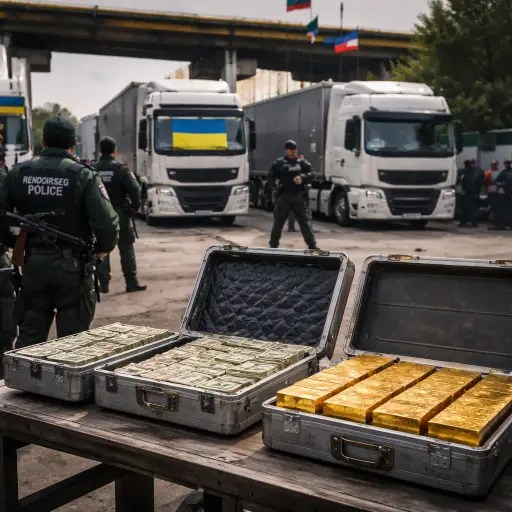
Kyiv accuses Budapest of unlawful confiscation after Hungarian authorities seize millions in cash and gold from a Ukrainian convoy, deepening tensions between the neighbors amid the continuing war in Eastern Europe.
A fresh diplomatic rift has opened between Ukraine and Hungary after Hungarian authorities seized a convoy carrying large quantities of cash and gold that Ukrainian officials say belonged to state linked financial institutions, prompting Kyiv to accuse Budapest of what it called outright banditry and to demand a response from European partners.
According to Ukrainian officials the convoy was transporting roughly seventy six million dollars worth of assets including gold bars and sealed containers of currency when it was intercepted by Hungarian authorities near the border, and Kyiv insists the shipment was part of wartime financial security measures designed to safeguard critical reserves during the ongoing conflict.
Hungarian authorities acknowledged the seizure but said the action was carried out under national financial oversight regulations and anti money laundering rules, arguing that the shipment raised legal concerns regarding documentation ownership verification and the movement of large quantities of currency and precious metals across a European Union border during wartime conditions.
The starkly different narratives have triggered one of the most serious diplomatic confrontations between the two countries since the war reshaped the political landscape of Eastern Europe, with both governments defending their positions while diplomatic channels attempt to prevent the dispute from escalating further.
Ukrainian officials insist the convoy was operating with proper authorization and accuse Hungary of exploiting a moment of vulnerability during the war, describing the seizure as confiscation disguised as enforcement and arguing that the assets were linked to state financial institutions and were being transported legally.
In Kyiv political leaders reacted sharply and warned that the move risks undermining regional solidarity at a moment when Ukraine remains dependent on cooperation with European partners for financial stability military assistance and economic survival during the prolonged conflict.
The Ukrainian government has formally requested explanations through diplomatic channels and is seeking support from European institutions, arguing that the seizure represents an unlawful action that requires scrutiny at a broader European level.
Hungarian officials reject the accusations and say authorities have a legal obligation to investigate shipments involving large quantities of gold or cash entering European Union territory, emphasizing that financial oversight rules apply regardless of political circumstances.
Budapest maintains that the seizure is temporary and subject to financial review procedures and insists the investigation is focused on verifying documentation and ensuring compliance with international financial regulations rather than targeting Ukraine politically.
The dispute highlights longstanding tensions between the two neighbors which have clashed repeatedly over minority rights energy policy and differing approaches to the war, with Hungary often taking a more cautious position toward sanctions and regional security policies compared with many other European governments.
Analysts say the incident reflects the complex intersection of wartime economic security and international financial law, noting that governments facing conflict frequently relocate valuable reserves to protect them from destruction capture or destabilizing economic shocks.
European Union regulations require strict reporting and documentation when significant amounts of currency or precious metals cross borders and authorities have the right to intervene if irregularities appear in paperwork or declarations.
Yet the political context surrounding the convoy has made the case far more sensitive than a routine customs investigation, especially given the symbolic importance of financial reserves for a country fighting to sustain its economy during war.
The accusation of banditry from Kyiv reflects a deeper frustration among Ukrainian officials who argue that Hungary should have coordinated directly with Ukrainian authorities or European institutions rather than seizing the assets unilaterally.
Diplomatic observers say the dispute could eventually involve mediation by European Union bodies if bilateral talks fail to resolve the disagreement, as officials in several European capitals watch closely to prevent divisions within the bloc.
For Hungary the situation is also delicate as the government insists it is acting within its legal authority while rejecting suggestions that the seizure was politically motivated or intended to undermine Ukraine.
Images of confiscated gold bars and sealed containers of currency circulating in media coverage have amplified the drama surrounding the case and turned the incident into a visible symbol of the economic tensions created by the war.
Security experts note that financial assets have become an increasingly important dimension of modern conflict and that the protection and relocation of reserves can play a crucial role in maintaining state stability during wartime.
Against that backdrop the seizure carries significance beyond the monetary value involved because it highlights how financial security legal authority and geopolitical tensions intersect along the borders of a continent still shaped by conflict.
For now both governments remain firm in their positions as Ukraine demands the immediate return of the assets while Hungary insists that legal reviews must proceed, leaving the dispute unresolved and raising new questions about the balance between legal jurisdiction wartime urgency and European solidarity.



 The Tower Post