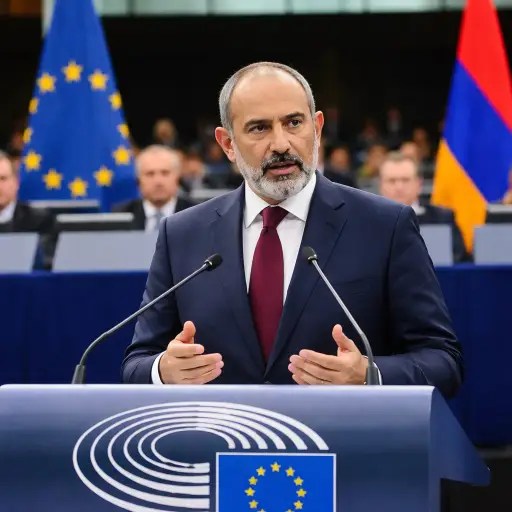
Pashinyan outlines vision for peace and European integration while facing backlash over policies toward the Armenian Church and Artsakh
Armenian Prime Minister Nikol Pashinyan delivered a closely watched address to the European Parliament, presenting Armenia’s ambitions for deeper ties with Europe and a vision of long-term regional peace. Yet the speech, intended to reinforce Armenia’s evolving geopolitical alignment, has also triggered sharp criticism from political opponents, diaspora groups, and religious figures.
Speaking before European lawmakers in Strasbourg, Pashinyan framed Armenia as a country navigating a historic crossroads. He emphasized democratic reforms, security concerns in the South Caucasus, and the government’s commitment to expanding cooperation with the European Union.
The address marked one of the clearest signals yet of Armenia’s gradual shift toward closer political and economic integration with Europe. However, the speech quickly became a focal point for broader debates within Armenia and among international observers about the country’s national identity, foreign policy direction, and the legacy of the conflict surrounding Artsakh.
A Message of European Partnership
In his remarks, Pashinyan portrayed Armenia as a democratic state seeking stability and economic opportunity through stronger engagement with European institutions.
He highlighted the importance of reforms designed to strengthen rule of law, transparency, and governance, arguing that Armenia’s democratic trajectory aligns naturally with European values.
The prime minister also emphasized the need for sustained international support to secure lasting peace in the South Caucasus. According to his message to European lawmakers, Armenia’s long-term security depends not only on regional diplomacy but also on international partnerships that promote stability.
Pashinyan described Armenia’s dialogue with the European Union as an opportunity to deepen cooperation in areas such as trade, energy, technology, and governance reforms. While stopping short of outlining a formal EU membership pathway, he suggested that Armenia’s future could involve a far more integrated relationship with European institutions.
For many members of the European Parliament, the speech reinforced the perception of Armenia as one of the region’s most active reform-oriented governments.
Several lawmakers welcomed Armenia’s commitment to democratic development and praised its willingness to pursue diplomatic engagement following years of conflict in the region.
Yet outside the parliamentary chamber, reactions were far more mixed.
Criticism From Opposition and Diaspora Voices
Critics argue that Pashinyan’s vision of European integration risks overlooking unresolved national issues and internal political tensions.
Some Armenian political figures accused the government of prioritizing international recognition over domestic concerns, particularly regarding the aftermath of the Artsakh conflict.
Opponents contend that the government’s approach to negotiations and regional diplomacy has weakened Armenia’s traditional strategic positions. For these critics, the emphasis on European integration appears premature given the continuing geopolitical pressures facing the country.
Members of the Armenian diaspora also voiced concern following the speech, saying that Armenia’s foreign policy should maintain stronger focus on protecting national heritage and cultural identity.
The most sensitive criticism, however, has centered on the government’s relationship with the Armenian Apostolic Church, one of the country’s most influential institutions.
Tensions With the Armenian Church
Some church leaders and conservative groups have accused the government of pursuing policies they view as undermining the role of the Armenian Church in national life.
These critics argue that recent political discourse has marginalized religious institutions and weakened the historic relationship between the Armenian state and the church.
Supporters of Pashinyan reject these accusations, insisting that the government respects religious traditions while maintaining a clear separation between church and state.
Still, the debate reflects broader cultural tensions inside Armenia about modernization, political reform, and the preservation of national traditions.
The Shadow of Artsakh
No issue has generated more emotional reactions than the continuing political debate surrounding Artsakh, a region whose status remains a defining topic in Armenian public life.
While Pashinyan’s speech focused heavily on diplomacy and regional peace, critics say it did not sufficiently address concerns related to the displacement and long-term security of Armenians connected to the region.
Opposition figures argue that Armenia’s leadership must more clearly define its position regarding the future of the region and the rights of those affected by the conflict.
Supporters of the government counter that Armenia’s strategy aims to prioritize stability and prevent further escalation in the South Caucasus.
The issue continues to dominate political discourse in Yerevan and among Armenian communities worldwide.
A Geopolitical Turning Point
The broader significance of Pashinyan’s speech lies in Armenia’s evolving geopolitical identity.
Historically positioned between major regional powers, Armenia has long balanced relationships with multiple international partners. In recent years, however, the country has increasingly sought stronger connections with Western institutions, including the European Union.
This shift reflects both domestic political changes and broader regional dynamics.
Analysts say Armenia’s outreach to Europe represents an attempt to diversify diplomatic relationships and reduce dependence on any single geopolitical partner.
At the same time, such moves inevitably carry political risks, particularly in a region where alliances and security arrangements remain complex.
For European policymakers, Armenia’s engagement presents an opportunity to strengthen cooperation in a strategically sensitive part of the world.
Yet it also requires navigating delicate regional relationships.
A Speech That Resonates Beyond Brussels
Pashinyan’s address to European lawmakers may have lasted only a short time, but its political impact is likely to continue.
Within Armenia, the speech has already fueled debates about national direction, political accountability, and the country’s place in the global order.
For supporters of the government, the message signaled confidence and forward-looking diplomacy.
For critics, it highlighted unresolved questions about identity, sovereignty, and historical responsibility.
As Armenia continues to redefine its international partnerships, the discussion sparked by this speech underscores the challenges facing a nation navigating both regional pressures and internal transformation.
Whether Armenia’s path ultimately leads toward deeper European integration remains uncertain.
What is clear, however, is that the country’s geopolitical trajectory—and the debates surrounding it—are entering a new and consequential phase.


 The Tower Post