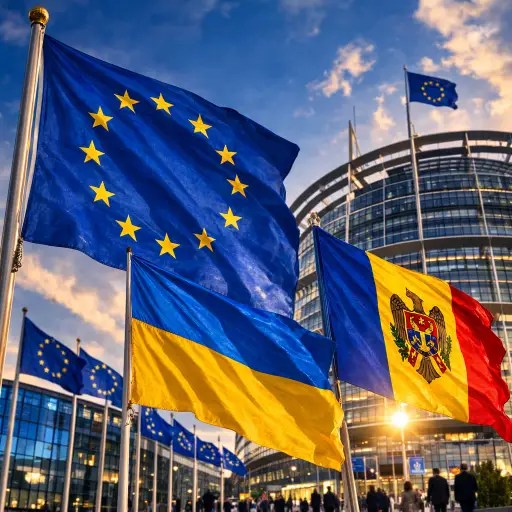
Lawmakers frame enlargement as a strategic response to security challenges in Eastern Europe
European lawmakers are intensifying calls to accelerate membership negotiations with Ukraine and Moldova, marking a new phase in the European Union’s approach to enlargement amid ongoing geopolitical tensions in Eastern Europe. Members of the European Parliament argue that bringing the two countries closer to the EU is no longer only a matter of economic integration or political reform, but a strategic necessity for the continent’s security and stability.
The push reflects a growing consensus among many European policymakers that the EU must move faster in opening negotiation chapters with Kyiv and Chisinau. Officials say that deeper integration with the two Eastern European countries would reinforce democratic institutions, strengthen regional resilience, and send a clear political signal about the EU’s long-term commitment to its eastern neighbors.
A Strategic Shift in EU Enlargement Policy
For years, enlargement policy in the European Union has often advanced cautiously, shaped by concerns over institutional capacity, political readiness, and economic convergence. However, the geopolitical landscape in Eastern Europe has reshaped the debate.
European lawmakers increasingly describe enlargement as part of the EU’s broader security strategy. In parliamentary discussions and policy briefings, officials stress that accelerating accession talks with Ukraine and Moldova would help anchor both countries firmly within Europe’s political and institutional framework.
Supporters of the initiative argue that the EU cannot afford a slow or uncertain approach at a time when regional security concerns remain high. By advancing negotiations, the EU would reinforce democratic governance in the region and demonstrate that European integration remains open to countries committed to reform and alignment with EU values.
The message from many members of the European Parliament is clear: enlargement policy must adapt to the current strategic environment.
Momentum for Opening Negotiation Chapters
At the heart of the parliamentary push is the call to open negotiation chapters more quickly. These chapters form the technical backbone of the accession process, covering areas ranging from judicial reforms and economic policy to environmental standards and competition rules.
Opening these chapters allows candidate countries to begin aligning their legislation and administrative systems with EU law. It also creates a structured pathway toward eventual membership, though the process itself can take years.
Advocates of faster progress say Ukraine and Moldova have already made significant efforts to implement reforms under challenging circumstances. Lawmakers argue that acknowledging these efforts through accelerated negotiations would help maintain reform momentum and strengthen public confidence in the European integration process.
For Ukraine in particular, the stakes are especially high. EU officials see accession talks as a way to deepen political and economic ties while supporting the country’s long-term recovery and institutional modernization.
Political Integration Moving Forward
Beyond the technical aspects of accession, the debate in Brussels also reflects a broader political vision. Many policymakers believe the EU must demonstrate that it is capable of responding decisively to major geopolitical developments.
Accelerating negotiations with Ukraine and Moldova would represent a powerful symbol of European unity and solidarity. It would also underscore the EU’s role as a political and strategic actor, rather than merely an economic bloc.
Some officials emphasize that the integration process should not be seen only as a distant goal but as an ongoing transformation. Through regulatory alignment, economic cooperation, and institutional reforms, both countries are already moving closer to the EU framework.
This gradual integration is expected to deepen cooperation in areas such as trade, infrastructure, digital policy, and energy security. For many policymakers, these steps represent tangible progress even before formal membership is achieved.
Challenges Ahead
Despite strong political support for faster negotiations, the enlargement process remains complex. Candidate countries must still meet rigorous criteria related to governance, rule of law, anti-corruption measures, and economic stability.
Some EU member states have traditionally favored a cautious approach to enlargement, emphasizing the need for thorough reforms before advancing the process. Concerns also remain about the EU’s institutional readiness to accommodate new members.
Nevertheless, the current debate suggests that many leaders believe the strategic benefits of enlargement outweigh the risks of delay.
By integrating Ukraine and Moldova more closely into the European system, the EU could strengthen stability along its eastern borders while reinforcing democratic governance across the region.
A Defining Moment for Europe
The renewed momentum around Ukraine and Moldova’s EU aspirations signals what many analysts describe as a defining moment for European policy.
If negotiations accelerate as lawmakers hope, the coming years could reshape the political map of Europe. The integration of Ukraine and Moldova would expand the EU’s influence eastward while redefining the bloc’s role in regional security.
For supporters of enlargement, the argument is straightforward: a stronger, more united Europe depends on extending the promise of integration to those countries willing to undertake the reforms necessary to join it.
As the European Parliament continues to press for faster progress, the debate over enlargement is increasingly framed not just as a bureaucratic procedure, but as a strategic decision about the future of the continent itself.



 The Tower Post