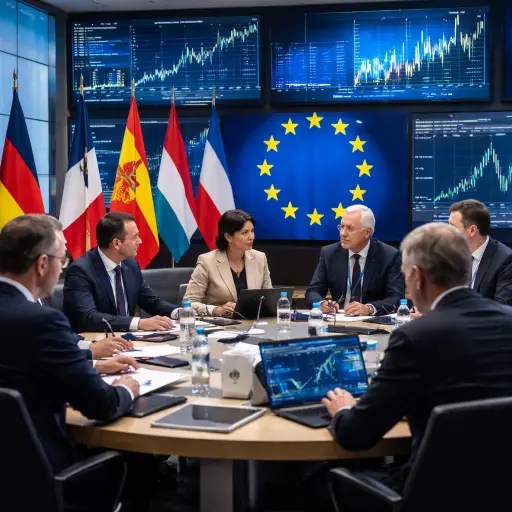
Germany, France and four other major economies champion a stronger pan-European regulator to streamline financial rules, deepen capital markets and bolster the bloc’s economic resilience.
As Europe navigates a period of economic uncertainty and intensifying global competition, several of the European Union’s largest economies are calling for a significant shift in how the region supervises its financial markets. Germany, France, Italy, Spain, the Netherlands and Poland are increasingly aligned behind a proposal to strengthen centralized oversight of EU capital markets, a move supporters say could transform Europe’s fragmented financial landscape.
The initiative reflects growing concern among policymakers that the European Union’s financial system remains too divided along national lines. Despite decades of economic integration, supervision of financial markets is still largely conducted by national regulators. Leaders in Europe’s largest economies argue that this structure complicates investment, slows cross-border financing and limits the global competitiveness of European capital markets.
By advocating stronger powers for a centralized supervisory framework, proponents believe the EU can simplify regulation, improve transparency and create a more unified financial ecosystem capable of attracting large-scale international investment.
A push for deeper capital markets
At the heart of the proposal lies a longstanding European objective: building deeper and more integrated capital markets across the union. Policymakers have argued for years that European businesses—especially innovative and fast-growing companies—often struggle to access financing compared with their counterparts in the United States.
Fragmented regulatory oversight is widely viewed as one of the key obstacles. Each EU member state maintains its own supervisory approach, licensing procedures and enforcement practices. While these frameworks follow EU-wide legislation, implementation can vary significantly from one country to another.
Supporters of centralised supervision say this complexity discourages investors from operating across multiple jurisdictions. A unified supervisory structure, they argue, could help standardize oversight and reduce administrative barriers, allowing companies and investors to navigate the European market more easily.
In practical terms, the proposal would expand the authority of EU-level regulators, enabling them to oversee certain market activities directly rather than relying solely on coordination among national authorities.
Competing on the global stage
The push for reform also reflects Europe’s desire to strengthen its position in global finance. Policymakers increasingly warn that the EU risks falling behind other major financial centres if it fails to streamline its capital markets.
The United States benefits from a highly integrated financial system, while emerging markets are rapidly expanding their investment ecosystems. European leaders worry that without deeper integration, capital and innovation could increasingly flow toward more unified financial hubs.
By creating a stronger centralized supervisory structure, EU policymakers hope to signal stability and predictability to international investors. Advocates argue that clearer rules and consistent oversight could make Europe a more attractive destination for global capital, particularly at a time when geopolitical tensions and shifting trade relationships are reshaping investment patterns.
Balancing sovereignty and efficiency
Despite growing support among major economies, the proposal faces political sensitivities. Financial regulation remains closely tied to national sovereignty, and some EU member states are cautious about transferring additional supervisory authority to the European level.
Smaller financial centres, in particular, worry that centralized oversight could reduce their influence over domestic markets or impose rules that do not fully reflect local conditions.
Proponents of reform insist that the goal is not to eliminate national regulators but to improve coordination and efficiency. Under the envisioned framework, national authorities would continue to play a critical role in monitoring markets while operating within a more unified supervisory structure.
Supporters argue that stronger EU-level oversight could also help prevent regulatory inconsistencies and reduce the risk of financial instability spreading across borders.
Strengthening economic resilience
Beyond investment and competitiveness, advocates say centralized supervision could also enhance Europe’s economic resilience. Recent crises—from the global financial downturn to energy shocks and geopolitical tensions—have highlighted how quickly financial instability can ripple across interconnected economies.
A more integrated supervisory system could allow regulators to identify systemic risks earlier and coordinate responses more effectively. By improving oversight of cross-border financial activity, EU authorities hope to strengthen the stability of the bloc’s financial system.
For Europe’s largest economies, the proposal represents part of a broader effort to reinforce the foundations of the EU’s economic architecture. Alongside banking reforms and industrial policy initiatives, deeper capital market integration is seen as a key pillar in the bloc’s long-term strategy for growth.
A pivotal moment for financial integration
As discussions continue among EU institutions and member states, the proposal has sparked renewed debate about the future of European financial governance. While significant political negotiation remains ahead, the growing alignment among the EU’s largest economies suggests momentum is building behind the idea of stronger centralized oversight.
If implemented, the reform could mark one of the most significant steps toward financial integration in the European Union in years. Supporters believe it would not only simplify regulation but also unlock investment, accelerate innovation and reinforce Europe’s role in the global financial system.
The coming months are likely to determine whether this vision gains broader support across the bloc. For now, the initiative highlights a clear message from Europe’s largest economies: deeper financial integration may be essential for the EU to remain competitive and resilient in an increasingly complex global economy.


 The Tower Post