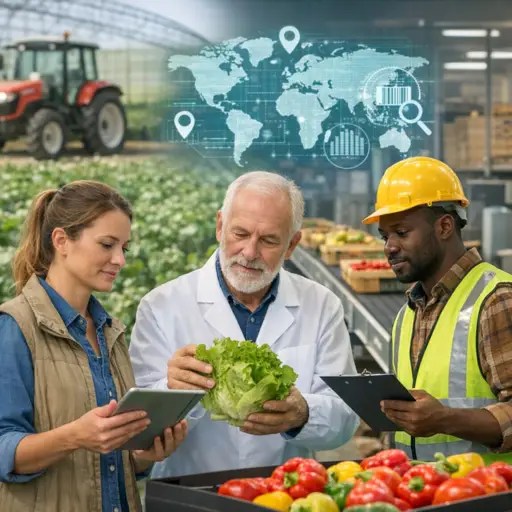
International network links scientists, governments, and industry to track food losses, modernize supply chains, and strengthen global food security.
A new wave of international cooperation is emerging in the fight against one of the world’s most persistent sustainability challenges: food waste. Researchers across Europe are now spearheading a global scientific network designed to reduce food losses throughout the entire agro-food chain—from farms and processing facilities to supermarkets and households.
The initiative brings together scientists, policymakers, agricultural producers, and technology developers from multiple regions, aiming to build a coordinated system capable of identifying, tracking, and ultimately preventing waste at every stage of the food system. Experts involved in the collaboration say the project represents a significant step toward tackling both environmental pressures and growing concerns about global food security.
Food waste has become one of the defining inefficiencies of modern food systems. Vast quantities of crops are lost during harvesting, storage, transportation, and retail, while significant amounts are discarded by consumers. Researchers say that addressing these losses could dramatically improve the efficiency of food production without increasing pressure on land, water, or energy resources.
The newly established network is designed to act as a platform for scientific exchange and technological development. Universities, agricultural research institutes, and policy organizations are working together to develop practical tools that farmers, distributors, and retailers can use to monitor food losses more accurately.
One of the core pillars of the project is the development of digital tracking systems capable of mapping the movement of food across supply chains. By integrating sensors, logistics data, and digital reporting platforms, researchers hope to identify precisely where losses occur and how they can be prevented.
“Without reliable data, it is extremely difficult to design effective solutions,” explained one agricultural systems analyst involved in the initiative. “Digital tracking allows us to see where food is being lost, whether during harvesting, storage, transportation, or retail distribution. Once we understand the problem in detail, we can begin to fix it.”
Technology is expected to play a central role in the network’s strategy. Researchers are experimenting with tools such as smart packaging that monitors product freshness, AI-driven logistics systems that optimize delivery routes, and predictive analytics that help retailers manage inventory more efficiently. These innovations aim to prevent products from expiring before they reach consumers.
Beyond technological development, the project also focuses on improving coordination across the food supply chain. In many regions, communication gaps between farmers, distributors, processors, and retailers contribute to unnecessary waste. When production levels and market demand are poorly aligned, surplus products often go unused.
To address this challenge, the international network encourages the creation of shared data platforms where producers and distributors can exchange real-time information about crop volumes, market needs, and storage capacity. Researchers believe that improved transparency could significantly reduce losses caused by oversupply or logistical bottlenecks.
Agricultural innovation is another major focus of the initiative. Scientists are exploring new harvesting techniques, climate-resilient crop varieties, and improved storage technologies that can extend the shelf life of fresh produce. Cold-chain improvements, in particular, are seen as a key factor in reducing spoilage during transportation.
In parallel, policymakers participating in the collaboration are examining regulatory frameworks that could encourage waste reduction. Governments are increasingly considering incentives for companies that adopt waste-monitoring technologies or donate surplus food to redistribution programs.
Some experts argue that reducing food waste may represent one of the fastest and most cost-effective ways to improve global food availability. Instead of expanding farmland or intensifying production, which can place additional strain on ecosystems, minimizing losses could allow existing food systems to feed more people with fewer resources.
Environmental benefits are also central to the project’s goals. Food that is produced but never consumed still carries a substantial environmental footprint, including greenhouse gas emissions, water use, and land degradation. By preventing waste, researchers say the global food system could significantly lower its environmental impact.
The international character of the initiative is considered one of its most important strengths. Food supply chains frequently cross national borders, meaning that solutions must operate across different regulatory environments, agricultural practices, and economic systems.
By connecting research centers from Europe with partners in other regions, the network aims to share knowledge and develop adaptable solutions that can work in both industrialized and developing food systems.
“The problem of food waste is global, and the solutions must be global as well,” noted one policy advisor involved in the discussions. “Collaboration allows us to learn from each other’s experiences and scale up innovations more quickly.”
The network is also expected to support training programs for young researchers and agricultural professionals. Workshops, collaborative research projects, and technology demonstrations are planned to help transfer knowledge from laboratories into real-world farming and distribution systems.
Industry partners have shown increasing interest in the initiative as well. Food retailers and logistics companies are exploring how new monitoring technologies could reduce operational costs while improving sustainability credentials. For many businesses, minimizing waste is becoming both an economic and environmental priority.
Although the project is still in its early stages, researchers involved say momentum is building quickly. With climate pressures intensifying and global food demand continuing to rise, reducing waste has become a central element of international food policy discussions.
Experts emphasize that solving the problem will require coordinated action across science, technology, policy, and consumer behavior. However, the emerging international network represents a promising framework for bringing these different actors together.
If successful, the collaboration could reshape how food systems operate worldwide—transforming inefficiencies into opportunities for innovation while helping ensure that more of the food produced each year actually reaches the people who need it.
In a world facing growing environmental challenges and rising food demand, reducing waste may prove to be one of the most powerful tools available for building a more resilient and sustainable global food system.


 The Tower Post