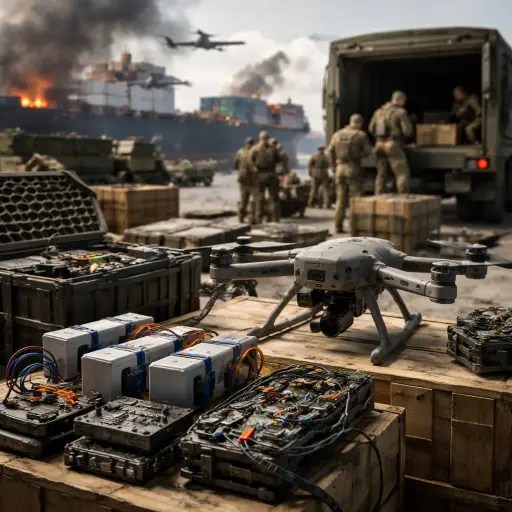
Escalating tensions in the Middle East ripple through global logistics networks, squeezing the flow of drone technology and batteries vital to Kyiv’s battlefield operations.
As conflict intensifies around Iran and across parts of the Middle East, a new pressure point has emerged far from the region itself: Ukraine’s war supply lines. Military analysts and logistics specialists say the widening crisis is beginning to disrupt global transport routes and industrial supply chains that Ukraine relies on for critical battlefield equipment, particularly drones and the batteries that power them.
The overlap of two conflicts—one in Eastern Europe and another spanning the Middle East—has created a complicated web of logistical bottlenecks. From shipping lanes and air cargo routes to specialized electronics manufacturing, the ripple effects are increasingly visible in the supply pipelines supporting Ukraine’s defense effort.
For Kyiv, whose military has become deeply reliant on unmanned aerial systems for reconnaissance, targeting, and strike missions, even small disruptions in the supply of electronic components can have outsized operational consequences.
Global Routes Under Pressure
Much of the strain originates in the global logistics network that links Asian manufacturers, Middle Eastern transit corridors, and European distribution hubs. As tensions involving Iran expand across the region, insurance costs for cargo vessels have surged and some commercial carriers have altered or suspended routes through sensitive waterways.
Shipping companies are increasingly diverting traffic away from areas considered high risk, forcing goods onto longer and more expensive routes. Air cargo, often used for higher-value electronics and military-relevant components, is also facing congestion as airlines adjust flight paths to avoid unstable airspace.
These disruptions are not limited to weapons shipments. Many of the items used on the battlefield—such as lithium battery cells, sensors, microcontrollers, and communication modules—originate in civilian supply chains that stretch across several continents.
When those commercial routes tighten, the impact eventually reaches the front line.
Drone Warfare’s Fragile Backbone
Drones have become central to Ukraine’s military strategy. Small reconnaissance quadcopters guide artillery fire, long-range drones strike deep behind enemy lines, and modified commercial platforms provide surveillance along hundreds of kilometers of front.
But the systems themselves are only part of the equation. Each drone requires a complex ecosystem of spare parts, batteries, chargers, cameras, and radio components.
Batteries, in particular, are proving to be a weak link.
High-performance lithium cells used in drones are typically produced by a handful of specialized manufacturers in East Asia. From there they move through international freight networks before reaching assembly facilities or logistics depots that supply Ukrainian units.
Analysts say delays in these shipments are already being reported by organizations involved in drone procurement and distribution.
“Drones are relatively cheap compared to traditional weapons, but their supply chain is surprisingly delicate,” said one European defense logistics researcher. “You can have thousands of airframes ready, but if batteries or control modules are delayed, operational capacity drops quickly.”
A Collision of Two War Economies
The emerging disruptions illustrate how modern conflicts increasingly intersect through globalized production networks.
The war in Ukraine already transformed international defense supply chains, accelerating drone development and creating massive demand for electronics and industrial materials. At the same time, escalating tensions involving Iran are drawing resources and security attention into another strategically vital region.
Some analysts believe the two crises may begin competing indirectly for transport capacity, intelligence focus, and industrial output.
Cargo space on certain air routes, for instance, has become more limited as governments and private contractors move equipment linked to Middle Eastern security operations. That competition for transport bandwidth can slow the delivery of goods headed toward Europe.
Insurance premiums and security measures for ships operating near contested maritime chokepoints have also risen sharply, increasing costs for companies shipping electronics components that ultimately feed into military supply chains.
Europe Watches the Supply Pipeline
European governments supporting Ukraine are closely monitoring these developments. Many of the final assembly and distribution points for drone equipment are located in European countries, where volunteer networks, defense contractors, and government programs channel equipment toward Ukrainian units.
Officials fear that sustained logistical friction could complicate long-term military assistance if alternative routes are not secured.
Several governments are reportedly exploring ways to diversify component sourcing, expand domestic manufacturing, and build strategic reserves of key drone parts.
However, creating new industrial capacity takes time—something that wartime demand rarely allows.
Strategic Implications for Kyiv
For Ukraine, maintaining a steady flow of drone technology has become almost as important as traditional weapons deliveries.
Unmanned systems provide constant surveillance across the battlefield and allow Ukrainian forces to offset disadvantages in artillery and manpower. They also enable long-distance strikes on logistics infrastructure, ammunition depots, and fuel storage far behind enemy lines.
A slowdown in drone component deliveries would not stop those operations entirely, but it could reduce their intensity and frequency.
Military planners in Kyiv have increasingly emphasized redundancy—stockpiling spare parts and expanding domestic drone production—to guard against such disruptions. Still, many of the most critical components remain tied to international supply networks.
A New Layer of Geopolitical Risk
The convergence of two wars in different regions underscores how interconnected modern conflicts have become.
Unlike earlier eras when military supply lines were largely national or regional, today’s battlefield technology depends heavily on commercial electronics industries and global transport systems. That makes military operations vulnerable not only to enemy action but also to geopolitical shocks far beyond the front.
If instability around Iran continues to strain shipping lanes and logistics corridors, analysts warn that the indirect consequences could ripple into multiple conflicts simultaneously.
For Ukraine, the lesson may be clear: securing supply lines is no longer only about weapons deliveries. It also means protecting the fragile global network that provides the tiny electronic components powering the war’s most widely used technology.
And as overlapping crises reshape those networks, the struggle to keep drones in the air may become an increasingly strategic challenge.




 The Tower Post