
European Parliament signals mounting frustration with political developments in Georgia as rights and rule-of-law issues dominate the debate
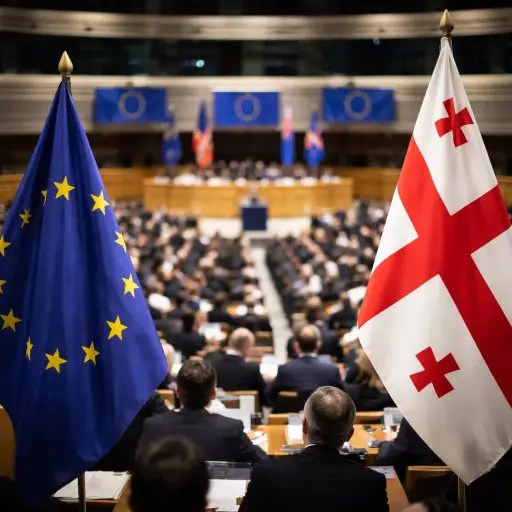
As concerns about democratic standards deepen across parts of Eastern Europe, members of the European Parliament are calling for targeted sanctions against officials linked to Georgia’s ruling political establishment. The move reflects growing unease within European institutions over what lawmakers describe as a pattern of democratic backsliding and mounting pressure on civil society in the South Caucasus country.
In a resolution adopted by a strong majority of lawmakers, the European Parliament urged European Union institutions and member states to consider restrictive measures against individuals believed to be responsible for undermining democratic governance and human-rights protections in Georgia. The resolution focuses particularly on officials associated with the governing elite and individuals perceived to wield significant influence over political decision-making.
The vote marks one of the most forceful signals yet from Brussels that patience within the EU is wearing thin.
Rising Concerns in Brussels
For several years, Georgia has been viewed by the European Union as a key partner in the Eastern Partnership framework, a program aimed at fostering closer economic and political ties with neighboring countries. The country has often presented itself as a pro-European democracy seeking deeper integration with Western institutions.
Yet recent political developments have led many EU lawmakers to question whether Georgia is moving away from the democratic standards expected of a country aspiring to closer ties with the bloc.
Members of Parliament behind the resolution argue that a combination of political polarization, perceived pressure on independent institutions, and concerns about media freedom have created an environment that threatens the rule of law. In their view, these developments undermine the democratic commitments that Georgia has repeatedly pledged to uphold in its relations with the European Union.
European lawmakers stressed that the proposed sanctions would not target Georgia as a country or its population. Instead, they would be directed at individuals believed to be responsible for decisions that weaken democratic institutions or restrict fundamental freedoms.
The goal, supporters say, is accountability rather than punishment.
Focus on Targeted Measures
The resolution calls for the European Union to explore targeted sanctions such as travel bans and asset freezes against specific members of Georgia’s ruling elite and associated figures. Such measures, commonly used by the EU in response to human-rights violations, aim to pressure political actors without affecting broader economic relations or the well-being of ordinary citizens.
Supporters of the proposal argue that this approach allows the EU to defend democratic principles while maintaining its long-term partnership with the Georgian people.
Several lawmakers emphasized that the EU must demonstrate consistency in defending democratic values across its neighborhood. They warned that failing to respond decisively could weaken the credibility of the EU’s external policies, particularly in countries seeking deeper integration with Europe.
At the same time, many members of Parliament highlighted that sanctions would represent a last resort rather than an immediate policy shift. Any final decision on restrictive measures would ultimately rest with EU member states and the Council of the European Union.
Still, the parliamentary vote sends a clear political message.
Human-Rights Concerns at the Center
Human-rights organizations have also raised alarms about developments in Georgia. International watchdog groups have pointed to issues ranging from alleged intimidation of activists to legal initiatives that critics say could restrict the activities of independent organizations and media outlets.
These concerns formed a central part of the parliamentary debate.
Lawmakers backing the resolution argued that the European Union cannot ignore developments that appear to challenge democratic norms. They noted that respect for human rights, judicial independence, and political pluralism are core conditions for countries seeking closer alignment with the EU.
Several members of Parliament described the situation as a critical moment for Georgia’s democratic trajectory. According to them, the country now faces a choice between strengthening democratic institutions or drifting toward a more centralized political system.
Georgian Government Rejects Criticism
Officials in Georgia’s government have strongly rejected the accusations raised in the European Parliament. Representatives of the ruling political leadership insist that the country remains committed to democratic reforms and European integration.
Government figures argue that the criticism coming from Brussels reflects political misunderstandings rather than factual evidence of democratic decline. They have also accused certain European lawmakers of relying on incomplete information or politically motivated sources.
According to the Georgian leadership, recent legislative initiatives and political decisions are part of broader efforts to ensure stability and transparency within the country’s political system.
Despite these assurances, skepticism remains among many EU lawmakers.
Strategic Importance of Georgia
The political debate carries significance beyond the immediate dispute between Brussels and Tbilisi. Georgia occupies a strategically important position in the South Caucasus, a region that sits at the crossroads of Europe, Asia, and the Middle East.
The country has long been viewed as a potential democratic anchor in a region marked by geopolitical competition and complex security challenges. Its aspirations for closer ties with European institutions have made it a focal point of EU foreign policy in the neighborhood.
Because of this strategic importance, many European policymakers remain cautious about taking steps that could alienate Georgian society or weaken the country’s pro-European orientation.
This delicate balance explains why the European Parliament’s resolution emphasizes targeted sanctions rather than broader punitive measures.
A Signal of EU Frustration
Observers say the parliamentary vote reflects a broader shift in tone within the European Union. While Brussels has traditionally sought to encourage reforms in partner countries through dialogue and cooperation, patience appears to be wearing thin when democratic commitments appear to falter.
The resolution illustrates growing frustration among European lawmakers who believe stronger tools may be necessary to defend democratic norms in countries seeking closer integration with the EU.
At the same time, many members of Parliament stressed that the European Union’s ultimate objective remains constructive engagement with Georgia.
They argue that the door to cooperation remains open—provided that democratic standards are respected and meaningful reforms continue.
Uncertain Next Steps
The European Parliament’s resolution does not automatically trigger sanctions. Instead, it serves as a political recommendation to EU governments and institutions responsible for foreign policy decisions.
Whether targeted sanctions will ultimately be imposed depends on discussions among EU member states, where consensus is required for such measures.
For now, the resolution stands as a warning signal from Brussels.
It underscores the message that democratic standards remain central to the European Union’s relationships with its partners—and that concerns about human rights and the rule of law can have tangible political consequences.
As debates continue in both Brussels and Tbilisi, the future of Georgia’s relationship with the European Union may increasingly depend on how these concerns are addressed in the months ahead.




 The Tower Post