
Former Italian prime minister says the European Union must accelerate innovation, investment, and structural reforms or risk falling behind global rivals.
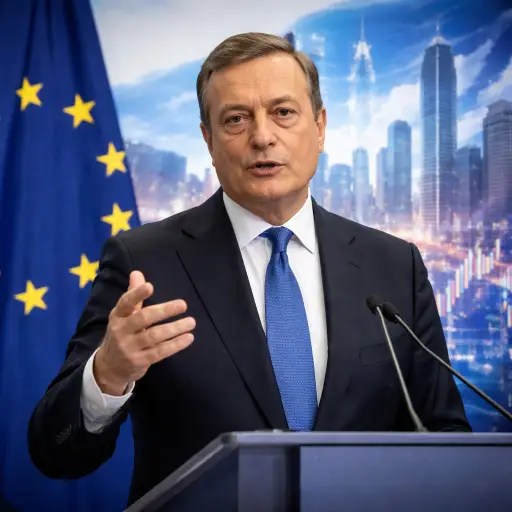
Europe is entering a decisive moment in its economic trajectory. As global competition intensifies and technological change reshapes industries at unprecedented speed, former Italian prime minister Mario Draghi has delivered a stark warning: the European Union cannot afford complacency if it wants to remain a major economic force.
Speaking with increasing urgency to policymakers and business leaders, Draghi argued that Europe’s economic model—long admired for its stability, social protections, and regulatory standards—is under pressure from faster-moving rivals. In particular, he highlighted the widening gap between Europe and the United States and China in areas such as technological innovation, industrial investment, and strategic economic policy.
According to Draghi, the challenge is not simply about growth rates or market share. It is about whether Europe can adapt quickly enough to a world in which technological leadership, supply-chain resilience, and industrial capacity increasingly determine geopolitical influence.
“Europe must move from complacency to action,” he warned, emphasizing that the continent risks losing competitiveness unless it undertakes deeper structural changes.
A Competitive Landscape Redefined
The global economy is evolving rapidly. The United States has launched major programs to support advanced manufacturing, clean energy, and semiconductor production. China continues expanding its industrial capacity while pursuing technological self-sufficiency in critical sectors.
Against this backdrop, Europe’s economic approach—traditionally built on open markets, coordinated regulation, and fiscal discipline—faces growing scrutiny.
Draghi noted that while the European Union remains one of the world’s largest economic blocs, it often struggles to translate its scale into strategic advantage. Fragmented capital markets, slower policy coordination, and uneven investment levels across member states have limited the bloc’s ability to respond quickly to global shifts.
The result is an increasing concern among policymakers that Europe could become a follower rather than a leader in several key industries, including artificial intelligence, advanced manufacturing, and next-generation energy technologies.
Innovation at the Heart of the Challenge
Central to Draghi’s warning is the issue of innovation. Europe continues to produce world-class research and highly skilled talent, yet it has often struggled to transform scientific breakthroughs into globally dominant companies.
Many of the world’s largest technology firms are headquartered in the United States or China. European startups, while dynamic, frequently face difficulties scaling up due to fragmented venture capital markets, regulatory complexity, and limited access to large pools of risk capital.
Draghi has argued that addressing this structural gap will require coordinated investment in innovation ecosystems, deeper financial integration, and stronger support for high-growth companies.
Without these changes, Europe risks falling behind in the industries that will define the next generation of economic leadership.
Investment and Industrial Strategy
Another key element of Draghi’s message concerns investment. For many years, European economic policy emphasized fiscal stability and budget discipline—principles that helped maintain financial confidence during periods of crisis.
However, the global environment has shifted toward more assertive industrial strategies. Governments in major economies are investing heavily in strategic sectors such as semiconductors, renewable energy technologies, digital infrastructure, and advanced manufacturing.
Draghi believes Europe must respond with comparable ambition.
He has called for large-scale initiatives capable of mobilizing both public and private capital, particularly in areas linked to the green transition and digital transformation. Strengthening cross-border infrastructure and improving financing conditions for innovative firms are also central to this vision.
The objective, he suggests, is not to abandon Europe’s economic model but to modernize it so that it can compete effectively in a rapidly changing global system.
Policy Reform and Economic Integration
Beyond innovation and investment, Draghi has emphasized the importance of deeper policy reforms within the European Union.
One long-standing issue is the fragmentation of financial markets across member states. Although Europe operates a single market and many countries share a common currency, capital markets remain largely national in structure.
This fragmentation limits investment flows and reduces the scale of financing available for ambitious technological and industrial projects.
Completing the European capital markets union—an initiative discussed for years but only partially implemented—could unlock substantial economic potential by directing savings toward innovation, entrepreneurship, and infrastructure.
Draghi has also suggested that regulatory frameworks should evolve to encourage entrepreneurship while preserving Europe’s commitment to strong consumer protections, fair competition, and environmental sustainability.
Growing Awareness Among Leaders
Despite the challenges, Draghi expressed cautious optimism about Europe’s direction.
In recent discussions among European policymakers, there is increasing recognition that the global economic balance is shifting. Maintaining competitiveness will require not only cooperation among member states but also faster decision-making and more strategic investment.
The urgency of structural reform—once largely confined to academic and policy debates—is now moving toward the center of political discussion.
For Draghi, this change in mindset represents an important step toward action.
Europe’s Strategic Moment
Europe possesses powerful advantages: a highly educated workforce, strong industrial traditions, leading research institutions, and one of the world’s largest integrated markets.
Yet those strengths must be matched with greater dynamism if Europe is to compete successfully with other global powers.
Draghi’s message is ultimately a call for strategic renewal. The European Union does not lack capacity or talent—but unlocking that potential will require decisive reforms, sustained investment, and a renewed commitment to innovation.
The choice facing Europe is increasingly clear: remain cautious and risk gradual economic marginalization, or embrace structural change and reaffirm its place at the forefront of the global economy.



 The Tower Post