
European Commission approves latest disbursement as Berlin advances modernization, digitalization, and green transition projects under the bloc’s post-pandemic recovery plan.
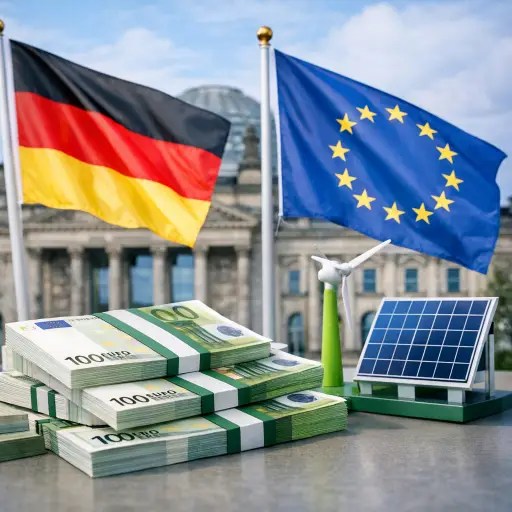
Germany has received a €4.6 billion payment from the European Union as part of the bloc’s post-pandemic recovery initiative, marking another step in the implementation of Europe’s ambitious economic rebuilding program. The latest disbursement follows the approval of Germany’s third payment request under the Recovery and Resilience Facility, the centerpiece financial instrument created by the EU to support member states in strengthening their economies after the global health crisis.
The European Commission confirmed that Germany had met a series of agreed milestones and reform commitments tied to the funding. These benchmarks include measures designed to accelerate the country’s energy transition, expand digital infrastructure, and modernize public administration. With the approval, the funds are now set to flow into projects aimed at reshaping the German economy for a more sustainable and technologically advanced future.
The Recovery and Resilience Facility was created as part of the European Union’s broader economic recovery strategy, a historic financial package designed to help member states overcome the long-term effects of the pandemic while preparing their economies for future challenges. Germany’s latest payment underscores the continued implementation of that program across the bloc and highlights the EU’s role in coordinating large-scale investment and reform.
Much of the newly released funding will support Germany’s green transformation. Authorities in Berlin plan to channel a significant portion of the money into renewable energy development, sustainable mobility initiatives, and energy-efficient infrastructure. These investments are expected to contribute to the EU’s broader climate targets, including the transition toward a low-carbon economy and reduced dependence on fossil fuels.
Germany’s recovery plan also places strong emphasis on digital modernization. The funds will help expand high-speed broadband access, improve digital services within government institutions, and support innovation within key industrial sectors. Officials argue that strengthening digital capacity is essential for maintaining Europe’s competitiveness in a rapidly evolving global economy.
The European Commission has stressed that payments from the recovery fund are performance-based, meaning that countries must demonstrate progress on specific reforms and investment targets before funds are released. Germany’s approval reflects the Commission’s assessment that the country has successfully completed the required steps for this stage of the program.
European officials have repeatedly described the Recovery and Resilience Facility as one of the most significant economic initiatives ever undertaken by the EU. The mechanism not only provides financial assistance but also encourages structural reforms designed to make national economies more resilient, sustainable, and innovative over the long term.
For Germany, the funding comes at a time when the country is navigating economic uncertainty linked to energy transitions, technological change, and global competition. Investments supported by the recovery program are expected to stimulate growth while helping industries adapt to new environmental and digital standards.
Analysts note that the latest payment also carries symbolic importance. As the EU’s largest economy, Germany’s participation in the recovery program demonstrates the collective nature of the initiative, reinforcing the principle that economic resilience within the union depends on coordinated investment and shared policy objectives.
Looking ahead, additional funding tranches may follow as Germany continues to implement the reforms and investment projects outlined in its national recovery plan. Each disbursement will depend on further progress toward agreed targets, ensuring that financial support remains closely tied to measurable economic transformation.
Across Europe, the recovery fund continues to play a central role in shaping the post-pandemic economic landscape. By linking financial assistance with modernization goals, the European Union aims not only to rebuild but also to redefine the foundations of growth within the bloc.
Germany’s latest payment therefore represents more than a financial transfer. It reflects a broader strategy to strengthen Europe’s economic resilience, accelerate the green transition, and equip member states with the tools needed to compete in a changing global environment.




 The Tower Post