Attack on civilian transport highlights growing danger in eastern Ukraine as Russian forces intensify efforts to reclaim territory in the Kharkiv region
A Russian missile strike on a civilian bus route near the eastern Ukrainian city of Kupiansk has left several people dead, underscoring the increasingly precarious conditions faced by residents living near the front line.
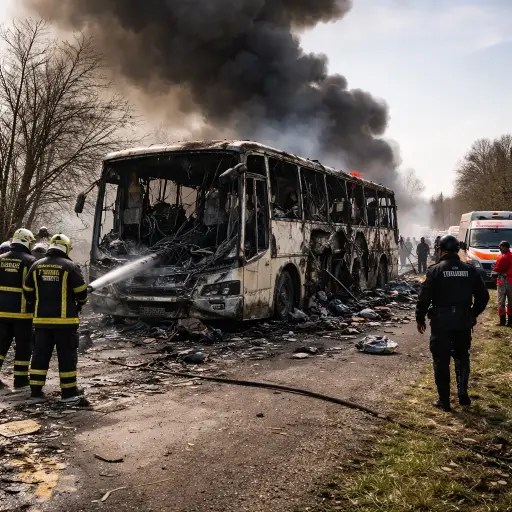
Local authorities reported that the missile hit a passenger bus traveling along a road frequently used by civilians moving between villages close to the contested area. Three people were killed in the attack, including the bus driver. Emergency crews arriving at the scene found the vehicle severely damaged, with debris scattered along the roadside and nearby fields.
Investigators said the strike occurred in an area located only a short distance from active combat zones, where Ukrainian and Russian forces continue to clash for control of territory in the Kharkiv region. Officials believe the bus was carrying civilians attempting to travel between settlements that remain partially inhabited despite the proximity of the fighting.
The incident has drawn renewed attention to the risks faced by civilians who continue to live and travel in communities near the front. Roads that once served routine transportation now pass through areas regularly exposed to artillery fire, drone surveillance, and missile attacks.
Kupiansk has long held strategic importance in the conflict. The city lies along key rail and road networks that connect several areas of northeastern Ukraine. Control of the region has shifted during the course of the war, and in recent months Russian forces have intensified efforts aimed at regaining ground around the city and nearby villages.
Military analysts say the surrounding countryside has effectively become a fluid front line, with Ukrainian defensive positions stretching across farmland, wooded areas, and small rural settlements. In such conditions, civilian infrastructure often sits dangerously close to military activity.
According to Ukrainian investigators, the missile struck the bus while it was traveling along a route commonly used by residents for essential journeys such as buying food, visiting relatives, or reaching medical facilities. Authorities noted that many villages in the region have limited transportation options, leaving residents dependent on a small number of buses or private vehicles to move between towns.
Witnesses described a powerful explosion followed by rising smoke visible from nearby homes. Residents who rushed toward the scene said the bus had been severely damaged by the blast, with shattered windows and fragments of metal scattered across the road.
Emergency responders worked quickly to secure the area and assist survivors. Local police and rescue teams began documenting the site soon after the attack, collecting fragments and examining the impact zone as part of a criminal investigation.
Ukrainian officials have repeatedly warned that attacks on civilian infrastructure near front-line areas remain a persistent danger. While some villages have been evacuated, thousands of people still live in communities across the Kharkiv region where fighting can erupt with little warning.
Regional authorities have continued to urge residents in the most exposed areas to leave while evacuation routes remain open. However, many people remain reluctant to abandon homes, farms, and family property that have been passed down through generations.
The strike near Kupiansk also comes amid reports of increased military activity along this section of the front. Ukrainian defense officials say Russian forces have stepped up assaults aimed at pushing closer to the city and disrupting Ukrainian supply routes.
Such operations often involve a combination of artillery bombardment, missile strikes, and reconnaissance drones used to identify potential targets. In heavily contested regions, the presence of civilian vehicles and infrastructure can complicate the battlefield environment.
Human rights observers have repeatedly emphasized the importance of protecting civilians during armed conflict, particularly in areas where military and civilian activity intersect. Investigators in Ukraine have opened numerous cases related to attacks that occurred near residential zones, roads, or public transportation routes.
For communities near Kupiansk, the attack serves as another stark reminder of the fragile line separating daily life from the dangers of war. Even routine travel between neighboring villages can become perilous when the front line lies only a few kilometers away.
As emergency teams cleared the damaged bus and investigators continued examining the site, the road where the strike occurred remained quiet, bordered by fields that have witnessed repeated waves of fighting since the conflict expanded across the region.
For the families of those killed, the tragedy represents yet another loss in a war that has already reshaped countless lives across eastern Ukraine. And for residents who remain in the region, the attack reinforces the uncertainty that now accompanies even the most ordinary journeys.



 The Tower Post