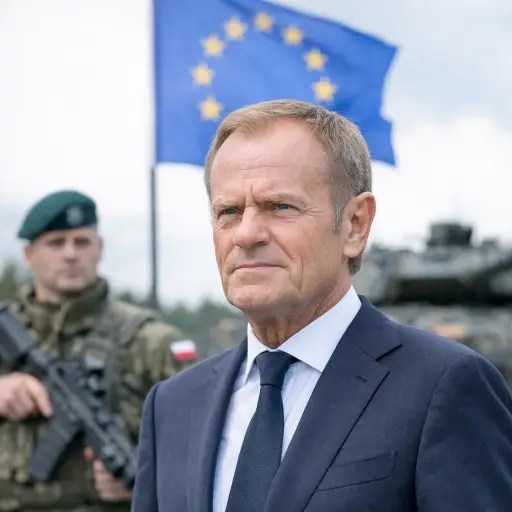
Poland’s government accelerates military investment and deepens cooperation with the European Union as regional security concerns reshape national priorities.
Polish Prime Minister Donald Tusk has signaled that his government will press ahead with plans to access European Union defense funding, even as political resistance emerges from the country’s presidency. The move highlights Warsaw’s determination to strengthen its military capabilities and underscores the growing sense of urgency across Europe over security on the continent’s eastern flank.
Speaking after consultations with cabinet members and defense officials, Tusk made clear that Poland cannot afford delays when it comes to strengthening its armed forces. The government intends to move forward with mechanisms that would allow the country to benefit from EU-backed loans designed to support defense investment and military modernization.
The decision comes amid heightened geopolitical tensions in the region and reflects a broader shift in European policy thinking. As concerns about long-term security persist, many EU members have begun exploring new financial instruments aimed at boosting defense readiness. For Poland, which sits on NATO’s eastern frontier, the stakes are particularly high.
A Strategic Priority for Warsaw
Poland has been among the most vocal European countries calling for stronger collective defense measures. The government in Warsaw has consistently argued that European security cannot rely solely on existing structures and must be reinforced through both national spending and cooperative frameworks with EU partners.
Tusk’s administration has placed defense at the center of its strategic agenda. Officials have emphasized that military investment is no longer simply a budgetary issue but a core national priority tied directly to regional stability.
In practical terms, this approach involves expanding Poland’s military capabilities through the acquisition of new equipment, improvements in logistics infrastructure, and modernization of command systems. The government is also prioritizing investments in air defense, armored units, and advanced technologies designed to enhance operational readiness.
EU-backed loans are viewed by the government as a crucial tool in supporting these ambitions. By tapping into European funding mechanisms, Warsaw aims to accelerate procurement programs and reduce the financial burden on domestic budgets.
Presidential Resistance
Despite the government’s push, the initiative has encountered political friction at home. Poland’s president has expressed reservations about the framework under which the EU defense loans would be implemented, raising concerns about sovereignty and the role of European institutions in national defense policy.
The presidential veto represents a significant institutional hurdle in Poland’s political system. However, Tusk’s government appears determined to navigate around the impasse through alternative legislative routes or negotiations aimed at securing broader parliamentary backing.
Government officials argue that the urgency of the security situation leaves little room for political deadlock. According to senior figures within the administration, the objective is to ensure that Poland remains fully prepared to respond to evolving threats while continuing to play a leading role in European defense initiatives.
The dispute has also revealed deeper political divisions within Poland’s leadership. While the presidency emphasizes caution regarding EU-level financial mechanisms, the government argues that closer European cooperation is essential for long-term stability.
Europe’s Defense Debate
The Polish debate reflects a broader conversation unfolding across the European Union. In recent years, EU leaders have increasingly discussed the need to strengthen the bloc’s defense capabilities and reduce dependence on external partners.
The proposed defense financing mechanisms are part of that wider effort. By enabling member states to access favorable loans for military investments, the EU hopes to encourage coordinated spending and improve the overall resilience of European defense systems.
For Poland, participation in such initiatives carries both practical and symbolic significance. The country has long positioned itself as a key contributor to NATO’s eastern defenses and a strong advocate for increased military preparedness within Europe.
Analysts say Warsaw’s support for EU defense loans could also influence the broader direction of European policy. As one of the EU’s largest countries and among its most defense-focused members, Poland’s decisions often carry weight in shaping regional strategies.
Military Expansion Accelerates
Beyond the political debate, Poland’s military expansion is already well underway. The government has launched multiple procurement programs aimed at upgrading the armed forces and strengthening the country’s deterrence capabilities.
These initiatives include investments in advanced fighter aircraft, missile defense systems, and modern armored vehicles. Poland has also expanded its troop numbers and increased training exercises in coordination with NATO allies.
Defense officials argue that the modernization program is designed not only to enhance Poland’s security but also to contribute to the broader stability of the region. By building a stronger military, Warsaw hopes to reinforce the security architecture of Central and Eastern Europe.
The use of EU financing mechanisms could allow these projects to progress more rapidly. According to government sources, access to additional funding would make it easier to scale up procurement and accelerate infrastructure development tied to military readiness.
Balancing Politics and Security
The confrontation between Poland’s government and presidency highlights the complex relationship between domestic politics and national security planning. While disagreements over funding mechanisms and institutional authority are not unusual, the current debate unfolds against a backdrop of heightened geopolitical tension.
For Tusk, the challenge lies in maintaining momentum for defense reform while navigating Poland’s political landscape. The prime minister has repeatedly emphasized that the country must remain focused on strengthening its security posture regardless of internal disagreements.
Observers note that Poland’s strategic position on Europe’s eastern edge places unique pressure on its policymakers. Decisions about defense spending and international cooperation are often viewed not only through the lens of domestic politics but also through the broader context of regional stability.
Looking Ahead
As discussions continue in Warsaw, the outcome of the dispute over EU defense loans could shape Poland’s military strategy for years to come. If the government succeeds in securing access to European funding, the country may be able to accelerate its ambitious modernization plans.
At the same time, the debate underscores a broader transformation in Europe’s approach to security. Governments across the continent are reconsidering how defense should be financed, organized, and coordinated in an increasingly uncertain geopolitical environment.
For Poland, the message from the government is clear: strengthening the nation’s defenses remains an urgent priority. Whether through domestic funding, European cooperation, or a combination of both, Warsaw appears determined to ensure that its armed forces remain prepared for the challenges ahead.
In pressing forward despite political obstacles, Tusk’s administration is signaling that security considerations will remain at the forefront of Poland’s policy agenda and could influence the evolving debate over Europe’s collective defense future.



 The Tower Post