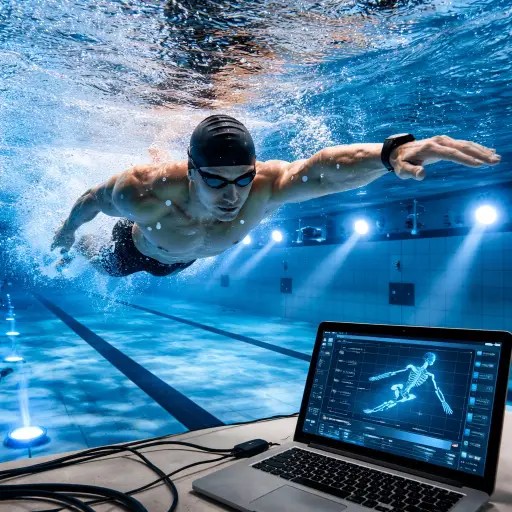
European sports laboratories are using underwater artificial intelligence motion tracking to analyze the smallest movements of elite swimmers—research that could lead to the most efficient training methods and the fastest performances ever seen in the pool.
In a quiet aquatic laboratory in Europe, Olympic swimmers glide through crystal-clear water while dozens of cameras track every movement of their bodies. To the naked eye, the swimmers appear flawless—powerful strokes, streamlined turns, and effortless speed. But to the artificial intelligence systems monitoring them beneath the surface, every motion tells a deeper story.
Sports scientists across several European research centers are now studying elite swimmers with advanced underwater AI motion-tracking technology. The goal is simple but ambitious: understand exactly how the world’s fastest athletes move through water, down to the smallest detail, and translate that knowledge into “super-efficient” training methods that could redefine competitive swimming.
The research focuses on biomechanics—the physics of how bodies move. In swimming, efficiency is everything. Water is far denser than air, meaning even tiny inefficiencies in movement can slow an athlete significantly. A slightly misplaced hand, a poorly angled kick, or an unnecessary ripple of the torso can create drag that costs precious milliseconds.
Those milliseconds, scientists say, can mean the difference between a world record and a missed podium.
To uncover these details, researchers have installed sophisticated underwater camera arrays inside specialized pools. These systems capture swimmers from multiple angles simultaneously, recording thousands of data points per second. The footage is then processed by artificial intelligence algorithms capable of reconstructing the swimmer’s body in three dimensions.
The result is a digital twin of the athlete moving through virtual water.
With this model, researchers can analyze movements that are impossible to study with the human eye alone. AI can measure the exact angle of a swimmer’s wrist as it enters the water, the subtle rotation of the hips during a freestyle stroke, or the timing difference between the left and right leg during a dolphin kick.
Researchers say that elite swimmers are not just powerful—they are extraordinarily precise. The best athletes minimize wasted motion in ways that are incredibly subtle.
One major focus of the research is drag reduction. In swimming, drag acts like a constant invisible brake, resisting forward motion. Scientists believe that even microscopic changes in body alignment can dramatically affect how water flows around the swimmer.
By analyzing elite athletes, researchers are identifying patterns that reduce turbulence and allow swimmers to cut through the water more smoothly. For example, slight adjustments in head position during freestyle may improve the overall body line, reducing resistance throughout the stroke cycle.
Another area of investigation is propulsion—the force that pushes swimmers forward. Traditional coaching relies heavily on visual observation and experience, but AI analysis can reveal which specific movements generate the most thrust.
Researchers have already discovered that small variations in hand orientation during the pull phase can change how efficiently a swimmer “grips” the water. Similarly, differences in ankle flexibility can influence how effectively the feet act like flippers during kicks.
The technology is also transforming how swimmers train. Instead of relying solely on stopwatch times, athletes can now receive biomechanical feedback after every session. Coaches can review detailed reports showing where drag increases, where propulsion weakens, and how movements change under fatigue.
In some training facilities, swimmers watch animated models of their own strokes within minutes of leaving the pool.
The system highlights inefficiencies, showing exactly where energy is being lost. A swimmer might discover that their body angle drops slightly during breathing or that one arm produces less propulsion than the other.
Correcting such issues could lead to meaningful performance gains.
For performance analysts, the technology acts like an X-ray for technique. For the first time, coaches and scientists can see exactly how each motion interacts with the water.
The implications extend beyond individual athletes. Scientists are building a massive database of elite swimming movements, allowing them to compare patterns across different athletes and strokes.
Over time, this could help define the most efficient swimming techniques ever measured.
Interestingly, the data suggests that the fastest swimmers often share certain hidden similarities. While their strokes may look different above water, their underwater mechanics—such as hip rotation timing or body alignment during glide phases—frequently follow comparable patterns.
Understanding these patterns could reshape how swimming is taught at every level of the sport.
For younger athletes, the technology may eventually lead to training programs tailored to their unique body structure and movement style. Instead of forcing swimmers to copy a single “perfect” technique, AI could help coaches identify the most efficient stroke mechanics for each individual.
There are also potential benefits beyond competitive swimming. Insights from the research could influence rehabilitation programs, aquatic therapy, and even the design of swimwear or pool training equipment.
Still, scientists emphasize that technology will not replace traditional coaching expertise. Swimming remains a deeply human sport that relies on feel, rhythm, and instinct developed over years of training.
What artificial intelligence offers is a new layer of understanding.
It does not change the athlete’s dedication or the coach’s experience, but it provides a powerful microscope for performance.
As the research expands, experts believe the impact on elite swimming could be profound. By refining technique at the microscopic level, athletes may unlock levels of efficiency that were previously impossible to detect.
In a sport where races are often decided by fractions of a second, those insights could reshape the limits of human speed in the water.
If scientists are right, the next generation of Olympic swimmers may not simply be stronger or fitter than those before them.
They may simply move through water better than anyone ever has before.




 The Tower Post