Winds Carry Saharan Dust Across the Mediterranean, Tinting Rainfall and Cities in Rust-Colored Hues
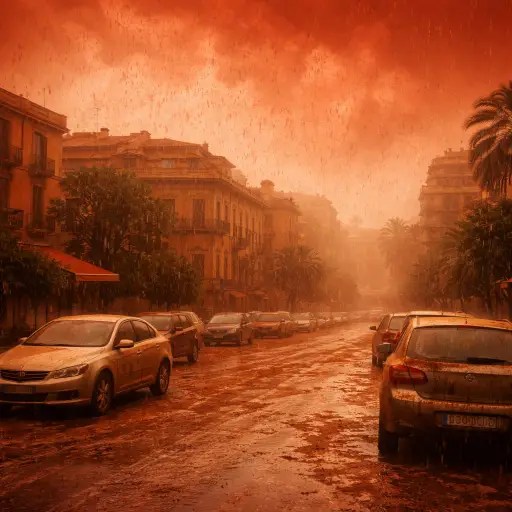
Residents across parts of southern Europe woke to an unsettling sight as rain fell from crimson-tinted skies, leaving streets, cars, and buildings coated in a layer of reddish dust. The striking phenomenon—often referred to as “blood rain”—has transformed ordinary rainfall into an eerie spectacle across regions of Spain, Portugal, and southern France.
The unusual weather event occurs when strong winds sweep vast quantities of dust from the Sahara Desert and carry it northward across the Mediterranean. As the airborne particles mix with moisture in rain clouds, the precipitation becomes stained with the desert’s iron-rich sand, giving it a reddish-brown appearance as it falls.
Across several cities, residents described waking to skies colored in shades of orange and red before the rain began. Once the showers arrived, the dusty mixture settled over urban landscapes, leaving vehicles streaked with muddy residue and sidewalks coated with a fine rust-colored film.
In Madrid, Lisbon, and Marseille, streets quickly took on an almost otherworldly appearance. Parked cars appeared as though they had been dusted with powdered clay, while balconies and rooftops accumulated thin layers of reddish sediment. For many residents, the scene felt surreal.
“It looked like something from another planet,” said one resident in Seville while wiping the dusty residue from the windshield of his car. “The sky had this strange color, and everything outside was suddenly covered in red dust.”
Images circulating online showed entire neighborhoods tinted with the distinctive hue left behind by the desert particles. In coastal cities such as Barcelona and Porto, patios, terraces, and public squares were visibly stained after the rain passed through.
Meteorologists say the phenomenon, while visually dramatic, is not uncommon in parts of southern Europe. Saharan dust storms frequently push northward when atmospheric conditions align, particularly during periods of strong winds over North Africa.
“When desert dust becomes suspended high in the atmosphere, it can travel thousands of kilometers,” explained a climatologist monitoring the event. “If rain develops while that dust is present in the clouds, it can fall back to the ground mixed with the precipitation, creating the so-called blood rain effect.”
Despite its alarming appearance, experts stress that the rain itself is not dangerous. However, the fine dust particles can temporarily reduce air quality and may cause irritation for individuals with respiratory conditions such as asthma or allergies.
Environmental agencies in affected regions have advised residents to limit unnecessary outdoor activity during heavy dust episodes and to rinse vehicles and outdoor surfaces once the rain has passed. The reddish coating left behind is typically harmless but can cling stubbornly to surfaces if allowed to dry.
Street cleaners and municipal crews in several cities were already working to wash away the dusty residue from roads and public spaces. In many neighborhoods, residents could be seen hosing down cars, windows, and balconies as the skies gradually cleared.
For some observers, the phenomenon served as a reminder of the powerful natural forces linking continents. The sand responsible for the reddish rain began its journey in one of the world’s largest deserts before traveling hundreds of kilometers through the atmosphere.
Meteorologists note that such dust events can also influence weather and ecosystems beyond Europe. Saharan dust has been known to fertilize soils and oceans far from its source, carrying minerals that contribute to environmental cycles across the Atlantic and Mediterranean regions.
Still, for those who witnessed the unusual rainfall firsthand, the most memorable aspect was the spectacle itself. Red-stained streets and copper-colored skies created scenes that many residents said they had never experienced before.
As skies gradually return to their normal shades and cleanup continues, the episode stands as a vivid example of how weather patterns can transform familiar landscapes in unexpected ways—turning an ordinary rainstorm into a striking reminder of the vast desert lying just beyond Europe’s southern horizon.


 The Tower Post