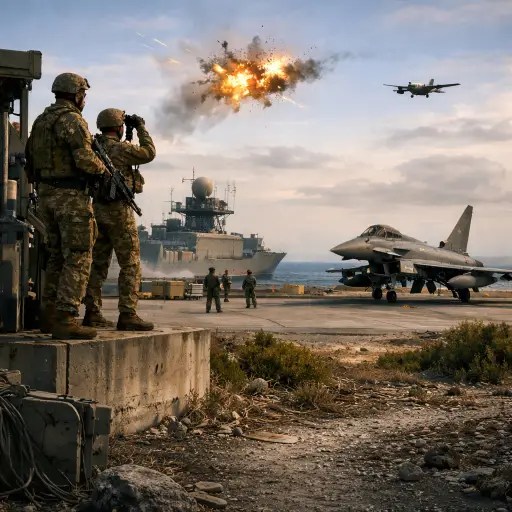
Intercepted UAV attacks near British bases expose the eastern Mediterranean as a new frontline, prompting European forces to strengthen air and naval defenses.
The widening confrontation linked to the ongoing war involving Iran has begun to reach beyond the Middle East’s traditional battlefields, drawing the eastern Mediterranean—and European strategic territory—into a growing web of military tension. Recent drone interceptions near British military installations on the island of Cyprus have underscored how rapidly the conflict’s operational footprint is expanding.
European and allied defense forces stationed on Cyprus reported that air defense systems were activated after several unmanned aerial vehicles approached restricted military zones hosting United Kingdom assets. The drones were intercepted before reaching their targets, according to officials familiar with the operations, but the episode has raised urgent concerns across European capitals about the vulnerability of Mediterranean bases to long-range or proxy drone attacks.
Cyprus, though geographically close to the Middle East, is part of the European Union and hosts some of the most strategically important Western military facilities in the region. British sovereign base areas on the island have long supported surveillance, logistics, and air operations linked to crises across the Middle East. The attempted drone strikes therefore represent more than an isolated security incident; they signal the potential geographic spillover of a conflict that has already destabilized much of the surrounding region.
Defense analysts say the use of drones reflects a broader pattern emerging in modern conflicts: relatively inexpensive unmanned systems are increasingly deployed to probe air defenses, test response times, and create psychological pressure without escalating immediately to large-scale missile strikes. In this case, the attempted incursions appear to have been designed to test the defensive perimeter around Western military infrastructure in the eastern Mediterranean.
European security officials are now assessing whether the drones were launched directly from the region or deployed through proxy networks operating closer to the Mediterranean theater. The ambiguity surrounding their origin complicates both attribution and response. Intelligence services across several EU states are reportedly examining potential links to militant groups or regional actors aligned with Tehran’s broader strategic interests.
The incident has intensified debate within Europe about the degree to which the Iran-related conflict could spread into areas previously considered peripheral to the fighting. For years, the eastern Mediterranean served primarily as a logistical corridor for Western military operations in the Middle East. Now, it increasingly resembles a potential operational zone in its own right.
In response, several European governments have begun reinforcing their military posture in the region. Naval deployments have increased across key maritime routes linking the Mediterranean to the Suez Canal, while additional fighter aircraft and early-warning surveillance systems have been positioned at bases in southern Europe. Air defense assets capable of intercepting drones and cruise missiles are also being repositioned to protect critical infrastructure and military installations.
Officials within the European Union describe the measures as precautionary rather than escalatory. However, the scale of coordination suggests a growing recognition that the eastern Mediterranean may play a more active role in the evolving security environment.
Military planners are particularly concerned about the vulnerability of forward operating bases and naval task groups to swarm-style drone attacks. The technology behind many of these systems has proliferated rapidly in recent years, allowing state and non-state actors alike to field relatively sophisticated capabilities without the resources required for traditional missile programs.
For Cyprus itself, the developments carry both strategic and political implications. The island has long occupied a delicate position between Europe and the Middle East, serving as a hub for diplomacy, humanitarian operations, and military logistics. While the government in Nicosia maintains a policy of stability and regional cooperation, the presence of foreign military facilities inevitably places the island within the broader dynamics of regional security.
Local authorities have emphasized that civilian life on the island remains unaffected and that defensive measures are coordinated closely with European and allied partners. Nevertheless, the drone interceptions have prompted increased aerial monitoring and coordination among regional air traffic and defense authorities.
Across Europe, policymakers are watching the situation closely. The possibility that Middle Eastern hostilities could extend into areas under European jurisdiction raises difficult questions about collective security obligations and the risk of escalation. While the intercepted drones caused no damage, they serve as a reminder that the geographic boundaries of modern conflicts are increasingly fluid.
Strategists warn that the eastern Mediterranean’s dense concentration of military assets—from NATO bases to commercial shipping routes—makes it a particularly sensitive arena. Any miscalculation involving drones, air defenses, or naval forces could rapidly draw additional actors into the confrontation.
At the same time, diplomatic channels remain active. European governments continue to emphasize the need for de-escalation and regional dialogue, even as they strengthen their defensive posture. Officials argue that maintaining credible deterrence is essential to prevent further spillover of the conflict into European territory.
For now, the skies over Cyprus have returned to relative calm. Yet the attempted drone strikes have altered strategic perceptions across the region. What once seemed like a distant conflict now appears capable of reaching Europe’s doorstep, carried not by large military formations but by small, silent aircraft navigating the night skies of the Mediterranean.
As defense systems track the horizon and naval patrols intensify, the episode serves as a warning: in the era of drone warfare, the boundaries between regional conflicts and global security zones are becoming increasingly difficult to define.




 The Tower Post