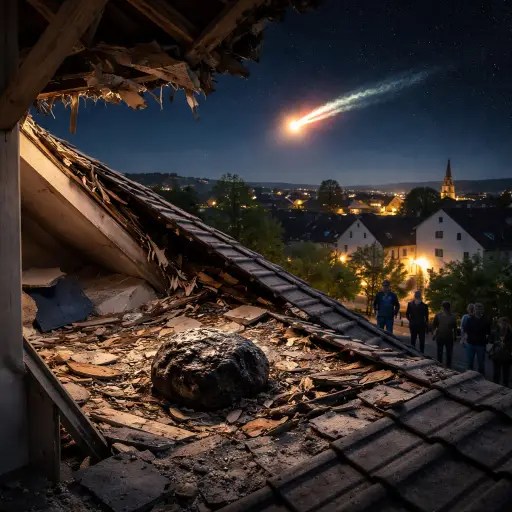
Rare celestial event startles thousands across Western Europe as a blazing meteor breaks apart and one fragment slams into a house in Koblenz
A spectacular fireball blazing across the night sky startled residents across Western Europe before fragments from the object plunged toward Earth, with one meteorite crashing through the roof of a home in the German city of Koblenz. The dramatic event lit up the sky, triggered widespread reports from witnesses in several countries, and left scientists racing to analyze the rare space rock that landed inside a private residence.
The cosmic visitor streaked over the region in a brilliant burst of light visible across France, Belgium, the Netherlands, and parts of western Germany. Witnesses described a glowing object moving rapidly across the sky before exploding in a flash that briefly illuminated rooftops, streets, and fields.
Moments later, fragments of the meteorite began falling toward the ground.
One of those fragments punched directly through the roof of a house in a quiet residential area of Koblenz. The impact left a hole roughly the size of a soccer ball and scattered pieces of roofing material into an upstairs bedroom that happened to be empty at the time.
Residents inside the home reported hearing a loud crack followed by the sound of debris striking the floor. When they investigated, they discovered the damaged roof and a dark, rock-like object resting among the debris.
Remarkably, no one was injured.
Local authorities quickly secured the area while scientists and planetary researchers were alerted to the discovery. Early assessments suggest the object is indeed a meteorite—a fragment of rock that survived its fiery descent through Earth’s atmosphere.
The fireball that preceded the impact was widely observed across the region. Social media quickly filled with reports from thousands of witnesses who described the same dramatic sight: a bright streak cutting across the sky, followed by a sudden burst of light.
Some observers reported hearing a delayed rumble or sonic boom minutes after the flash, a phenomenon that occurs when the shock wave from a meteor traveling faster than the speed of sound reaches the ground.
Astronomy networks that track fireballs and meteor events also registered the phenomenon. Cameras designed to monitor the night sky captured the object’s path, providing scientists with valuable data about its trajectory and possible origin.
Preliminary analysis suggests the meteor entered Earth’s atmosphere at extremely high speed before breaking apart under intense pressure and heat. During this process, fragments slowed enough to survive the descent and reach the ground as meteorites.
While meteorites reach Earth every day in small amounts, the chance of one striking a building is extraordinarily small. Most space rocks burn up completely in the atmosphere, and those that survive usually fall into oceans, forests, or remote areas.
Planetary scientists estimate that millions of tiny meteoroids enter Earth’s atmosphere each day, but only a small fraction produce bright fireballs visible from the ground.
Even fewer reach the surface as recoverable meteorites.
Cases in which meteorites strike homes are exceptionally rare, though they do occur occasionally. Such events often attract significant scientific attention because freshly fallen meteorites can provide valuable information about the early solar system.
Researchers are particularly interested in quickly collecting and analyzing meteorites after they fall. Exposure to Earth’s atmosphere, moisture, and human handling can gradually alter the chemical composition of these extraterrestrial rocks.
Initial observations suggest the Koblenz meteorite may belong to a common class of stony meteorites known as chondrites. These meteorites contain some of the oldest material formed in the early solar system and can offer clues about how planets—including Earth—formed billions of years ago.
Experts will examine the fragment’s mineral composition, internal structure, and isotopic signatures to determine its precise origin.
Tracking data from the fireball may even allow astronomers to estimate the object’s orbit before it collided with Earth.
For the homeowners in Koblenz, the experience was both startling and surreal.
Residents initially believed something far more ordinary—perhaps falling debris or storm damage—had caused the noise. Only after discovering the unusual stone and the hole in the roof did they realize the event might be far from ordinary.
Neighbors gathered outside as news spread through the neighborhood, and local officials documented the damage before scientists removed the meteorite for study.
Despite the shock, the homeowners expressed relief that no one had been in the room when the object crashed through the ceiling.
Events like this serve as dramatic reminders that Earth exists within a dynamic cosmic environment. Every day, our planet encounters dust and debris left behind by asteroids and comets orbiting the Sun.
Most of these particles are harmless, burning up high above the surface and appearing as brief streaks of light commonly known as shooting stars.
Occasionally, however, larger pieces survive the fiery descent.
The meteorite that pierced the roof in Koblenz is one such survivor—a small fragment of ancient cosmic material that traveled millions of kilometers through space before ending its journey in an empty bedroom.
For scientists, it represents an invaluable sample from beyond Earth. For the residents who experienced the impact firsthand, it is likely a story that will be told for years to come—about the night a fireball crossed the sky and a rock from space fell straight through their roof.



 The Tower Post