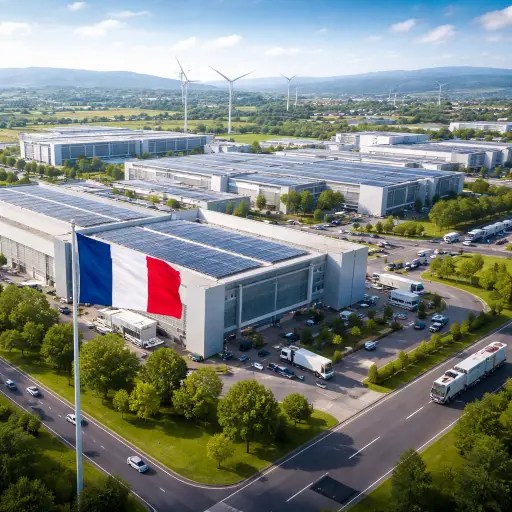
New industrial districts aim to bring semiconductor, battery, and green-energy manufacturing back to Europe while reviving regional economies
Across several regions of France, large areas of land once associated with shuttered factories and declining industrial towns are being prepared for a new role. The French government is rolling out a sweeping initiative known as “Reindustrialization Zones,” a network of specially designated industrial areas designed to attract major manufacturing investment through a powerful combination of tax exemptions, streamlined regulations, and accelerated building permits.
The initiative reflects a broader shift in European economic strategy. After decades of globalization that saw large portions of manufacturing relocate to Asia, policymakers across the continent are increasingly focused on bringing strategic industries back to Europe. France now aims to position itself at the center of that movement.
Under the new plan, companies that establish operations in these zones will benefit from significant tax relief on corporate income, payroll contributions, and property taxes during their initial years of operation. In addition, environmental and construction permits—often a major obstacle for industrial projects in Europe—will be processed through fast-track administrative channels designed to dramatically reduce delays.
French officials argue that speed and certainty are crucial in a global competition for high-tech investment.
Industrial projects today move at a rapid pace, and governments are racing to secure the next generation of advanced factories. If approval processes take too long, companies may simply choose to invest elsewhere. By simplifying procedures while maintaining regulatory standards, France hopes to present itself as one of the most attractive destinations for industrial investment in Europe.
The Reindustrialization Zones are aimed primarily at industries considered essential for economic sovereignty and the energy transition. Among the top targets are semiconductor fabrication plants, battery manufacturing facilities, and factories producing components for renewable energy technologies.
Each of these sectors has become central to geopolitical and economic debates in recent years. Semiconductor shortages exposed the vulnerabilities of global supply chains, while the rapid expansion of electric vehicles has intensified the race to build large-scale battery production capacity closer to European markets.
France hopes the new industrial zones will allow the country to capture a meaningful share of these rapidly expanding sectors.
Government planners have identified several regions with existing infrastructure, skilled labor pools, and available industrial land. Many of these areas were once major manufacturing hubs but suffered from deindustrialization during the late twentieth and early twenty-first centuries. Local leaders believe the new initiative could mark a turning point.
In towns that have spent years grappling with job losses and economic stagnation, the prospect of new advanced factories carries both economic and symbolic importance.
Regional authorities are working closely with national agencies to prepare the zones for incoming investors. That preparation includes upgrading electricity grids capable of supporting energy-intensive facilities such as chip fabrication plants and battery gigafactories. Transport connections—including rail networks, highways, and logistics platforms—are also being strengthened to ensure efficient supply chains.
Equally important is the development of a highly skilled workforce.
Manufacturing in these new zones will not resemble the heavy industry of previous generations. Instead, the factories being targeted are highly automated and rely on engineers, technicians, and specialized operators. To meet those needs, universities and technical institutes are expanding training programs in fields such as microelectronics, robotics, advanced materials, and renewable energy engineering.
Officials say the initiative could generate thousands of high-skill jobs directly, along with additional employment in construction, services, and regional supply networks.
The government is also betting that the zones will trigger broader regional economic revival. Historically, major industrial investments tend to attract smaller suppliers, research centers, and start-ups that cluster around large production facilities.
Such ecosystems are considered critical for long-term competitiveness.
When research, manufacturing, and supply chains operate in close proximity, innovation often accelerates. Engineers, suppliers, and technology developers can collaborate more easily, allowing new industrial processes and products to emerge more quickly.
Still, the plan faces several challenges.
Building advanced manufacturing facilities requires enormous financial investment, and companies will carefully compare France’s incentives with those offered by other countries pursuing similar strategies. Governments across Europe, North America, and Asia are introducing their own subsidy programs as they compete to host strategic industries.
Environmental concerns also remain a key issue. While the new zones promise faster administrative procedures, French authorities emphasize that environmental protections will remain in place. The objective is



 The Tower Post