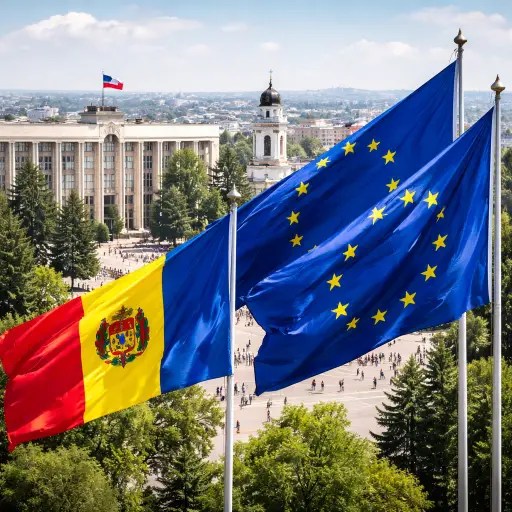
As Chisinau accelerates its strategic pivot toward Europe, the move signals a deeper geopolitical shift across Eastern Europe and heightens tensions with Moscow.
Moldova is taking decisive steps to distance itself from the Commonwealth of Independent States (CIS), the Russia-led regional alliance formed after the collapse of the Soviet Union. The move marks one of the clearest signs yet that the small Eastern European country is reorienting its political, economic, and security priorities toward the European Union and the wider Western sphere.
Officials in Chisinau have steadily reduced their participation in CIS structures over the past few years, but recent political momentum suggests the process is accelerating. Government leaders have framed the shift not as a sudden break, but as the logical conclusion of a broader national strategy aimed at European integration, democratic consolidation, and economic modernization.
For Moldova, a country historically caught between competing geopolitical influences, the transition represents a defining moment. For Moscow, however, the decision underscores the gradual erosion of its influence across parts of the post-Soviet space.
A Gradual Departure from a Post-Soviet Framework
The Commonwealth of Independent States was originally created as a loose political and economic framework to maintain cooperation among former Soviet republics. While some members continued to see value in the organization, others gradually reduced their involvement as their political priorities shifted.
Moldova’s relationship with the CIS has been increasingly uneasy in recent years. Successive governments in Chisinau have questioned whether the organization still serves the country’s long-term interests, particularly as Moldova deepens its ties with European institutions.
Officials argue that many of the CIS agreements overlap with other international commitments or no longer reflect the country’s economic orientation. Trade patterns have shifted significantly toward European markets, and regulatory reforms have increasingly aligned with EU standards.
As a result, Moldovan authorities have begun reviewing numerous agreements signed within the CIS framework. Some have already been suspended or allowed to lapse, while others are under evaluation as the government works to streamline its international obligations.
The process is complex. Moldova still maintains certain economic and technical arrangements with countries in the region, meaning a complete withdrawal requires careful legal and diplomatic coordination. Yet the direction of travel appears unmistakable.
European Integration as the Strategic Anchor
At the heart of Moldova’s policy shift is its ambition to anchor itself firmly within the European political and economic system. Leaders in Chisinau argue that integration with the European Union offers the most reliable path toward long-term stability, investment, and institutional reform.
Over the past several years, Moldova has intensified cooperation with Brussels on a range of issues, from judicial reform and anti-corruption measures to infrastructure development and energy diversification. European institutions have also increased financial and technical support aimed at strengthening Moldova’s democratic institutions.
Security considerations have become increasingly important as well. The broader geopolitical environment in Eastern Europe has heightened concerns about political vulnerability and external influence. For Moldovan policymakers, closer alignment with European partners is seen as a way to reinforce national resilience.
Public opinion has also evolved. While Moldova remains politically diverse, surveys and political trends indicate growing support for stronger ties with the European Union, particularly among younger generations and urban voters.
Government officials emphasize that moving away from CIS structures does not necessarily mean severing all regional cooperation. Instead, they argue, Moldova is seeking partnerships based on modern economic realities and shared political principles.
Moscow’s Uneasy Reaction
Russia has watched Moldova’s trajectory with increasing concern. The gradual distancing from CIS institutions reflects a broader trend seen in parts of Eastern Europe and the former Soviet region, where several countries have sought closer integration with Western institutions.
Moscow has historically viewed the CIS as one of the instruments through which it maintains regional influence. As a result, Moldova’s withdrawal carries symbolic weight beyond its practical implications.
Russian officials have warned that the move could weaken longstanding economic ties and complicate cooperation in areas such as energy, trade, and labor migration. Economic pressure has occasionally been used in the past as a political lever in disputes between Russia and neighboring states.
However, Moldova’s government appears determined to continue its strategic reorientation. Officials stress that their decisions are driven primarily by domestic priorities rather than geopolitical rivalry.
The delicate balance between maintaining pragmatic relations with Russia while deepening integration with Europe remains one of the country’s most complex diplomatic challenges.
A Regional Signal
Moldova’s shift may also resonate beyond its borders. Across Eastern Europe and parts of the former Soviet region, governments are reassessing their positions within older regional structures that emerged in the early post-Soviet era.
Economic globalization, new security realities, and evolving political identities have reshaped the strategic calculations of many countries in the region. In this context, Moldova’s gradual exit from the CIS reflects a broader transformation in how some states define their alliances and partnerships.
Analysts note that the process unfolding in Moldova is not only about institutional membership. It also reflects a deeper effort to redefine the country’s political identity after decades of navigating competing geopolitical pressures.
For a nation that has long stood at the crossroads of Europe and Eurasia, the decision carries both symbolic and practical significance.
The Road Ahead
Despite the momentum behind the shift, Moldova’s path forward will require careful diplomacy. The country remains economically interconnected with several CIS states, and abrupt disruptions could carry domestic consequences.
Energy supply, regional trade flows, and the status of the breakaway region of Transnistria all remain sensitive issues that could complicate Moldova’s geopolitical transition.
Nevertheless, policymakers in Chisinau appear confident that the long-term benefits of European integration outweigh the risks. By aligning its institutions, economy, and political framework with European standards, Moldova hopes to strengthen its sovereignty and attract greater international investment.
The process is likely to unfold gradually rather than through a single dramatic announcement. Yet the trajectory is increasingly clear.
As Moldova continues to recalibrate its foreign policy, its departure from the CIS framework is becoming another milestone in a broader transformation—one that reflects both the country’s internal aspirations and the evolving geopolitical landscape of Eastern Europe.



 The Tower Post