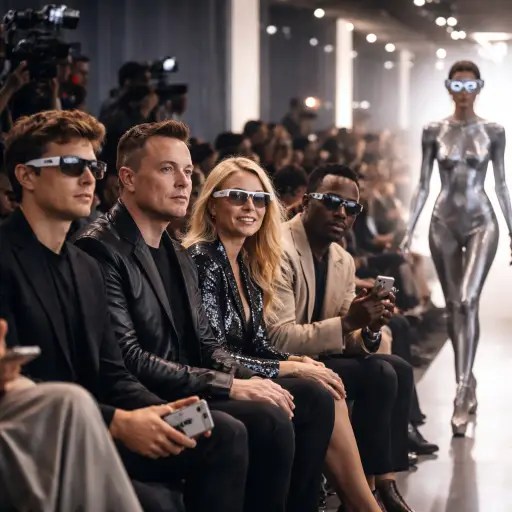
As tech moguls appear front row in Milan and Paris, insiders say the next runway revolution may be coded as much as it is stitched.
The front rows at the world’s most prestigious runway shows are beginning to look a little different. Alongside editors, models, and celebrities, a new type of guest has become increasingly visible: Silicon Valley’s billionaire founders and venture capital heavyweights.
In recent seasons, tech leaders known for shaping social media platforms, artificial intelligence labs, and global software companies have been quietly taking seats at major shows in Milan and Paris. Their presence has sparked a wave of speculation across the fashion industry, where insiders believe the relationship between fashion and technology is entering a new phase.
What once felt like an unlikely pairing is rapidly evolving into a strategic alliance.
For decades, fashion houses and technology companies moved in largely separate worlds. Designers focused on craftsmanship, storytelling, and aesthetic innovation, while tech entrepreneurs pursued efficiency, data, and digital scale. But as artificial intelligence, augmented reality, and wearable computing mature, the two industries are beginning to converge in ways that few predicted.
The runways are now becoming meeting grounds.
Backstage conversations increasingly include discussions about sensors embedded in fabrics, adaptive clothing powered by machine learning, and accessories that function as both fashion statements and personal devices. Industry executives say the presence of tech investors at shows reflects a growing understanding that the next wave of wearable technology may not come from gadget companies alone.
“It’s no longer just about smartwatches,” said one fashion consultant who works with European luxury brands. “The next generation of wearables will have to look beautiful. That means fashion has to be involved from the beginning.”
That realization is drawing Silicon Valley’s attention.
Many technology investors see fashion as an untapped frontier for consumer hardware innovation. Clothing is the most universal interface humans have with the physical world, worn every day and deeply tied to identity and culture. For entrepreneurs exploring the future of computing beyond smartphones, garments and accessories represent a powerful new platform.
Luxury brands, meanwhile, see opportunity in the technology sector’s enormous research budgets and engineering talent. Advanced materials, embedded processors, and AI-driven personalization could transform how clothing is designed, produced, and experienced.
The collaboration potential is particularly visible in the emerging field of AI-powered wearables.
Several startups, backed by venture capital firms from California, are experimenting with garments that can monitor health metrics, adjust temperature automatically, or respond to environmental conditions. In parallel, designers are exploring ways to integrate these technologies without compromising aesthetics.
The goal is subtlety rather than spectacle.
“People don’t want to look like they’re wearing a device,” explained a creative director at a European fashion house. “The dream is technology that disappears into the garment.”
Another area generating intense interest is smart eyewear.
Fashion insiders say early conversations are taking place between luxury eyewear brands and technology companies developing next-generation smart glasses. These devices could eventually combine augmented reality displays, voice assistants, and cameras within frames designed by high-end fashion labels.
The idea is simple: if smart glasses are to become a mainstream product, they must first become desirable accessories.
Fashion Week provides a natural testing ground for such ideas. Designers are already experimenting with prototypes that blend advanced optics with couture-level design. Though most of these collaborations remain confidential, industry observers say the momentum is unmistakable.
“Technology companies understand that style determines adoption,” said one venture investor attending shows this season. “If the product isn’t fashionable, people won’t wear it.”
The shift is also reshaping how fashion brands think about innovation.
Traditionally, collections evolved through seasonal cycles driven by creative direction. But technology partnerships introduce a different rhythm—one influenced by research labs, software updates, and product development timelines.
Some brands are now hiring engineers alongside pattern makers. Others are opening innovation studios focused on materials science and digital design tools.
Artificial intelligence is already transforming the creative process itself.
AI models trained on decades of runway archives can now help designers explore silhouettes, generate textile patterns, or predict emerging consumer tastes. While some critics fear this could dilute the artistry of fashion, many designers see AI as a powerful tool for experimentation.
“It’s like having a creative collaborator that can process millions of references instantly,” said one designer experimenting with machine learning systems.
For Silicon Valley investors, the potential financial upside is significant. Wearable technology has long been predicted as the next major computing platform after smartphones, yet adoption has remained uneven.
Fashion could change that equation.
If technology becomes seamlessly embedded into garments and accessories people genuinely want to wear, the market for wearable devices could expand dramatically. Analysts believe that the intersection of luxury fashion and advanced consumer technology could unlock entirely new categories of products.
There are challenges, however.
Integrating electronics into garments raises questions about durability, sustainability, and repairability. Privacy concerns also remain a major issue, particularly for devices that include cameras or biometric sensors.
Still, the energy surrounding fashion-tech collaboration continues to grow.
At runway venues across Europe, it is no longer unusual to see venture capitalists discussing prototypes with designers over espresso, or technology founders studying fabric innovations backstage. What began as curiosity has increasingly turned into investment.
For fashion, the presence of Silicon Valley’s elite represents more than just new faces in the front row. It signals the possibility of a structural shift in how clothing is imagined and produced.
For technology companies, the lesson is equally clear: the future of wearable computing may not be built solely in laboratories.
It might also be designed on the runway.




 The Tower Post