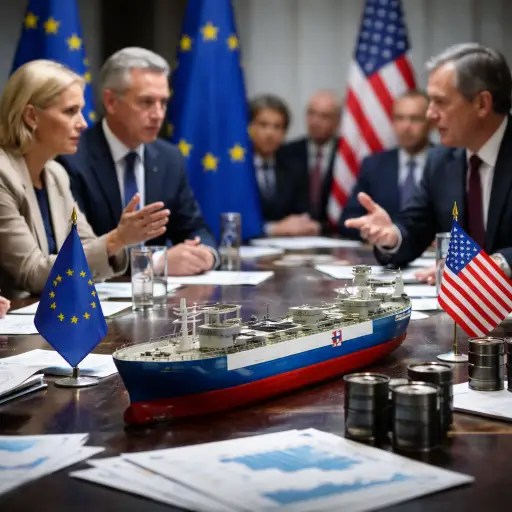
European leaders warn that Washington’s easing of restrictions on Russian energy exports risks weakening Western unity during the Ukraine war
A fresh strain has emerged in the transatlantic alliance after European leaders sharply criticized Washington’s decision to loosen restrictions on Russian oil exports, a move they fear could erode the economic pressure that Western governments have sought to maintain against Moscow since the invasion of Ukraine.
Officials across the European Union voiced concern that the policy shift risks undermining years of coordinated sanctions aimed at constraining Russia’s ability to finance its war effort. Diplomats in Brussels described the decision as a strategic misstep that could complicate the fragile unity among Western partners, particularly at a moment when the conflict shows little sign of resolution.
The debate has quickly become one of the most contentious issues in recent transatlantic diplomacy. European policymakers argue that sanctions on Russian energy remain one of the most effective tools available to limit the Kremlin’s revenues. By easing certain restrictions, they warn, Washington may unintentionally open new avenues for Russian crude to reach global markets.
Several European officials stressed that the sanctions regime was designed to work through collective pressure. Any deviation by one major partner, they say, risks weakening the broader architecture that has constrained Moscow’s economic options since the war began.
“We built this strategy together,” one senior EU diplomat said privately in Brussels. “If the structure begins to loosen in one place, the entire system becomes less effective.”
Concerns in Brussels
Within the European Commission and among member states, the decision has triggered a wave of consultations about how to preserve the sanctions framework while maintaining close cooperation with the United States.
For European governments, the stakes extend beyond the immediate energy market. Leaders worry that diverging policies could embolden Russia while also sending mixed signals to global markets about the durability of Western sanctions.
The EU has spent years restructuring its own energy system to reduce dependence on Russian fossil fuels. Imports of Russian oil into Europe have declined sharply since the beginning of the war, replaced by supplies from the Middle East, the United States, and other producers.
That transition has come at significant economic and political cost. European governments invested heavily in alternative supply chains, expanded liquefied natural gas infrastructure, and introduced emergency measures to stabilize domestic energy prices.
Against that backdrop, some European officials say Washington’s move risks undercutting sacrifices already made across the continent.
“The message we have tried to send to Moscow is that aggression carries long-term consequences,” said one EU energy official involved in sanctions policy. “If the pressure weakens, the credibility of that message also weakens.”
Washington’s Rationale
U.S. officials have defended the decision as a pragmatic response to evolving global energy dynamics.
According to policymakers in Washington, the adjustment aims to prevent excessive disruptions in global oil supply while maintaining the broader sanctions regime against Russia. Energy markets have remained volatile, and officials argue that calibrated flexibility may help stabilize prices without fully dismantling restrictions.
Some analysts in the United States also point out that the sanctions architecture has always been complex, balancing geopolitical objectives with economic realities. If global oil supply tightens too sharply, they warn, energy prices could spike, potentially harming Western economies and weakening public support for sanctions.
Still, the policy has triggered unease even among some American lawmakers, who worry that any easing of restrictions could send the wrong signal while fighting continues in Ukraine.
A Test of Western Unity
The disagreement highlights the delicate balance within the Western coalition supporting Kyiv. Since the start of the conflict, the United States and European Union have coordinated sanctions, military aid, and diplomatic initiatives aimed at isolating Russia.
That unity has been widely seen as one of the alliance’s greatest strengths. Yet the latest dispute demonstrates how fragile that alignment can become when energy markets, domestic politics, and geopolitical priorities collide.
For Europe, the fear is not only about immediate oil flows but also about long-term strategic messaging. Leaders worry that Moscow could interpret policy differences among Western partners as a sign of weakening resolve.
Diplomats say discussions are already underway to clarify how the U.S. policy change will operate in practice and whether additional safeguards might be introduced to prevent Russian revenues from expanding significantly.
Global Market Implications
Energy traders and analysts are watching the situation closely. Russian oil exports remain a major factor in global supply, and even modest changes in sanctions policy can ripple across international markets.
If additional Russian barrels reach the market more easily, prices could stabilize or decline in the short term. However, analysts note that geopolitical uncertainty surrounding sanctions often creates volatility rather than stability.
For Europe, the broader concern is strategic rather than purely economic. EU leaders emphasize that sanctions were designed not only to reshape markets but also to demonstrate a unified Western stance against aggression.
Searching for Common Ground
Despite the tensions, officials on both sides of the Atlantic insist that the broader partnership remains intact. Diplomatic channels between Washington and Brussels remain active, and discussions are expected to continue as policymakers attempt to reconcile energy stability with geopolitical pressure.
European leaders are pushing for renewed coordination to ensure that any adjustments to sanctions policy do not weaken the overall strategy toward Russia. Some diplomats suggest that new monitoring mechanisms or complementary measures could help reassure European governments.
Behind the scenes, many policymakers acknowledge that the alliance has weathered disagreements before. Yet they also recognize that maintaining unity requires constant negotiation, particularly as the war in Ukraine continues to reshape the global political landscape.
For now, the dispute over Russian oil has become the latest reminder that even close allies can diverge when economic pressures intersect with geopolitical strategy.
What remains clear, European officials say, is that the effectiveness of sanctions ultimately depends on collective resolve — and that preserving that unity may prove just as challenging as imposing the measures in the first place.


 The Tower Post