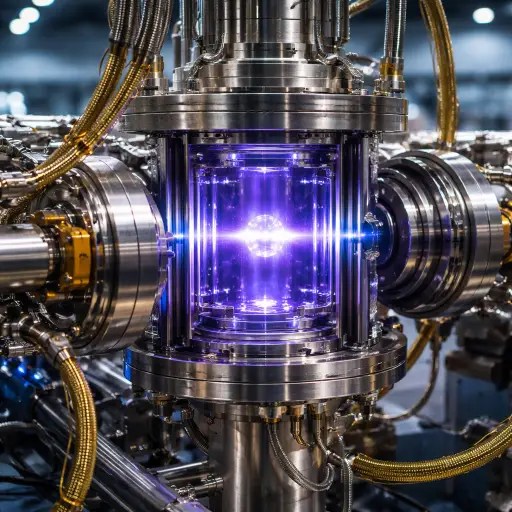
Physicists develop magnetic traps to safely transport the universe’s most volatile substance, opening the door to a new era of precision physics and future energy breakthroughs.
Deep beneath the French-Swiss border, where some of the world’s most advanced particle accelerators run through kilometers of underground tunnels, scientists are preparing for a remarkable experiment: transporting antimatter outside the laboratory where it was created.
At the European Organization for Nuclear Research, known globally as CERN, physicists are developing highly sophisticated magnetic containment systems designed to safely move tiny quantities of antimatter from one experiment to another. If the effort succeeds, it will mark the first time antimatter has been deliberately transported between facilities while remaining stable and contained.
Although the quantities involved are microscopic, the implications are enormous. Researchers believe that the ability to transport antimatter could transform how it is studied, enabling new types of experiments and opening a pathway toward discoveries that could reshape our understanding of the universe.
The Most Dangerous Substance Known to Physics
Antimatter is often described as the mirror image of ordinary matter. Every fundamental particle has an antimatter counterpart with the same mass but an opposite electric charge. When matter and antimatter meet, they annihilate each other instantly, converting their mass into energy.
Even an extremely small amount can release enormous power. When antimatter collides with normal matter, the result is a burst of pure energy according to the famous relationship between mass and energy. Because of this, antimatter is considered the most energy-dense substance known to science.
Fortunately, laboratories produce only incredibly small amounts. These particles exist for only fractions of a second unless they are carefully trapped and isolated using magnetic fields.
At CERN, antimatter particles are created during high-energy collisions inside particle accelerators. The resulting antiprotons must then be slowed down and captured in special electromagnetic traps, because touching the walls of a container would immediately destroy them.
For decades, scientists have studied antimatter only within the experimental systems where it was produced. Moving it elsewhere has long been considered one of the most difficult challenges in particle physics.
Building a Portable Magnetic Prison
The new experiment attempts to solve this challenge using an advanced containment device sometimes described as a portable antimatter trap.
Instead of using physical walls, the device relies entirely on magnetic and electric fields to suspend particles in empty space. Inside this magnetic configuration, charged antimatter particles spiral along invisible field lines and remain confined without touching any material surface.
Designing a trap that can be transported safely, however, requires extreme engineering precision.
The system must remain perfectly stable while being physically moved. Vibrations, temperature changes, or tiny fluctuations in the magnetic field could destabilize the trap and allow the antimatter to escape.
To prevent this, engineers have created a compact cryogenic chamber equipped with superconducting magnets and specialized shock-absorbing supports. Independent power supplies maintain the magnetic fields continuously during transport.
In effect, the antimatter travels inside a moving magnetic bottle.
Unlocking New Precision Experiments
Transporting antimatter is not simply a technical curiosity. It could fundamentally change how antimatter research is conducted.
Different experiments at CERN focus on different properties of antimatter. Some analyze the behavior of antihydrogen atoms, while others investigate how antimatter interacts with gravity or electromagnetic forces.
Until now, each research group has had to produce and trap its own antimatter supply. This process can be slow and technically demanding, limiting the number and precision of experiments that can be performed.
If antimatter can be transported safely between laboratories, a single production system could supply multiple experiments. Scientists would gain greater control over the conditions under which antimatter is studied, dramatically improving measurement accuracy.
Searching for the Universe’s Missing Symmetry
One of the greatest mysteries in modern physics is why the universe is dominated by matter rather than antimatter.
The laws of physics suggest that the Big Bang should have created matter and antimatter in nearly equal quantities. If that had happened, the two would have annihilated each other, leaving behind a universe filled mostly with radiation.
Yet the observable cosmos is clearly dominated by matter. Galaxies, stars, planets, and life itself exist because some unknown process favored matter over antimatter in the earliest moments of cosmic history.
By studying antimatter with increasing precision, physicists hope to uncover tiny differences between matter and antimatter that could explain this imbalance.
Experiments comparing hydrogen with antihydrogen atoms are especially important. Even the slightest variation in their behavior could point to new physics beyond the current theoretical framework.
From Fundamental Physics to Future Technologies
Whenever antimatter is discussed outside the scientific community, it often inspires visions of futuristic power sources or interstellar spacecraft.
In reality, practical applications remain extremely distant. Producing antimatter currently requires enormous amounts of energy, and the quantities generated in laboratories are unimaginably small.
Nevertheless, understanding how to manipulate and control antimatter is an essential step toward exploring its potential uses.
Some antimatter particles already play a role in medicine. Positrons, the antimatter counterparts of electrons, are used in medical imaging technologies such as positron emission tomography, which allows doctors to observe metabolic processes inside the human body.
Future research may expand antimatter’s role in advanced medical treatments, materials science, and high-precision measurement technologies.
A Small Journey with Historic Significance
For the scientists involved, the upcoming transport experiment represents a major milestone in antimatter research.
The journey itself may involve only a tiny number of particles traveling a short distance between experimental halls. Yet achieving that controlled movement would represent decades of technological progress in particle trapping and magnetic confinement.
If the effort succeeds, antimatter will no longer be confined to the precise apparatus that created it. Instead, it will become a mobile resource that can be shared between experiments.
In scientific terms, this seemingly modest step could open the door to an entirely new generation of research.
And in the quiet underground laboratories where antimatter is produced and studied, that small journey could mark the beginning of a new era in the exploration of the fundamental nature of reality.



 The Tower Post