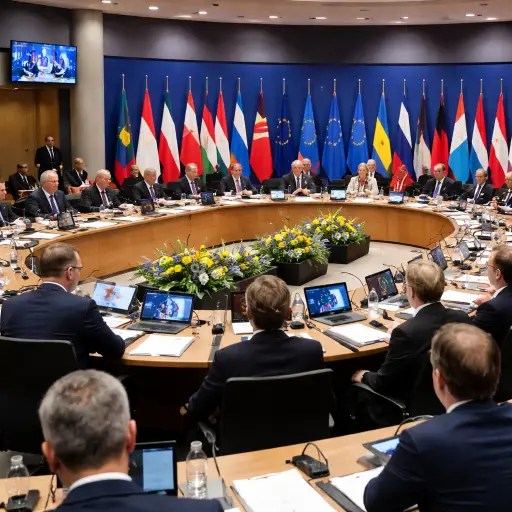
As geopolitical tensions rise and migration pressures persist, European leaders gather to shape the bloc’s next strategic priorities
As Europe faces a period of mounting geopolitical uncertainty and domestic political pressure, leaders from across the European Union are preparing for a pivotal summit expected to define the bloc’s direction on security, migration, and economic resilience. The upcoming meeting of the European Council will bring together heads of state and government for discussions that could influence the EU’s strategic agenda for years to come.
At the center of the summit’s agenda will be Europe’s evolving security landscape. Ongoing conflicts beyond the Union’s borders, particularly the war in Ukraine, continue to dominate strategic discussions in Brussels and national capitals alike. European leaders are expected to review the EU’s military assistance and political support for Kyiv while assessing broader regional stability and the implications for the continent’s defense posture.
The conflict has accelerated debates about Europe’s ability to defend itself in a world marked by renewed geopolitical rivalry. In recent months, several EU member states have increased defense spending and strengthened cooperation within NATO and the EU’s own defense initiatives. The summit is likely to explore ways to deepen defense coordination, boost joint procurement of military equipment, and expand the EU’s industrial capacity in the defense sector.
Officials in Brussels say the discussion will not only focus on immediate support for Ukraine but also on the longer-term challenge of ensuring Europe’s security in an increasingly volatile global environment. The possibility of further instability in neighboring regions, as well as tensions involving major global powers, has reinforced calls for stronger strategic autonomy and closer security cooperation among EU members.
Migration is expected to be another major focus of the meeting. Over the past year, irregular migration routes into Europe have remained active, particularly across the Mediterranean and along the EU’s eastern borders. Several member states have pushed for stronger border management measures and more effective cooperation with countries of origin and transit.
European leaders are expected to evaluate progress on migration policies that aim to balance humanitarian obligations with stricter control of external borders. Negotiations over asylum rules and burden-sharing among member states have been a persistent source of political debate within the Union. The summit could provide an opportunity to reaffirm commitments to a coordinated European approach while addressing concerns raised by governments facing domestic political pressure over migration.
At the same time, officials emphasize that migration policy cannot be separated from broader geopolitical dynamics. Conflicts, economic instability, and climate-related disruptions in neighboring regions continue to drive population movements toward Europe. For many EU policymakers, the challenge lies in developing long-term partnerships with neighboring countries that address the root causes of migration while ensuring orderly and legal pathways for those seeking protection.
Beyond security and migration, economic policy will also feature prominently in discussions. European economies are navigating a complex environment marked by slower growth, persistent inflationary pressures in some sectors, and intensified global competition in technology and industry. Leaders are expected to discuss measures aimed at strengthening the EU’s competitiveness, supporting innovation, and ensuring energy security.
Particular attention may be given to the bloc’s industrial strategy, including efforts to support strategic sectors such as green technologies, semiconductors, and defense manufacturing. European officials have increasingly warned that global competition requires coordinated policy responses if Europe is to maintain its economic influence.
Energy security remains closely linked to these discussions. While Europe has significantly reduced its reliance on Russian fossil fuels, the transition toward more diversified energy sources continues to present challenges. Leaders are expected to review progress in expanding renewable energy capacity, improving cross-border energy infrastructure, and stabilizing energy markets.
The summit also comes at a moment when EU institutions are beginning to look ahead to the Union’s next strategic agenda. This multi-year roadmap, which guides the EU’s political priorities, will shape policymaking across areas such as defense, digital transformation, economic resilience, and climate policy.
Diplomats say the meeting is likely to serve as an early platform for outlining the themes that will define the EU’s future policy direction. Discussions among leaders may focus on how to strengthen the Union’s ability to respond quickly to crises while maintaining unity among its diverse member states.
Maintaining that unity has become an increasingly central concern for EU officials. Political divisions within the bloc have occasionally complicated decision-making, particularly on sensitive issues such as migration and foreign policy. Nevertheless, European leaders often emphasize that collective action remains the Union’s greatest strength in confronting global challenges.
Observers in Brussels note that the summit will take place against a backdrop of shifting global alliances and intensifying competition among major powers. For the European Union, balancing economic interests, security commitments, and democratic values is becoming an increasingly delicate task.
The outcome of the meeting may not produce immediate breakthroughs on every issue, but it is expected to clarify the EU’s priorities at a time when the international environment is rapidly evolving. Decisions taken, or signals sent during the summit, could shape European policymaking well beyond the immediate moment.
For European leaders, the gathering represents more than just another routine meeting. It is an opportunity to demonstrate that the European Union can act cohesively in the face of external pressures and internal debates alike.
As discussions unfold, policymakers, analysts, and citizens across the continent will be watching closely. The summit may ultimately serve as a defining moment in determining how the European Union positions itself in a world marked by uncertainty, conflict, and transformation.


 The Tower Post