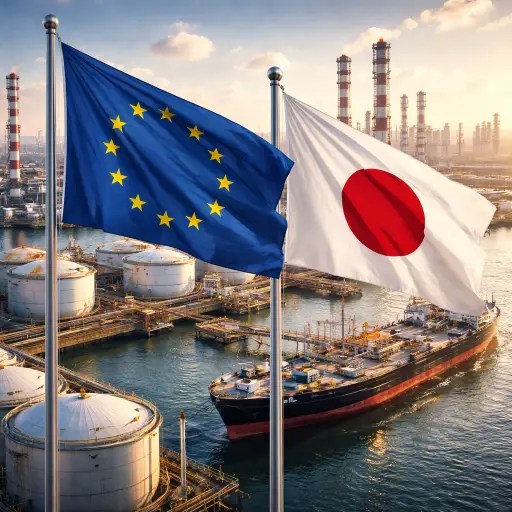
Joint move by major economies aims to calm volatility, support industry, and demonstrate growing international coordination in energy policy
As global energy markets navigate renewed volatility, European nations and Japan have taken a coordinated step designed to steady supply and reassure industries that depend on stable fuel prices. Officials from both regions confirmed that strategic oil reserves have been released in a synchronized effort intended to ease pressure on global supply chains and temper sudden price fluctuations.
The decision reflects an increasingly cooperative approach among major industrial economies facing the complex dynamics of the modern energy market. Strategic petroleum reserves—massive stockpiles maintained for emergencies—are traditionally used during severe supply disruptions. However, policymakers now view them as flexible tools that can also be deployed to prevent destabilizing market swings.
Energy authorities in Europe emphasized that the release was carefully calibrated, aiming to inject additional supply without disrupting long-term market balance. The additional barrels entering the market are expected to help smooth temporary shortages and reassure traders that governments remain prepared to act when supply risks escalate.
Japanese officials echoed the same message, describing the move as a preventive measure designed to protect domestic industries and maintain economic stability. Manufacturing sectors, shipping companies, and airlines remain highly sensitive to energy costs, and sudden spikes in oil prices can ripple quickly through production chains and consumer markets.
By coordinating their actions, European governments and Japan sought to amplify the effect of the reserve release. Market analysts say simultaneous moves from multiple large economies send a stronger signal than isolated national decisions. The coordinated approach can influence market sentiment as much as physical supply, helping calm speculation that often accelerates price surges.
Energy traders reacted cautiously but positively to the announcement. In recent months, markets have faced a mixture of uncertainty, including geopolitical tensions, logistical disruptions in shipping routes, and fluctuating demand patterns in large economies. Such factors can quickly tighten supply expectations, even when global production remains relatively stable.
Strategic reserves function as a buffer against these sudden shocks. Built over decades in response to past energy crises, the reserves are stored in underground caverns, storage terminals, and other secure facilities. Their purpose is to ensure that essential sectors—transportation, manufacturing, and power generation—continue operating even during severe disruptions.
The coordinated release demonstrates how governments are adapting these tools to the realities of a highly interconnected global energy system. Oil markets today react instantly to political developments, economic signals, and supply data. A localized disruption can rapidly influence prices worldwide.
European policymakers highlighted that the decision emerged from consultations among energy ministries, market regulators, and international partners. The aim was not only to address immediate pressures but also to demonstrate that major economies are willing to work together to maintain market stability.
Japan’s participation underscores the country’s longstanding reliance on imported energy. With limited domestic resources, Japan maintains one of the world’s largest strategic petroleum reserves. These reserves have historically served as a safeguard against supply disruptions, particularly those affecting maritime transport routes.
The latest coordinated action suggests that energy security is increasingly being treated as a shared international responsibility. Rather than acting independently, governments are exploring collaborative responses that can influence both physical supply and market expectations.
Analysts say the strategy also reflects lessons learned from past energy shocks. When governments act alone, the impact on global markets can be limited. Coordinated responses, however, can send a powerful signal of stability and preparedness.
Beyond short-term price stabilization, the move highlights the broader evolution of energy diplomacy. As countries transition toward diversified energy systems—including renewables, nuclear power, and emerging technologies—oil remains a critical component of global economic activity. Managing its market stability remains a priority for policymakers.
Industry leaders welcomed the coordinated reserve release, noting that predictable energy prices are essential for planning investment, managing logistics, and maintaining production schedules. Even moderate price spikes can influence transportation costs, supply contracts, and consumer inflation.
The cooperation between Europe and Japan also reflects broader geopolitical alignment among advanced economies seeking to strengthen economic resilience. Energy policy, once largely national in scope, is increasingly shaped by alliances and coordinated strategies.
While the immediate goal is to calm volatile markets, the decision may also signal how governments intend to respond to future disruptions. Strategic reserves, long viewed as emergency stockpiles, are becoming more dynamic instruments of economic policy.
Market observers will continue monitoring supply conditions, shipping flows, and demand indicators in the coming weeks. But the message from policymakers is clear: when markets face turbulence, coordinated action among major economies can serve as a stabilizing force.
In an era where energy, economics, and geopolitics intersect more closely than ever, the joint release of oil reserves illustrates a growing recognition that stability in global energy markets depends not only on production, but also on cooperation.


 The Tower Post