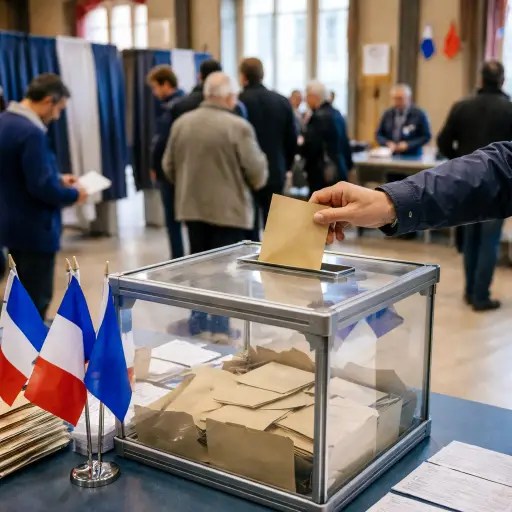
Municipal contests across the country draw intense scrutiny as analysts look for clues about the strength of nationalist parties ahead of France’s next presidential battle.
France’s mayoral elections are unfolding under an unusual level of national and international attention, with political observers across Europe treating the municipal contests as an early test of the country’s shifting political balance. While local issues traditionally dominate city hall races, the latest round of voting is widely seen as a revealing indicator of the far right’s growing influence and its prospects in the next presidential contest.
Across France, voters have been casting ballots for mayors and municipal councils in elections that determine leadership in thousands of communes, from small rural towns to major metropolitan centers. Yet this year’s races have become something more than routine local contests. For many analysts, they represent the first significant political barometer since the last national elections and a chance to assess how deeply far-right parties have embedded themselves in the country’s political landscape.
The results are expected to carry implications far beyond city hall.
Local Ballots, National Stakes
Municipal elections in France traditionally revolve around pragmatic issues: housing, transportation, public safety, and local taxes. Candidates often run on community-focused agendas rather than national ideological platforms. But the broader political climate has increasingly blurred those lines.
Economic uncertainty, migration debates, and public frustration with traditional political parties have reshaped the political conversation in recent years. In that environment, far-right movements have gained traction, positioning themselves as alternatives to both centrist leadership and the fragmented left.
As a result, mayoral races in key cities are now being scrutinized as potential signals of a wider political shift.
Municipal elections rarely determine national outcomes directly, but they reveal whether a political movement is capable of building durable local support. That is precisely what analysts, parties, and European observers are watching.
For nationalist parties seeking long-term power, local victories matter. Municipal governments provide political legitimacy, administrative experience, and a grassroots network that can be mobilized in future national campaigns.
Cities as Strategic Battlegrounds
Major urban centers are emerging as the most closely watched arenas. Cities that historically leaned toward mainstream conservative or socialist parties have become competitive ground where nationalist candidates hope to expand their appeal beyond their traditional base.
Winning mayoral offices in prominent cities would mark a significant milestone for the far right, demonstrating its ability to govern large and diverse populations rather than only smaller municipalities where its support has traditionally been strongest.
At the same time, centrist and left-leaning coalitions are working to prevent such breakthroughs, framing municipal contests as a defensive line against what they describe as the normalization of far-right politics.
In several metropolitan areas, campaigns have taken on an intensity more commonly associated with national elections. Debates about policing, urban development, immigration policy, and social cohesion have dominated local discussions, highlighting how municipal governance intersects with broader national concerns.
Fragmented Opposition
One factor shaping the electoral landscape is the fragmentation of France’s traditional parties. Both the center-right and the left have struggled in recent years to maintain unified political blocs, leading to multiple competing lists in some cities.
That fragmentation can create opportunities for far-right candidates, who often benefit when the opposition vote is divided. In close races, even modest increases in support can translate into decisive electoral gains.
Political strategists note that the municipal system itself — which can involve multiple rounds of voting and coalition-building — adds an additional layer of complexity. Alliances between parties after initial voting rounds can dramatically reshape the final outcome.
For nationalist parties, expanding their local footprint would signal that their appeal has broadened beyond protest votes and into sustained electoral support.
Europe Watches Closely
Interest in the French municipal elections extends beyond the country’s borders. Across Europe, governments and political movements are closely monitoring the results as part of a wider trend in which nationalist and populist parties have gained strength in several countries.
France, as one of the European Union’s largest and most influential members, plays a particularly important role in shaping the continent’s political direction. A significant expansion of far-right influence at the municipal level could reinforce the perception that nationalist politics are continuing to gain momentum.
European policymakers are therefore paying close attention not only to who wins mayoral offices, but also to shifts in voter turnout, coalition patterns, and regional voting trends.
The Road Toward the Presidential Race
While municipal elections alone cannot predict the outcome of the next presidential race, they often reveal emerging political dynamics years before national campaigns begin in earnest.
Local victories can strengthen party infrastructure, attract new candidates, and build credibility with voters who may previously have viewed certain movements as outsiders.
For the far right, expanding municipal control could provide a powerful narrative: that it is evolving from a protest movement into a governing force capable of managing cities and public institutions.
For its opponents, preventing such breakthroughs is equally important. Centrist and left-wing leaders argue that local elections represent a critical opportunity to demonstrate that mainstream parties remain capable of addressing voters’ concerns.
A Political Climate in Transition
Whatever the final distribution of mayoral offices, the municipal elections are already underscoring a broader transformation within French politics. The traditional two-bloc system that dominated for decades has given way to a more fluid and unpredictable landscape, where new alliances and emerging movements compete for influence.
That volatility has turned even local elections into events with national significance.
As ballots continue to be counted across the country, analysts will be searching for patterns that could shape the political narrative in the months ahead. Gains for nationalist candidates would reinforce the perception that the far right is steadily expanding its reach, while strong performances by centrist or left-leaning coalitions could suggest that its rise is encountering meaningful resistance.
Either way, France’s mayoral elections have become far more than a contest for city halls. They are a snapshot of a nation recalibrating its political identity — and a preview of the battles that may define the country’s next presidential race.



 The Tower Post