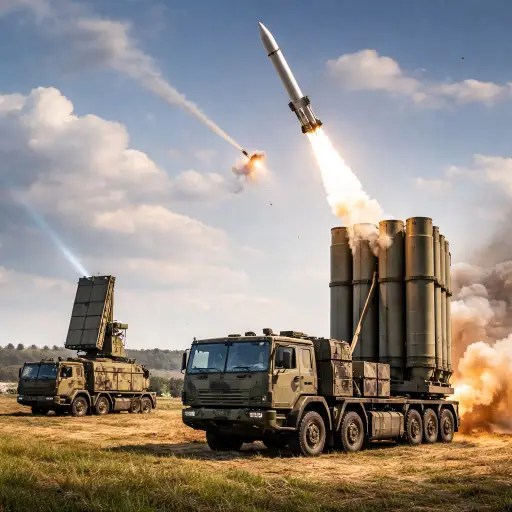
A Franco-Italian defense system designed to intercept ballistic threats may signal a new phase in European military autonomy.
As the war in Ukraine continues to reshape Europe’s security architecture, Kyiv is preparing to test one of the continent’s most advanced air defense technologies: the next-generation SAMP/T NG missile defense system. Developed jointly by France and Italy, the system represents Europe’s most ambitious attempt to field a modern, independent alternative to the widely used U.S. Patriot air defense platform.
The upcoming evaluation is expected to focus on the system’s ability to intercept ballistic missile threats—an increasingly urgent capability as Russian forces continue to employ a mix of cruise missiles, drones, and short-range ballistic weapons against Ukrainian cities and infrastructure. For Ukrainian military planners, the test offers an opportunity not only to strengthen defenses but also to assess how European-built systems can complement existing Western-supplied equipment.
The SAMP/T NG—short for Sol-Air Moyenne Portée/Terrestre Nouvelle Génération—is the latest evolution of the Franco-Italian air defense architecture originally designed for medium-range protection of critical assets. The system integrates advanced radar, command-and-control networks, and the Aster interceptor missile family, allowing it to engage aircraft, drones, and certain classes of ballistic missiles.
European defense officials view the new generation as a significant technological leap. Its updated radar is designed to track multiple high-speed threats simultaneously while providing greater resistance to electronic warfare. Improved targeting algorithms and enhanced integration with NATO command networks are intended to allow the system to function as part of a layered defense shield.
For Ukraine, which already operates a diverse array of Western air defense platforms, the test could demonstrate whether the SAMP/T NG can expand its interception capabilities against increasingly sophisticated attacks. Ukrainian forces have relied heavily on systems such as NASAMS, IRIS-T, and the Patriot battery to defend urban centers and energy infrastructure. Yet the scale and persistence of missile strikes have highlighted the need for additional coverage and redundancy.
Military analysts say that introducing the SAMP/T NG into Ukraine’s defensive network could also provide valuable operational data for its European developers. Real-world combat environments present challenges that are difficult to replicate during standard trials. Testing the system under Ukrainian operational conditions—where missile launches, drone swarms, and electronic interference are frequent—could accelerate refinements before broader deployment across European armed forces.
Beyond its technical implications, the evaluation carries significant political weight. European governments have spent the past several years debating how to strengthen the continent’s strategic autonomy in defense. While the United States remains the backbone of NATO’s military power, Russia’s invasion of Ukraine has intensified calls for Europe to expand its own industrial and technological capabilities.
The SAMP/T NG is often cited as a symbol of that ambition. By developing an indigenous missile defense platform capable of rivaling American systems, European states aim to reduce dependence on external suppliers while strengthening their own defense industries. France and Italy, the program’s lead partners, have emphasized that the system is designed to integrate with NATO while preserving European technological sovereignty.
Officials involved in the program also see Ukraine as a critical proving ground. If the system demonstrates strong performance during operational testing, it could encourage additional European nations to adopt the platform as part of future air defense networks. Several countries are already examining how to expand continental missile defense coverage, particularly in response to the growing threat posed by ballistic and hypersonic weapons.
The concept of a coordinated European air defense architecture has gained momentum in recent years. Initiatives aimed at linking national systems into a unified protective network have been discussed among EU and NATO members, with the goal of creating a layered shield capable of countering a wide spectrum of aerial threats. In that context, the SAMP/T NG could become a central component of Europe’s defensive framework.
For Ukraine, however, the issue remains immediate and practical. Each new capability introduced into its defensive arsenal directly affects the protection of cities, power plants, and civilian populations. Air defense systems have become one of the most critical elements of the country’s survival strategy, intercepting missiles that would otherwise strike densely populated areas.
Ukrainian officials have repeatedly emphasized that maintaining an effective air shield requires both technological diversity and sustained international support. Different systems excel at intercepting different categories of threats. Integrating the SAMP/T NG into the broader network could therefore strengthen resilience by adding another layer to an already complex defensive grid.
Defense experts note that Europe’s broader strategic outlook may also hinge on the results of such tests. If the SAMP/T NG proves capable of reliably intercepting ballistic missiles in demanding operational conditions, it would reinforce confidence in Europe’s ability to develop high-end defense technologies independently.
The system’s success could also influence future procurement decisions across NATO’s European members. Governments balancing defense budgets and industrial policy priorities often weigh whether to purchase American systems or invest in domestic alternatives. Demonstrated performance in Ukraine could shift that balance toward European solutions.
Ultimately, the upcoming test reflects a convergence of military necessity and strategic ambition. Ukraine’s need for stronger defenses has accelerated the deployment and evaluation of advanced technologies, while Europe’s desire for greater defense independence has created momentum for new systems like the SAMP/T NG.
As the system prepares to face one of the most challenging operational environments in modern warfare, its performance will be closely watched across military headquarters, defense industries, and political capitals throughout Europe.
Whether it becomes a cornerstone of the continent’s future missile defense architecture may depend on what happens when the new shield meets the realities of the battlefield.



 The Tower Post