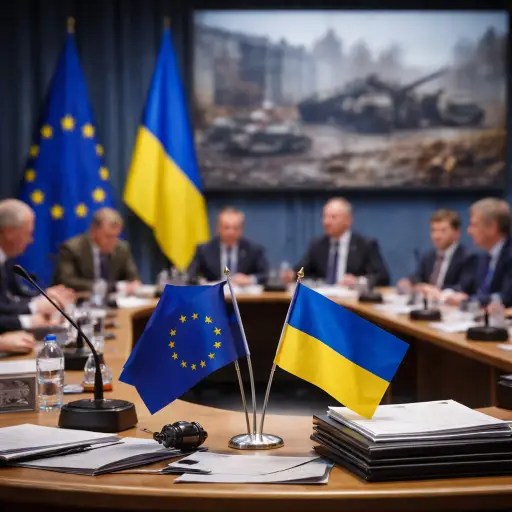
Brussels targets individuals linked to the Bucha massacre as European leaders stress that accountability for war crimes remains central to the continent’s response to Russia’s invasion.
The European Union has expanded its sanctions regime against individuals connected to alleged war crimes committed during Russia’s invasion of Ukraine, reinforcing a long-standing pledge by European leaders to pursue accountability for atrocities committed during the conflict.
In a move announced by officials in Brussels, the bloc imposed restrictive measures on a group of individuals believed to have been directly involved in or connected to the massacre in the Ukrainian town of Bucha. The killings, which shocked the international community when evidence first emerged after Russian forces withdrew from the area, remain among the most widely documented incidents of alleged war crimes during the invasion.
European officials say the new sanctions are intended to reinforce the message that crimes committed during wartime will not go unanswered. The measures form part of a much broader sanctions architecture created by the European Union since the start of the full-scale invasion, targeting political figures, military officers, and individuals accused of supporting or facilitating Russia’s war effort.
The newly listed individuals face travel bans and asset freezes within the European Union. Any property or financial holdings within EU jurisdictions are subject to immediate restriction, while European citizens and companies are prohibited from providing funds or economic resources to those sanctioned.
According to European officials familiar with the measures, the decision reflects ongoing investigations and documentation efforts conducted by international organizations, Ukrainian authorities, and independent human rights groups. Evidence collected in the aftermath of the Bucha massacre has played a central role in shaping the legal and political response among Ukraine’s allies.
Images and testimonies from the town became symbolic of the human toll of the conflict. Streets once lined with residential homes were transformed into scenes of devastation, and investigators later uncovered evidence of executions, torture, and mass graves. Ukrainian authorities quickly accused Russian forces of carrying out systematic killings of civilians.
Russia has repeatedly denied responsibility for the events in Bucha, claiming that the allegations were fabricated or manipulated after its troops withdrew from the area. Western governments and independent investigators have rejected those claims, pointing to satellite imagery, forensic evidence, and eyewitness accounts that suggest the violence occurred while Russian forces controlled the town.
The European Union’s sanctions announcement reflects a broader shift among Western governments toward integrating accountability measures into their long-term strategy regarding the war. While economic sanctions against Russian financial institutions, energy sectors, and political elites have been central tools since the invasion began, the focus on individual responsibility for alleged war crimes has grown steadily more prominent.
European leaders have emphasized that justice mechanisms must accompany military and humanitarian support for Ukraine. Several EU member states have opened national investigations under universal jurisdiction laws that allow prosecution of war crimes regardless of where they occur. In parallel, international bodies have intensified their efforts to collect and preserve evidence that could be used in future trials.
Officials in Brussels describe the sanctions as part of a coordinated international effort aimed at ensuring that those responsible for atrocities cannot move freely, access global financial systems, or avoid scrutiny. European diplomats say the measures are designed not only to punish alleged perpetrators but also to signal continued political commitment to Ukraine.
“The message is clear,” one European official said following the announcement. “Those responsible for crimes against civilians will be identified, and they will face consequences.”
The sanctions also highlight the expanding scale of the EU’s punitive framework against individuals connected to the war. Over time, the list of sanctioned persons has grown dramatically, encompassing military commanders, political officials, propagandists, and private actors believed to support the Russian state’s war effort.
Analysts say the strategy reflects the European Union’s attempt to combine economic pressure with legal accountability. By targeting individuals linked to specific incidents, European governments hope to strengthen the evidentiary trail that could eventually support international prosecutions.
The question of justice remains deeply tied to the broader trajectory of the war. Ukrainian leaders have consistently argued that peace cannot be achieved without accountability for crimes committed against civilians. Kyiv has repeatedly called for the creation of international mechanisms capable of prosecuting both war crimes and the broader crime of aggression linked to the invasion.
Within Europe, the issue carries significant political weight. The atrocities reported in Bucha helped galvanize public opinion across the continent and reinforced support for sanctions, military aid, and humanitarian assistance to Ukraine. For many European governments, the events served as a turning point in perceptions of the war.
Human rights organizations have welcomed the EU’s continued focus on accountability but caution that sanctions alone cannot deliver justice. Investigations must be followed by formal legal processes capable of establishing individual responsibility beyond political condemnation.
Still, European officials argue that sanctions play an important role in building pressure while investigations continue. By restricting mobility and financial access, the measures limit the ability of suspects to evade scrutiny and keep international attention focused on alleged crimes.
As the war continues with no immediate resolution in sight, European leaders say maintaining pressure on those accused of atrocities remains essential. The expansion of sanctions tied to the Bucha massacre signals that the European Union intends to keep the issue of war crimes at the center of its response to the conflict.
For Ukraine and its allies, the message is meant to endure beyond the battlefield: accountability, they insist, is not optional.



 The Tower Post