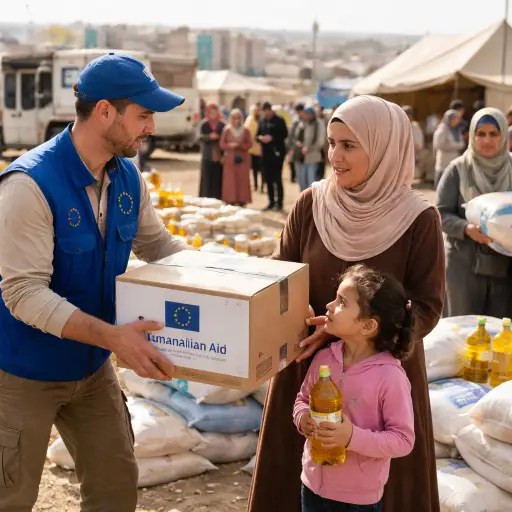
A new €458 million initiative signals the European Union’s growing commitment to stabilizing crisis-hit communities across Palestine, Lebanon, Syria, and Jordan.
The European Union has announced a sweeping humanitarian assistance package worth €458 million aimed at addressing urgent needs across some of the Middle East’s most fragile regions. The funding, unveiled by the European Commission, is intended to support humanitarian operations in Palestine, Lebanon, Syria, and Jordan—areas where protracted conflict, economic instability, and displacement continue to place millions of civilians at risk.
The initiative reflects an increasingly assertive European role in responding to humanitarian crises beyond its borders. As instability in the Middle East continues to reverberate across the wider region, EU officials say the new funding is designed not only to deliver emergency relief but also to reinforce long-term stability and resilience.
European humanitarian officials emphasized that the package will be directed toward life-saving services including food assistance, healthcare, shelter, and support for displaced communities. Aid organizations working on the ground will receive much of the funding through established humanitarian networks, ensuring rapid deployment to communities most in need.
Addressing Multiple Crises at Once
The Middle East remains one of the world’s most complex humanitarian landscapes. Years of conflict and economic decline have left deep scars across several societies, forcing millions of people to rely on international assistance for basic survival.
In Syria, the humanitarian situation remains particularly severe after more than a decade of conflict. Large portions of the population continue to face food insecurity, disrupted healthcare systems, and damaged infrastructure. The EU’s funding will help international organizations expand relief operations and maintain essential services in vulnerable communities.
Lebanon is also expected to receive significant support through the new aid package. The country has struggled under the weight of an unprecedented financial crisis while simultaneously hosting a large population of refugees from neighboring conflicts. Humanitarian groups have warned that deteriorating economic conditions have pushed increasing numbers of families below the poverty line.
In Palestine, humanitarian needs have grown as communities confront both economic hardship and the ongoing consequences of regional tensions. EU assistance is expected to focus on protecting vulnerable civilians, strengthening access to healthcare and education, and ensuring food supplies for communities facing instability.
Jordan, long considered a pillar of regional stability, continues to host a substantial refugee population despite limited domestic resources. European funding will help sustain services for displaced families and assist local communities that have absorbed the pressure of large-scale displacement.
Supporting Humanitarian Partners on the Ground
A key element of the EU strategy involves strengthening partnerships with international humanitarian organizations and local aid groups already operating in the region. By channeling funding through experienced actors, the European Commission aims to ensure that assistance reaches those most in need quickly and efficiently.
Humanitarian agencies emphasize that the scale of need across the Middle East requires sustained global support. While the EU has long been one of the world’s largest humanitarian donors, officials say the latest funding reflects a renewed determination to address crises that have persisted for years with no easy solutions.
Aid workers note that financial resources are only part of the response. Access to vulnerable communities, safe operating conditions for humanitarian staff, and cooperation among international partners remain critical to effective relief efforts.
A Broader Strategic Role for Europe
Beyond immediate humanitarian assistance, the funding announcement also carries geopolitical significance. European policymakers increasingly view humanitarian engagement as a key component of broader regional stability.
Persistent crises in the Middle East can have far-reaching consequences, including displacement, economic disruption, and security challenges that extend well beyond national borders. By investing in humanitarian support and resilience, European leaders hope to mitigate the conditions that fuel prolonged instability.
The initiative also underscores Europe’s ambition to maintain an active diplomatic and humanitarian presence in the region at a time when global attention is often divided among multiple international crises.
Challenges Ahead
Despite the new funding, humanitarian experts caution that the scale of need in the Middle East remains immense. Millions of people continue to require assistance, and relief organizations frequently face funding gaps that limit their ability to respond fully.
Economic volatility, political uncertainty, and the lingering effects of conflict mean that humanitarian needs are unlikely to diminish quickly. Long-term recovery will depend not only on aid but also on political solutions, economic reforms, and reconstruction efforts across the region.
Still, European officials argue that sustained humanitarian engagement can help prevent conditions from deteriorating further while diplomatic and development efforts continue.
A Message of Commitment
By committing hundreds of millions of euros to crisis-affected communities, the European Union is signaling that it intends to remain deeply involved in addressing humanitarian challenges in the Middle East.
For families struggling with displacement, food shortages, and fragile healthcare systems, the support offers a measure of relief. For policymakers in Brussels, the initiative represents both a humanitarian obligation and a strategic investment in regional stability.
As humanitarian agencies begin deploying the new resources across Palestine, Lebanon, Syria, and Jordan, the EU’s latest move highlights a broader reality: in a region shaped by overlapping crises, sustained international engagement remains essential to easing suffering and building a path toward long-term resilience.




 The Tower Post