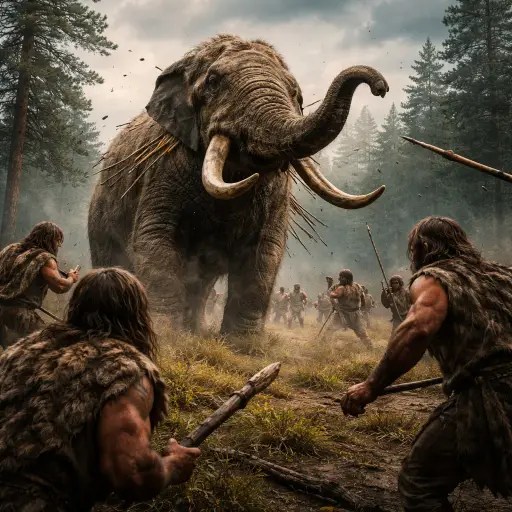
New research suggests prehistoric hunters tracked giant migrating elephants across vast stretches of Europe
For generations, Neanderthals were portrayed as primitive survivors—rugged, resilient, but limited in their ability to plan and organize. A new wave of scientific evidence is steadily reshaping that image. Recent research examining fossilized elephant teeth now suggests that Neanderthals were capable of tracking enormous prey across hundreds of kilometers, coordinating hunts that required patience, knowledge of migration patterns, and sophisticated cooperation.
The discovery comes from the analysis of ancient elephant remains found across Central Europe. By studying the chemical signatures preserved in fossilized teeth, researchers were able to reconstruct the movements of the animals during their lifetimes. The results reveal an astonishing journey: some of the massive prehistoric elephants had traveled more than three hundred kilometers before they were eventually killed.
For scientists studying early human behavior, the implications are striking.
The elephants in question were not ordinary animals. Towering over modern elephants and weighing several tons, they would have been among the largest creatures roaming Ice Age landscapes. Hunting such an animal would have required not only courage but also organization and strategic thinking. The new findings suggest that Neanderthal groups may have tracked these giants over vast distances, possibly following seasonal migration routes across forests, grasslands, and river valleys.
“This kind of movement tells us that the animals were highly mobile,” researchers explain. “If Neanderthals were hunting them, they must have understood where these herds were going and how to intercept them.”
The key to the discovery lies inside the elephants’ teeth. Like tree rings, layers within tooth enamel preserve chemical traces of the environment in which an animal lived. As elephants traveled across different landscapes, the composition of minerals in the water and plants they consumed changed. Those subtle differences became locked inside the teeth.
By comparing these chemical patterns with geological maps of Central Europe, scientists were able to reconstruct the animals’ routes. The data revealed that some elephants moved extraordinary distances during their lives, crossing multiple ecological zones before ending up at sites where Neanderthal hunting activity has been identified.
The findings challenge long-standing assumptions about Neanderthal life.
For decades, popular depictions suggested Neanderthals were opportunistic hunters who focused on animals they encountered nearby. The idea of tracking prey over hundreds of kilometers seemed unlikely for groups believed to live in small, localized territories.
But the new evidence paints a different picture—one of hunters deeply familiar with their landscapes.
To follow migrating elephants, Neanderthal groups would have needed detailed environmental knowledge. They likely understood seasonal patterns, water sources, and natural corridors that large animals used to travel. River valleys, open plains, and forest edges may have served as predictable pathways for the giants moving across Europe.
Tracking alone would not have been enough. Successfully hunting such a massive animal would require coordination among many individuals. Researchers believe Neanderthals may have used terrain to their advantage, guiding elephants toward natural bottlenecks, muddy ground, or steep slopes where the animals were more vulnerable.
Archaeological evidence from several European sites supports this idea. Remains of large elephants have been discovered alongside clusters of stone tools and butchered bones, indicating organized hunting and processing of the enormous carcasses.
The rewards would have been immense.
A single elephant could provide thousands of kilograms of meat, fat, and marrow—enough food to sustain a community for weeks. The hides could be used for shelter or clothing, while bones and tusks might be fashioned into tools or structural materials.
Such a bounty would have justified the risks involved in hunting an animal many times larger than the hunters themselves.
Equally important, the research suggests that Neanderthal groups may have been more mobile than previously believed. Following elephant migrations over large areas implies that these populations were capable of traveling widely and maintaining knowledge of distant territories.
This mobility could also have encouraged communication between groups. Some researchers speculate that different Neanderthal communities may have shared information about migration routes or seasonal hunting grounds.
The picture emerging from modern research is increasingly complex.
Far from being isolated bands struggling to survive, Neanderthals appear to have been adaptable and strategic hunters. Their survival across harsh Ice Age climates required not only physical endurance but also social cooperation and environmental awareness.
The new findings also highlight how modern scientific techniques are transforming our understanding of ancient life. Chemical isotope analysis, once rarely applied to archaeology, now allows scientists to reconstruct animal movements with remarkable precision. Each fossil tooth becomes a record of journeys that ended tens of thousands of years ago.
As more remains are analyzed, researchers expect additional surprises.
Prehistoric landscapes were dynamic environments filled with migrating herds, shifting climates, and human populations adapting to constant change. Understanding how Neanderthals navigated this world offers clues not only about their intelligence but also about the evolutionary roots of human hunting strategies.
In the end, the story told by a single elephant tooth stretches far beyond the animal itself. It reveals a network of movements across ancient Europe—and hunters who were far more capable and organized than once imagined.
The long hunt, it seems, may have been one of Neanderthal society’s greatest achievements.




 The Tower Post