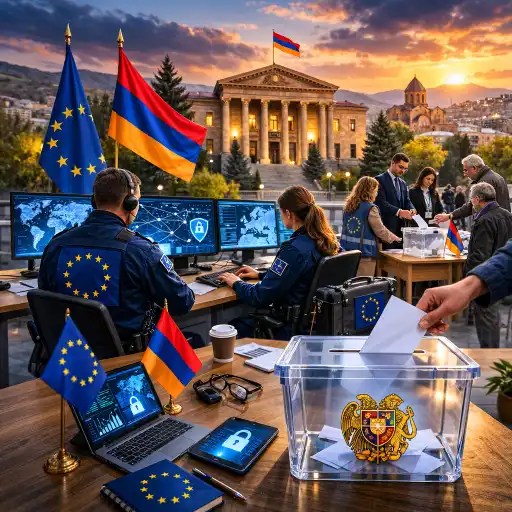
Brussels sends a specialized rapid response mission to help defend Armenia’s parliamentary elections from cyberattacks, disinformation, and foreign interference as protecting democratic systems abroad becomes a growing EU priority.
As Armenia prepares for a pivotal parliamentary vote, the European Union is stepping in with an unprecedented security initiative aimed at protecting the integrity of the country’s democratic process. In a move reflecting the growing geopolitical importance of election security, Brussels plans to deploy a Hybrid Rapid Response Team to assist Armenian authorities in countering cyber threats, disinformation campaigns, and other forms of hybrid interference.
The mission underscores a broader shift in European policy: safeguarding democratic institutions beyond the EU’s borders is increasingly seen as essential to the bloc’s own security.
European officials say the deployment reflects lessons learned from recent elections across Europe and neighboring regions, where digital attacks and information manipulation have become common tools of geopolitical competition. By providing technical expertise and operational support, the EU hopes to ensure that Armenia’s vote proceeds without disruption from external actors seeking to undermine public trust.
A New Type of Election Protection
The Hybrid Rapid Response Team is composed of cybersecurity specialists, strategic communication experts, and analysts trained in identifying coordinated disinformation operations. The unit is designed to operate quickly and flexibly, assisting partner countries that face emerging threats to democratic institutions.
In Armenia, the team will work alongside national authorities and election officials to strengthen digital defenses around voting infrastructure. This includes monitoring networks for potential cyber intrusions, advising on the protection of election-related databases, and coordinating responses if suspicious activity is detected.
Another key focus will be the information space. Disinformation campaigns targeting elections have become a central concern across Europe, often involving false narratives spread through social media platforms, anonymous websites, and coordinated bot networks.
EU specialists will help Armenian institutions identify and counter such campaigns before they gain traction. The goal is not to control political debate but to ensure voters receive accurate information and are not manipulated by fabricated stories or foreign influence operations.
Armenia’s Strategic Moment
For Armenia, the upcoming parliamentary vote carries particular significance. The country has undergone profound political and security challenges in recent years, and the election is widely viewed as an important moment for reaffirming democratic stability.
International observers note that Armenia has taken steps to strengthen electoral transparency since earlier political transitions. Still, the complex geopolitical environment of the South Caucasus has made the country increasingly vulnerable to hybrid threats.
These threats do not necessarily involve conventional military force. Instead, they can include cyber intrusions, economic pressure, propaganda campaigns, and other tactics designed to influence public opinion or destabilize political institutions.
By inviting European support, Armenia signals its intention to reinforce democratic safeguards while maintaining open engagement with international partners.
Hybrid Threats on the Rise
Across Europe and its neighborhood, hybrid interference has emerged as one of the defining security challenges of the digital era. Elections, in particular, have become prime targets for manipulation efforts aimed at weakening democratic legitimacy.
Cyberattacks can disrupt voter registration systems or election infrastructure, while coordinated disinformation campaigns attempt to erode trust in institutions, candidates, or the voting process itself.
European policymakers increasingly view these tactics as part of a broader strategy used by hostile actors to exploit open societies.
As a result, the EU has invested heavily in building capabilities to detect and respond to such threats. Hybrid Rapid Response Teams are one element of that effort, designed to deploy expertise rapidly wherever democratic processes may be at risk.
Brussels Expands Its Democratic Security Role
The mission to Armenia reflects a growing consensus within the European Union that defending democracy cannot stop at its own borders. Instability or interference in neighboring states can have ripple effects across the wider region, affecting security, migration, economic cooperation, and political stability.
By helping partners strengthen their electoral resilience, EU officials argue, the bloc contributes to a more stable and predictable international environment.
The deployment also represents a new form of diplomacy. Instead of traditional military assistance, the EU is offering technical expertise in areas such as cybersecurity, digital governance, and information integrity—fields that have become critical battlegrounds in modern geopolitics.
Balancing Support and Sovereignty
European officials emphasize that the mission will operate strictly in support of Armenian institutions. The team’s role is advisory and technical, ensuring local authorities remain fully responsible for managing the election process.
This cooperative approach is intended to avoid any perception of outside control while still providing meaningful assistance against sophisticated threats.
For Armenia, the partnership offers access to advanced expertise that can help strengthen long-term resilience against digital and informational attacks.
A Test Case for Future EU Missions
The deployment could also serve as a model for future operations. As hybrid threats evolve, the EU is exploring ways to provide rapid, targeted support to countries facing election interference or cyber pressure.
If the mission in Armenia proves successful, similar teams could be sent to other partner states preparing for major political events.
For Brussels, the message is clear: protecting democracy has become a central element of European foreign policy.
Looking Ahead
As Armenia approaches its parliamentary vote, the presence of European hybrid security specialists reflects a broader transformation in how elections are defended in the digital age.
Ballot boxes and polling stations remain at the heart of democratic participation, but the battleground now extends far beyond them—to cyberspace, social media platforms, and the complex ecosystem of online information.
By deploying its Hybrid Rapid Response Team, the European Union hopes to ensure that Armenia’s voters can make their choices freely, without manipulation or interference.
In an era where democratic processes are increasingly targeted by unseen digital forces, the effort signals a new reality: safeguarding elections has become not only a national responsibility, but an international one.




 The Tower Post