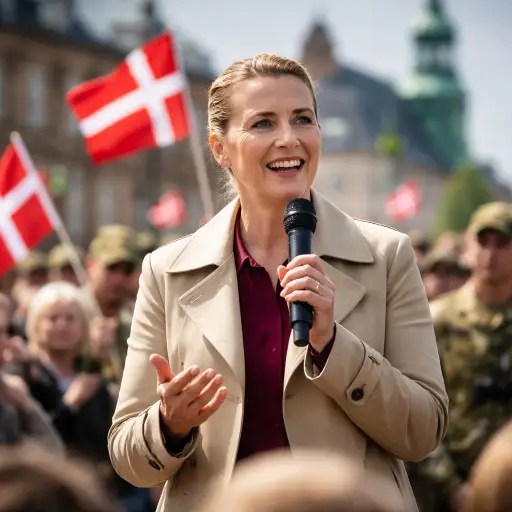
With voters focused on rising living costs, security policy, and Greenland’s geopolitical role, Denmark’s prime minister campaigns for renewed leadership in a shifting Nordic and European landscape.
Denmark’s political landscape is entering a decisive moment as Prime Minister Mette Frederiksen campaigns for another term, presenting herself as the steady hand capable of guiding the country through a period of economic pressure and strategic uncertainty. As the election approaches, the Danish leader is placing the cost of living, defense priorities, and the future of Greenland at the center of her appeal to voters.
Frederiksen, who has led the Social Democratic government for several years, is seeking to convince voters that continuity in leadership is essential while Europe navigates a volatile geopolitical environment. Her campaign message blends domestic economic concerns with broader security considerations, reflecting a reality in which Danish voters increasingly see national prosperity and international stability as closely linked.
The cost of living has emerged as the most immediate concern for households across Denmark. Despite the country’s reputation for strong social protections and economic resilience, rising prices for housing, energy, and everyday goods have strained many families. Frederiksen has emphasized that her government intends to shield middle- and lower-income households from further economic pressure, promising targeted relief and continued investment in public services.
In speeches across the country, the prime minister has framed economic stability as the foundation of Denmark’s broader policy agenda. Her government argues that maintaining strong welfare institutions while keeping public finances under control will help protect the country from the worst effects of global economic turbulence. Critics, however, contend that the government has not moved quickly enough to address inflationary pressures and argue that new approaches are needed to support Danish businesses and workers.
At the same time, Frederiksen’s campaign places unusual emphasis on defense policy, reflecting the shifting security environment in Europe. Denmark has increased its military commitments and strengthened cooperation with NATO allies in response to heightened tensions across the continent. The prime minister argues that maintaining robust defense capabilities is essential not only for Denmark’s security but also for safeguarding democratic stability in the wider Nordic and European regions.
Defense policy has become a prominent election issue as Danish leaders debate the scale and pace of future military investments. Frederiksen has pledged continued modernization of the armed forces and deeper collaboration with Nordic partners. Supporters view this as a pragmatic response to changing geopolitical realities, while opponents question whether increased defense spending could divert resources from domestic priorities.
Another key theme in the campaign is Denmark’s relationship with Greenland, the vast Arctic territory that remains part of the Kingdom of Denmark but has its own self-governing institutions. Greenland’s strategic importance has grown dramatically in recent years as global powers show renewed interest in the Arctic’s resources and shipping routes.
Frederiksen has argued that Denmark must maintain a balanced approach that respects Greenland’s autonomy while safeguarding the kingdom’s shared interests. Her government has stressed cooperation with Greenlandic authorities on economic development, climate policy, and infrastructure while also acknowledging the territory’s increasing geopolitical significance.
For Danish voters, Greenland is no longer a distant issue. The Arctic’s emerging role in global politics has elevated questions about sovereignty, security, and economic opportunity. Frederiksen’s campaign highlights the importance of keeping strategic decision-making within the kingdom while ensuring that Greenland’s voice remains central in discussions about its future.
The election could also have consequences beyond Denmark’s borders. As one of the Nordic region’s most influential political figures, Frederiksen plays an important role in shaping regional policy discussions. Her leadership style—often described as pragmatic and security-focused—has influenced debates on migration policy, welfare reform, and European cooperation.
Within the European Union, Denmark has been an active participant in discussions on energy policy, economic stability, and defense coordination. A renewed mandate for Frederiksen could reinforce Denmark’s current policy direction, particularly on issues related to security and social protection. A change in leadership, however, could shift the balance of voices within both Nordic cooperation and EU decision-making.
Political analysts note that the campaign reflects a broader transformation in European politics, where economic anxiety and geopolitical uncertainty increasingly dominate electoral debates. Denmark, long seen as a model of stability, now finds itself grappling with the same pressures reshaping politics across the continent.
Frederiksen’s strategy is to present herself as both a defender of the Danish welfare model and a leader prepared to confront international challenges. Her message emphasizes that the country’s social stability, economic resilience, and security commitments are deeply interconnected.
Whether voters ultimately grant her another mandate remains uncertain. The election will test not only the popularity of Frederiksen’s government but also the broader direction Denmark chooses as it navigates an era defined by economic strain and strategic competition.
What is clear is that the outcome will resonate beyond Denmark itself. In a region known for political stability and close cooperation, the choice Danish voters make could influence Nordic leadership dynamics and shape the tone of policy debates within Europe for years to come.

 The Tower Post