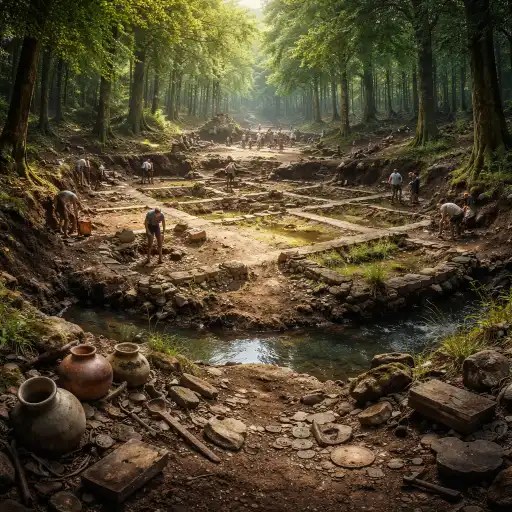
Archaeologists uncover the forgotten town of Stolzenberg hidden for centuries under dense woodland in Poland, revealing streets, a market square, and hundreds of artifacts — while the mystery of its disappearance deepens.
Across a quiet stretch of forest in Poland, where thick trees and moss-covered ground had long concealed the past, archaeologists have uncovered the remains of a forgotten medieval town — a settlement that once bustled with life before vanishing from history.
The lost city, identified as Stolzenberg, had been hidden beneath the forest floor for centuries. What researchers initially believed might be scattered ruins soon revealed itself to be something far larger: the nearly complete layout of a medieval town, preserved in remarkable detail beneath layers of soil, roots, and time.
Using advanced surveying methods and careful excavation, archaeologists mapped out a network of streets converging on a central market square, the beating heart of the settlement when it was alive with traders, craftsmen, and villagers. Around the square, foundations of wooden and stone structures indicate homes, workshops, and merchant stalls that once formed the lively center of the town.
One of the most striking discoveries is a deep defensive moat encircling part of the settlement. The moat suggests that Stolzenberg was not merely a small village but a strategically planned town, possibly fortified during periods of regional conflict. Its defensive design indicates the settlement may have held economic or military importance during the medieval period.
During the excavations, researchers uncovered more than four hundred artifacts from different eras, including pottery fragments, iron tools, coins, decorative objects, and household items. Together, these discoveries offer a vivid glimpse into everyday life in the settlement.
Some of the artifacts appear to originate from different historical periods, suggesting that Stolzenberg may have been inhabited for generations before it was ultimately abandoned. The mix of objects also hints at trade connections with nearby regions, indicating that the town may once have been part of a broader commercial network.
Yet despite the remarkable state of preservation, the biggest question surrounding Stolzenberg remains unanswered.
Why did the town disappear?
Historical records provide only fragmentary clues. The settlement’s name appears in a handful of medieval documents, but references abruptly stop, leaving historians with no clear explanation for its fate. Unlike cities destroyed by well-documented wars or disasters, Stolzenberg seems to have simply faded from written history.
Researchers are currently considering several possible explanations. One theory suggests the town may have been abandoned after a regional conflict or political shift disrupted trade routes. Another possibility is environmental change: flooding, soil degradation, or disease could have forced inhabitants to relocate.
Over centuries, abandoned farmland and empty streets can quickly return to wilderness. Once buildings collapse and vegetation spreads, a town can disappear almost completely from view. In Stolzenberg’s case, dense woodland gradually covered the site, preserving its layout while erasing it from living memory.
Today archaeologists carefully brush soil away from stone outlines and fragments of everyday objects that have not been touched for hundreds of years. Each artifact adds another piece to the puzzle of a community that once thrived here.
The discovery of Stolzenberg is already being described by researchers as one of the most intriguing archaeological finds in recent years. Unlike many excavations that uncover only isolated structures, this site provides an unusually complete picture of an entire medieval town.
For historians, the discovery offers a rare opportunity: the chance to reconstruct the life of a settlement that disappeared so thoroughly it slipped out of recorded history.
Further excavations are expected to continue as scientists attempt to map the full extent of the town and analyze the artifacts recovered from the site. New technologies, including soil analysis and remote sensing, may eventually reveal more about how Stolzenberg developed — and why it was ultimately abandoned.
For now, the quiet forest that concealed the city for centuries has become a window into the medieval past.
Beneath its trees lies the story of a community once filled with voices, trade, and daily life — a town that vanished without explanation, only to emerge again centuries later from the silence of the earth.




 The Tower Post