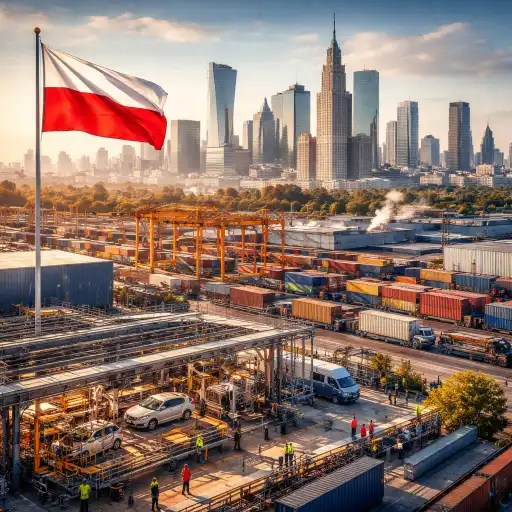
Rapid industrial growth, rising wages, and strong investment flows are turning Poland into one of the European Union’s most dynamic economies and reshaping the continent’s economic balance.
Across Europe, a quiet but powerful economic shift is underway. Once viewed primarily as a fast-growing emerging market within the European Union, Poland is increasingly being recognized as one of the continent’s central economic engines. Its combination of industrial expansion, rising wages, and sustained investment has propelled the country into a new role: a manufacturing hub and growth driver that is influencing the broader European economy.
For decades, Poland’s economic story has been one of transformation. Following the collapse of the communist system and the transition to a market economy, the country embarked on a long period of structural reforms and integration with Western institutions. Membership in the European Union accelerated this process, opening access to markets, funding, and supply chains that allowed Polish industry to modernize rapidly.
Today, the results of that transformation are becoming increasingly visible. Poland’s economy has expanded steadily, with manufacturing output, exports, and domestic consumption rising in tandem. Factories producing everything from automotive components to electronics and household appliances have spread across the country, supplying both European and global markets.
Analysts say the country’s economic rise is not simply a matter of growth rates. It represents a deeper shift in the economic geography of Europe.
“Poland is no longer just catching up,” one European economist explains. “It is becoming a central pillar of the continent’s industrial ecosystem.”
Manufacturing has become the backbone of Poland’s economic strength. International companies have steadily expanded their production bases in the country, attracted by a combination of skilled labor, modern infrastructure, and strategic geographic location between Western and Eastern Europe.
Industrial regions across the country have seen rapid development. Automotive production, machinery manufacturing, and electronics assembly have all flourished, often integrated into supply chains serving major European markets.
Polish firms themselves have also grown stronger. Many domestic manufacturers have moved beyond simple assembly operations into higher-value production, engineering, and technology development. The shift toward more advanced industrial activity has helped push productivity higher and has made the country more competitive globally.
Alongside industrial expansion, wages in Poland have been rising steadily. Higher incomes have strengthened household spending, contributing to robust domestic demand that complements export-driven growth.
The emergence of a stronger middle class has transformed the country’s economic landscape. Cities such as Warsaw, Kraków, Wrocław, and Gdańsk have become thriving economic centers, attracting investment in technology, services, and finance.
Retail, housing, and consumer services have expanded rapidly as purchasing power has increased. This growing domestic market has made Poland less dependent solely on exports and has provided an additional pillar of economic stability.
At the same time, higher wages are reshaping labor dynamics within Europe. For years, many Polish workers moved abroad in search of better opportunities. Now, an increasing number are choosing to stay or return home as job prospects improve domestically.
Investment remains a key driver of Poland’s economic momentum. Both foreign and domestic capital have flowed into infrastructure, industry, and innovation.
European funding programs have helped modernize transport networks, railways, and logistics hubs, making it easier for companies to operate and ship goods across the continent. Meanwhile, private investment has poured into technology parks, manufacturing plants, and research facilities.
The technology sector, in particular, has grown rapidly. Poland has become an important center for software development, business services, and engineering. International technology firms have established major operations in Polish cities, while local startups have begun to gain recognition across Europe.
This mix of industrial strength and technological development has created a diversified economic base that analysts believe will support long-term growth.
Poland’s geographic position also plays a crucial role in its economic rise. Located at the crossroads of major European trade routes, the country serves as a logistical bridge between Western Europe and emerging markets to the east.
This strategic location has made Poland an attractive destination for companies seeking to diversify supply chains and strengthen regional production networks.
In recent years, global supply disruptions have prompted many businesses to reconsider where they manufacture goods. Poland has benefited from this shift, with companies increasingly relocating production closer to European markets. Economists often describe this trend as “nearshoring,” and Poland has emerged as one of its biggest beneficiaries.
The country’s rapid economic progress is beginning to reshape Europe’s economic balance. While traditional powerhouses such as Germany and France remain dominant, Poland’s influence within the European economy is growing steadily.
As its industrial base expands and its domestic market strengthens, Poland is gaining greater weight in European policy discussions and economic strategy. Some analysts argue that Central and Eastern Europe as a whole is becoming a new axis of growth for the European Union, with Poland at its center.
“Poland is moving from the periphery to the core of Europe’s economy,” says one regional policy expert. “Its growth is helping redefine where economic dynamism in Europe comes from.”
Despite its strong momentum, Poland still faces challenges. Labor shortages, demographic pressures, and the need for continued innovation will require careful economic management in the years ahead.
Maintaining competitiveness while wages rise will also be crucial. Continued investment in education, technology, and infrastructure will likely play a key role in sustaining growth. Energy transformation is another important issue, as the country works to modernize its energy system while supporting industrial development.
Yet many economists remain optimistic. Poland’s track record of adaptation and reform has built confidence that the country can navigate future challenges successfully.
Poland’s rise reflects a broader transformation underway across the European economy. As industries evolve and supply chains shift, new centers of economic dynamism are emerging.
With its expanding manufacturing sector, rising incomes, and strong investment flows, Poland is increasingly positioned as one of those centers.
What began as a story of economic convergence is now becoming something more significant: the emergence of a new European powerhouse.


 The Tower Post