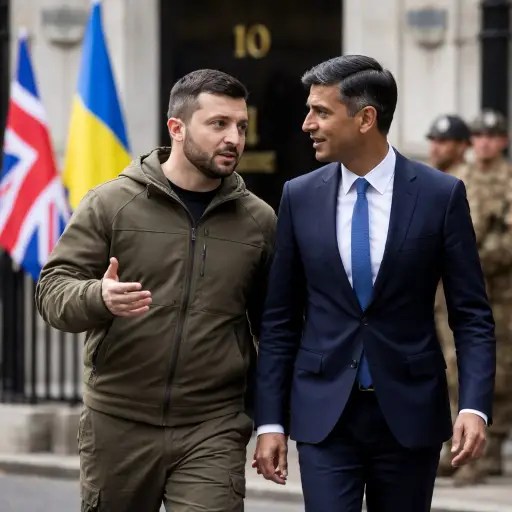
Ukrainian President warns that shifting global attention toward the Middle East could weaken military and diplomatic support for Kyiv.
Ukrainian President Volodymyr Zelensky has urged European leaders to maintain strong political and military backing for Ukraine as the war with Russia continues, warning that the conflict risks slipping from the center of global attention.
During meetings with British leaders in London, Zelensky emphasized that sustained European unity remains critical to Ukraine’s ability to resist Russian aggression. His message was direct: while other geopolitical crises intensify, the war in Ukraine cannot be allowed to fade into the background.
The Ukrainian leader’s visit comes at a moment when international focus has increasingly turned toward rising tensions in the Middle East, particularly the confrontation involving Iran and regional actors. Ukrainian officials fear that this shift could divert diplomatic energy, military resources, and political attention away from Europe’s largest armed conflict in decades.
“We cannot allow the world’s attention to drift away from Ukraine,” Zelensky said during discussions with British officials. “If focus weakens, the consequences will be felt directly on the battlefield.”
Concern Over Global Distraction
Western policymakers acknowledge that the growing complexity of global crises is creating competition for attention. The escalation of conflict dynamics in the Middle East has triggered urgent diplomatic efforts and military considerations across Europe and the United States.
For Kyiv, however, the concern is not merely symbolic. Ukrainian officials warn that a decrease in international engagement could translate into slower military deliveries, reduced financial assistance, and less coordinated diplomatic pressure on Moscow.
European leaders broadly agree that supporting Ukraine remains a strategic priority, but some analysts note that sustaining political momentum becomes more challenging as wars drag on and new crises emerge.
“The international system is dealing with multiple flashpoints at once,” said a senior European diplomatic official familiar with the discussions. “The challenge is ensuring that support for Ukraine does not erode simply because other emergencies demand attention.”
A War Entering a Prolonged Phase
The war between Russia and Ukraine has evolved into a prolonged and grinding conflict characterized by intense artillery battles, drone warfare, and shifting front-line positions. Ukrainian forces continue to depend heavily on Western-supplied equipment, intelligence cooperation, and financial assistance to maintain their defensive capabilities.
Zelensky has consistently argued that Ukraine’s fight is not only about national sovereignty but also about the broader security architecture of Europe. According to Ukrainian officials, allowing Russia to consolidate territorial gains would undermine international law and embolden further aggression.
That argument remains central to Kyiv’s diplomatic outreach across European capitals. By reinforcing the narrative that Ukraine’s defense is tied to continental stability, Zelensky hopes to maintain the unity that initially defined the Western response to the invasion.
The Message to Europe
During his meetings in London, Zelensky framed the issue as one of strategic consistency rather than competing crises. Europe, he suggested, must demonstrate that it can respond to multiple global challenges without abandoning commitments already made.
“Unity is our strength,” Zelensky said in remarks following his talks. “Europe has shown that it can stand together. Now it must continue to do so.”
British officials reiterated their commitment to supporting Ukraine and emphasized the importance of maintaining pressure on Russia through sanctions, diplomatic isolation, and continued military assistance.
Balancing Multiple Crises
The concern expressed by Ukrainian leaders reflects a broader reality facing global policymakers: the international agenda is increasingly crowded. Conflicts, geopolitical rivalries, and economic pressures are unfolding simultaneously, forcing governments to divide attention and resources.
Still, European officials involved in discussions with Kyiv insist that Ukraine remains a core strategic issue for the continent. Many argue that allowing fatigue or distraction to weaken support would send a dangerous signal about the durability of Western alliances.
For Zelensky, the message delivered in London was meant to reinforce a simple principle — that global crises cannot be ranked in a way that leaves Ukraine overlooked.
As diplomatic efforts continue and conflicts evolve elsewhere, Kyiv is determined to keep the war firmly in the international spotlight.
“Do not forget Ukraine,” Zelensky told European partners, underscoring the urgency of sustained support as the war continues.


 The Tower Post