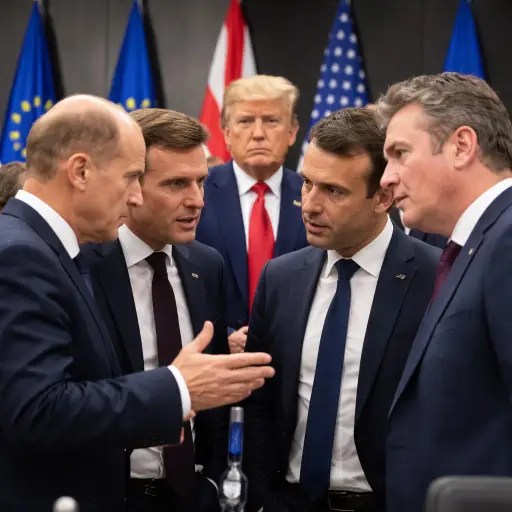
Germany, France, UK declare: “This is not our war” as transatlantic divide deepens over strategy and legality
In a striking and unusually unified stance, Europe’s leading powers have firmly rejected Washington’s call to join a new U.S.-led military campaign, marking one of the most serious political rifts between the United States and its European allies in recent years.
Leaders in Berlin, Paris, and London delivered a coordinated message: they will not commit troops, resources, or political backing to what they increasingly describe as a unilateral American operation lacking both strategic clarity and legal justification. The response signals not only a policy disagreement but a broader shift in how Europe defines its role in global security.
“This is not our war,” a senior European official stated bluntly, reflecting a sentiment echoed across multiple capitals. The remark captures a growing reluctance within Europe to be drawn into conflicts perceived as distant from its immediate security interests and insufficiently grounded in international consensus.
The refusal follows direct appeals from U.S. President Donald Trump, who urged European allies to support military action, framing it as a necessary step to maintain global stability and demonstrate Western unity. However, those appeals have been met with skepticism and, in some cases, outright resistance.
German leadership emphasized that its priority remains the protection of European territory and stability. Officials stressed that participation in external military engagements must meet strict legal and strategic criteria—standards they argue have not been satisfied in this case.
France has similarly underscored the importance of diplomacy over escalation. French authorities signaled concern that military intervention could worsen regional instability rather than resolve it, advocating instead for renewed negotiations and multilateral engagement.
In the United Kingdom, government officials aligned with their continental counterparts, reiterating a commitment to peaceful resolution and cautioning against rapid escalation. British leaders emphasized that alliance solidarity does not equate to automatic participation in every U.S.-initiated operation.
At the core of Europe’s refusal lies a deep concern over legality. Across the continent, policymakers and legal experts have questioned the absence of a clear international mandate. Without authorization from recognized global institutions, many European governments argue, participation would undermine the very legal frameworks they have long defended.
“This conflict lacks a solid basis under international law,” noted one European diplomat. “We cannot justify involvement without a legitimate mandate and a clearly defined objective.”
These concerns are not merely institutional—they are also political. Public opinion across Europe has shown strong resistance to entering another military conflict. Demonstrations have emerged in major cities, with citizens voicing fears of prolonged instability, economic consequences, and the human cost of war.
Polling trends indicate that a significant majority of Europeans oppose military involvement, reinforcing the cautious stance adopted by their governments. For many leaders, domestic pressure has become an additional factor shaping foreign policy decisions.
The disagreement has exposed a widening transatlantic divide, raising questions about the future of long-standing alliances. While cooperation between the United States and Europe remains robust in many areas, this episode highlights growing differences in strategic priorities and approaches to global conflict.
Analysts suggest that Europe is increasingly asserting a more independent foreign policy, one less automatically aligned with Washington’s agenda. This shift reflects broader changes in global power dynamics, as well as lessons drawn from previous conflicts that left lasting political and social consequences.
For the United States, the lack of European support presents both a diplomatic and operational challenge. The absence of key allies complicates efforts to present a unified international front and may impact the legitimacy of the campaign on the global stage.
Despite the tension, officials on both sides have signaled a desire to avoid a complete rupture. Diplomatic channels remain open, and discussions continue behind closed doors. However, the current standoff underscores a fundamental divergence that may shape transatlantic relations for years to come.
As the situation evolves, one reality is becoming increasingly clear: Europe is no longer willing to follow automatically where Washington leads. Instead, it is charting a course defined by its own legal standards, strategic calculations, and political realities.
Whether this marks a temporary disagreement or the beginning of a more lasting realignment remains uncertain. What is clear, however, is that the unity that once defined the transatlantic alliance is now facing one of its most significant tests in decades.



 The Tower Post